



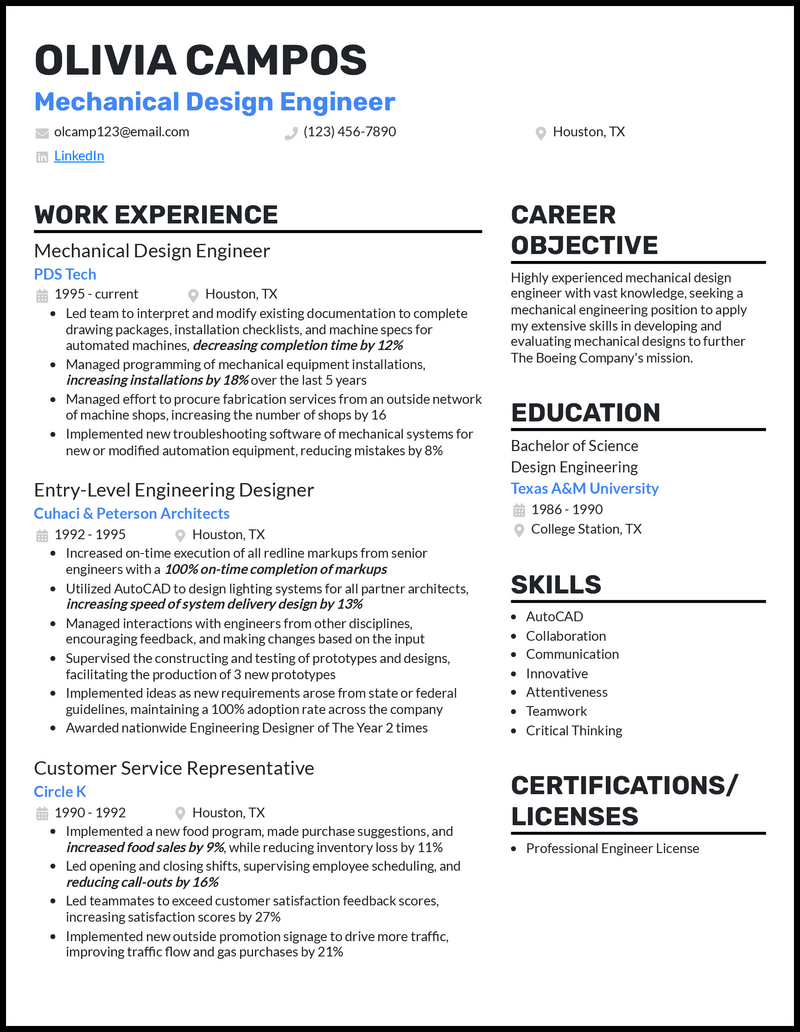
Engineering your future starts with a resume that proves you can turn ideas into precise, functional designs — and present them with the same clarity you’d bring to a project blueprint.
In this guide, we’ll show you how to choose the right effective resume template, make a resume that highlights your technical and creative edge, and position yourself as the mechanical design engineer every company wants on its team.
You’ll find here:
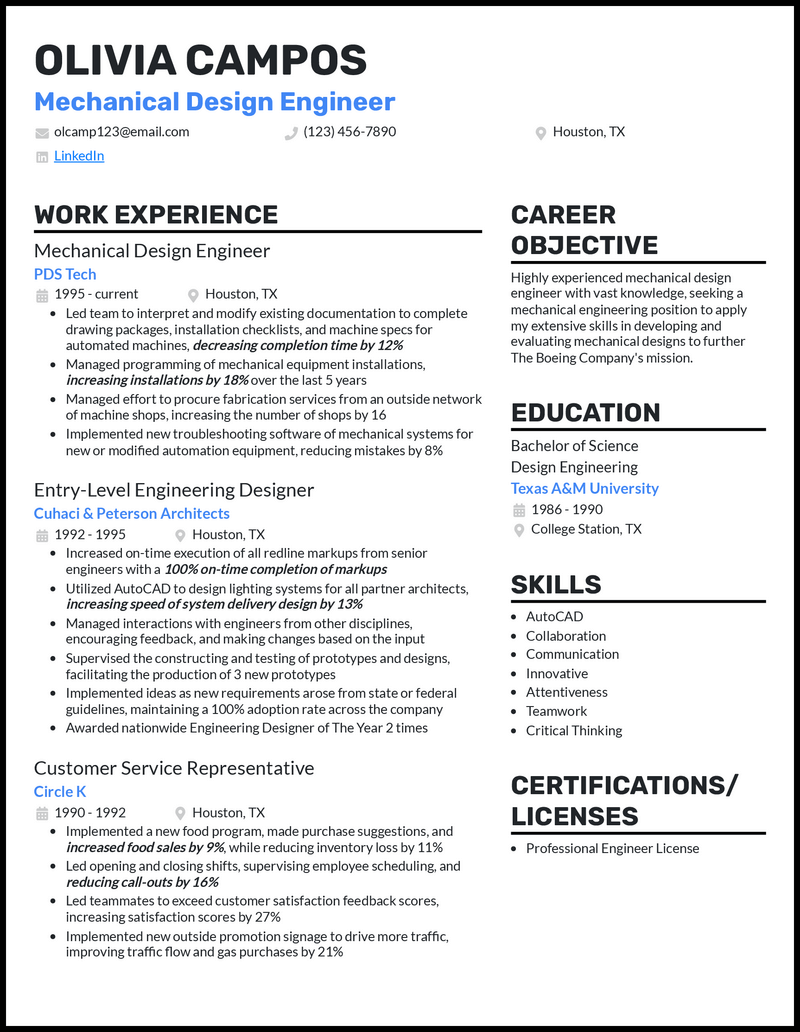
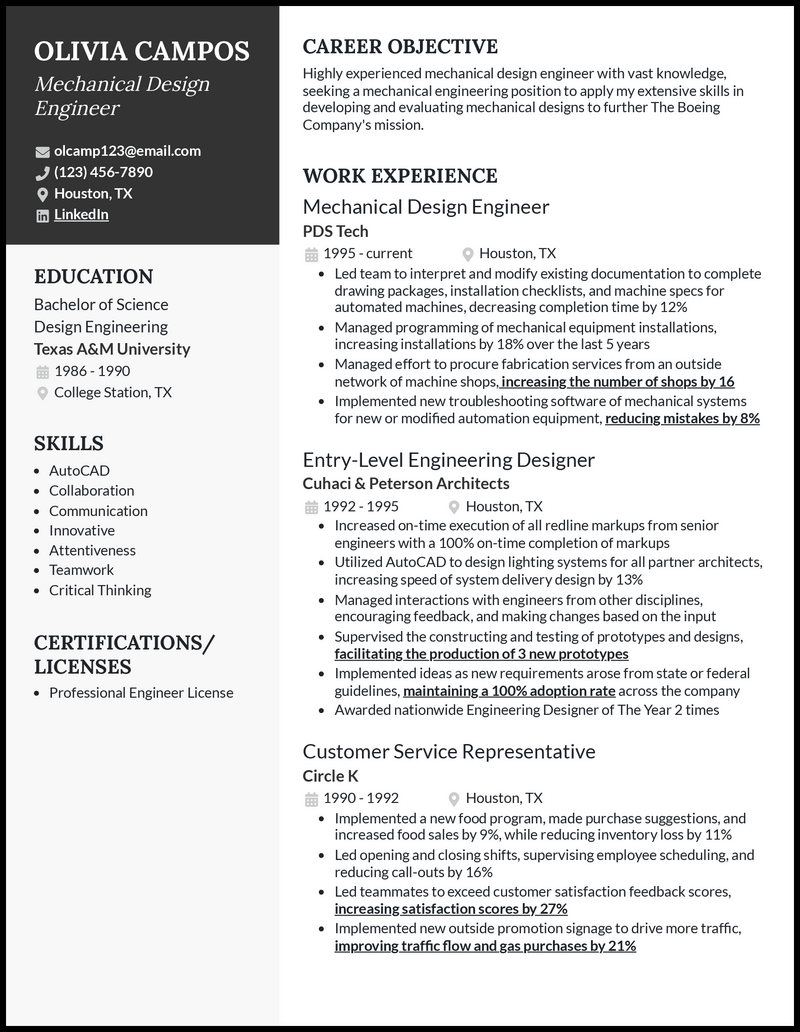
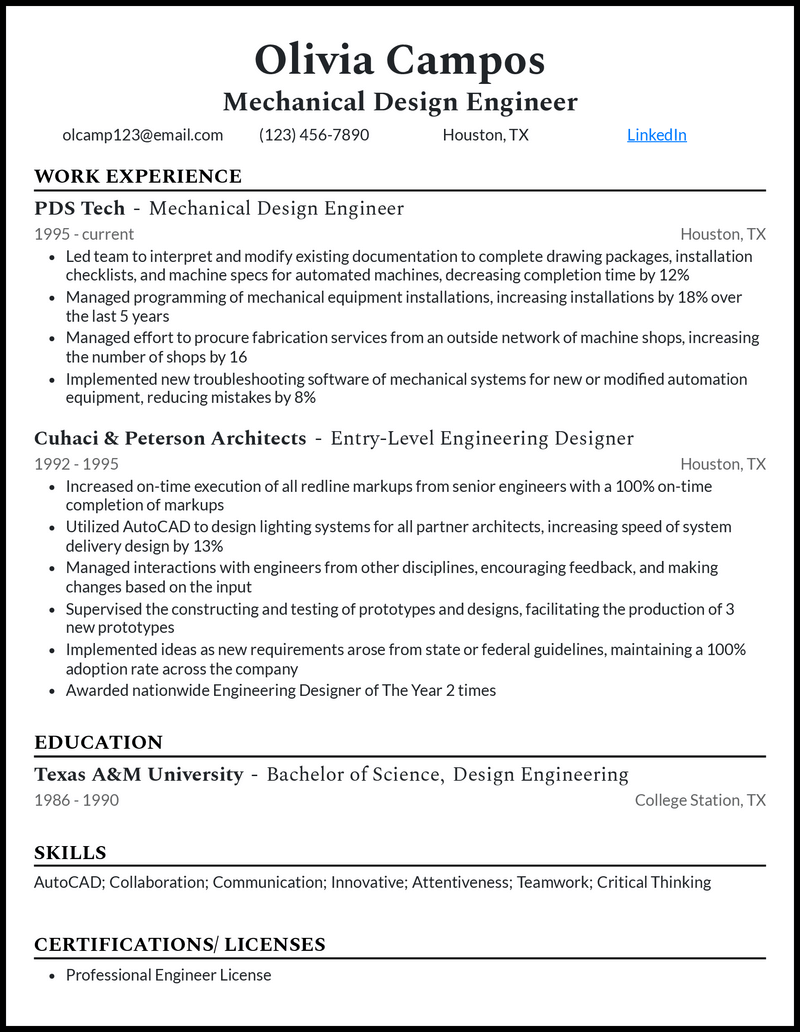
- ↪ 3 mechanical design engineer resume examples you can learn from and adapt
- ↪ A simplified process that breaks down resume writing into manageable steps
- ↪ Practical strategies to help you score your next job with confidence
Copy this text for your mechanical design engineer resume!
Kaida Kim
Labor and Delivery Nurse
[email protected]
(123) 456-7890
Knoxville, TN
WORK EXPERIENCE
Labor and Delivery Nurse
East Tennessee Children’s Hospital
November 2019 – current
Knoxville, TN
– Used GE Corometrics fetal monitors to track and evaluate fetal heart rates for 450+ cases each year, ensuring accurate and timely intervention as needed
– Developed and implemented individualized care plans for high-risk pregnancies, decreasing complications by 77%
– Used the Siemens epoc Blood Analysis System to provide immediate blood gas, electrolyte, and metabolite results
– Oversaw the neonatal resuscitation program, ensuring staff certification and contributing to a 62% improvement in neonatal outcomes
Phlebotomist
Saint Thomas Health
October 2015 – October 2019
Nashville, TN
– Drew blood from an average of 70 patients per day while maintaining a less than 2% recollection rate
– Provided rapid bedside blood analysis and reduced turnaround times for results by 43% through the Abbott i-STAT System
– Coordinated with lab technicians to ensure prompt and accurate blood sample analysis
– Conducted over 200+ mobile blood drives and boosted blood donations by 54%
Medical Assistant
Vanderbilt University Medical Center
September 2012 – September 2015
Nashville, TN
– Managed 3,000+ patient appointments with McKesson EHR each year, increasing clinic efficiency by 25%
– Reduced patient wait times by 36% by implementing self check-in kiosks and managing patient flow
– Cleaned and sterilized medical equipment, maintaining compliance with safety and health regulations
SKILLS
– McKesson
– GE Corometrics
– Baxter Sigma Spectrum
– Masimo Root with Radius-7
– GE Healthcare CARESCAPE Monitor B650/B850
– Abbott i-STAT System
– Siemens epoc Blood Analysis System
EDUCATION
Bachelor of Science
Nursing
Vanderbilt University
2008 – 2012
Nashville, TN
LICENSES
– Certified Registered Nurse in Obstetrics (C-OB)
ACTIVITIES
Program Coordinator at the National Organization for Women (NOW), organizing events that promote women’s health and reproductive rights
How to Write a Mechanical Design Engineer Resume

Breaking into a mechanical design engineer role in 2026 takes more than listing software and job titles — your resume has to show how you’ve solved problems, improved systems, and delivered results that matter.
Summary
Highlight your skills, results, and growth with a mechanical design engineer resume that proves your impact and sets you apart.
Backing it up with a strong cover letter gives you the chance to explain how your design work translates into business impact and why you’re the right fit for a team that values both innovation and precision.
You’ll walk away with guidance on:
- Highlighting the core skills employers look for, from CAD expertise and prototyping to analytical problem-solving
- Choosing a resume format that shows off both your technical depth and creative approach
- Framing your experience so it tells a clear story of career progression and hands-on achievement
- Using metrics, percentages, and project outcomes to prove the value of your work
- Adding credibility with certifications, key projects, and collaborative efforts that show you’re more than just a set of skills

Set a professional tone with the right contact section
Your resume’s first impression starts with the header. Include your first and last name, phone number, professional email address, and URL to your LinkedIn profile.
Don’t go with a casual email handles or outdated contact details. If you use a LinkedIn resume builder, make sure the information in your online profile mirrors what’s on your document — consistency builds trust.

Summarize your qualification (Summary statement)
Open with a concise, three to four sentence snapshot that conveys your experience, technical strengths, and career direction. Mention active working years, major design projects, and areas of expertise such as CAD modeling, prototyping, or product lifecycle management.
If you’re struggling to refine this section, a resume headline generator can help shape a professional hook, but ensure the final statement reflects your own voice and career story.

Choose the best resume format
Mechanical design engineer resumes should balance between your technical expertise and ease to read. A reverse-chronological format works best if you have steady work experience, while a hybrid layout can help if you want to highlight specific projects or skills up front.
Whichever you choose, keep formatting clean and structured — hiring managers skim fast, and clarity matters more than flair. For step-by-step structure, review guides on how to write a resume tailored to engineering roles.

Demonstrate your unique mechanical design skills
Being successful in your role is closely tied to your diverse skill set. From being a pro at various 3D modeling software to being a math whiz with a knack for creative thinking, you’ve got all the skills needed to transform a blueprint into a physical object.
It takes a lot to know how things work, and even more to know how to make them work better, or even to invent something new entirely. This is why filling out the “skills” part of your resume should be no problem, and you’ve got what it takes to make this section impressive.
While it’s important for you to translate complex innovations for a non-technical audience, your soft skills will have their chance to shine in the cover letter and the interview.
The secret recipe to successfully highlighting your engineering expertise is to focus on all your technical abilities. This includes staples, such as AutoCAD, but also things like an intimate knowledge of thermodynamics.
9 best mechanical design engineer skills
- AutoCAD
- Matlab
- SolidWorks
- ANSYS
- Rapid Prototyping
- Revit
- Thermodynamics
- Autodesk Inventor
- Fluid Mechanics

Align your skills to industry’s keywords and what employers want
Scan the job description closely and mirror the language employers use. If the posting emphasizes “finite element analysis,” “product design,” or “tolerance stack-ups,” include those terms naturally in your skills or experience.
This strategy not only helps with ATS filters but also signals that you understand the role. Group your skills into categories — design software, manufacturing processes, project management — to make them easy to scan.

Prove your value with impactful work experience bullet points
In your role, each day brings a new challenge, from patenting innovative engines to meticulous design reviews. When you fill out your resume, it’s best to stray away from the day-to-day.
Saying that you “tested designs” or “worked on documentation” might be true, but it’s not the highlight of your career, which is what you want to focus on here.
Think of achievements that are closely tied to the skills you’ve listed, and add data to make them more tangible.
For example, say that you were able to increase the production rate by 17% by optimizing the design of mechanical components—the percentage is eye-catching and shows your true impact.
Here’s how you can do this in your resume:
- Used SolidWorks to design and optimize a new HVAC system for a 10-story building, reducing energy costs by 21%
- Delivered a complex conveyor system project 3 weeks ahead of schedule, saving 20% of the budget
- Reduced design errors by 13% by spearheading a system of monthly design reviews, resulting in over $75,000 in annual savings
- Introduced the use of finite element analysis via ANSYS, reducing prototype costs for heat transfer solutions by 19%

Deploy metrics to emphasize your top achievements
Employers want results, not just responsibilities. Instead of “Responsible for CAD models,” write “Developed CAD models that reduced design cycle time by 21%.”
Metrics such as cost savings, efficiency gains, defect reduction percentages, or revenue contributions demonstrate your direct impact. Every bullet point should highlight action, outcome, and scale.

Highlight relevant education
List your degree(s), institution, and graduation year. Mechanical engineering, design engineering, or related fields should be prominent. If you’ve completed coursework in areas like thermodynamics, fluid mechanics, or advanced materials — especially if you’re early in your career — include them. For experienced engineers, keep this section concise but visible.

Add credibility with certifications
Certifications can differentiate you in a competitive market. Examples include Certified SolidWorks Professional (CSWP), AutoDesk Inventor certification, GD&T certification, or Six Sigma training. Mention issuing bodies and dates earned. Certifications show commitment to staying current with industry standards and tools.

Use awards and other recognitions to gain a competitive edge
Don’t overlook accolades. Recognition such as “Engineer of the Year,” academic honors, or internal awards for innovation or teamwork add weight to your application. These validate your skills through third-party acknowledgment and can tip the balance when employers are comparing candidates with similar technical abilities.
Top 5 tips for your mechanical design engineer resume
- Software is key
- Make sure to mention all the tools you’re proficient in. Focus on AutoCAD, SolidWorks, Matlab, ANSYS, CATIA, Creo Parametric, and other industry-specific tools. Bonus points if these programs are listed in the job description!
- Never re-use your resume
- Mechanical design engineering roles can vary wildly from one to the next, so make sure to tailor your resume to match the job. Swap skills and work experience bullet points in and out as needed. For example, if the company is in the automotive sector, mention your experience in building engine parts.
- Don’t forget your certification
- If you have the Professional Engineer (PE) certification, it’s worthy of inclusion, so pick a resume template that lets you easily add it.
- Be clever about your interpersonal skills
- With a host of technical skills to boot, you really don’t have space in your resume to list things like “creative” or “team player,” but slip them into your work experience. Mention instances of working with cross-functional teams of engineers or holding presentations for important clients.
- Show off your greatest designs
- Designing something from scratch is time-consuming, but so rewarding when your idea comes to life. Discuss your greatest designs in your resume and cover letter, be it a heat exchanger or a new pump, and elaborate on them during the interview.

Key takeaways
- Start with a professional header and consistent online presence
- Craft a strong summary that reflects your technical expertise and career goals
- Select a resume format that highlights your strengths clearly
- Align your skills with industry keywords to pass ATS filters and connect with employers
- Use metrics to prove achievements and quantify your impact
- Keep education relevant and certifications updated
- Showcase awards and recognitions to reinforce credibility
- Pair your resume with a tailored cover letter to present a complete application package
Mechanical Design Engineer Resume FAQs

A strong mechanical design engineer combines technical expertise in CAD software and product development with problem-solving skills, attention to detail, and the ability to deliver solutions that balance performance, cost, and manufacturability.
Group them under clear categories like “Design Software,” “Analysis Tools,” or “Project Management.” Place them after your summary or alongside your experience so recruiters see them quickly. Align them to keywords in the job posting for maximum relevance.
Zone in on your engineering knowledge and try to look for transferable skills. For example, if you’re applying to a company in the aerospace sector, highlight your knowledge of safety standards and thermodynamics.
You can, but only if you update it for each company. Use it to quickly summarize your greatest accomplishments and describe how you’re hoping to grow in your new role.
Create a cover letter as an extension of your resume. For example, if you talked about developing a new gearbox design using CATIA, circle back to that in the cover letter and explain what you learned from the whole process.
Mechanical design engineers create, test, and refine mechanical systems and products. Their work spans concept sketches, 3D CAD modeling, prototype testing, and collaborating with cross-functional teams to ensure that designs meet performance, safety, and cost requirements.

Stephen is the co-founder and CEO of BeamJobs. Frustrated with the challenges he'd faced in his own job search, he left the corporate world to start BeamJobs with his brother. Drawing on firsthand experience with hiring and getting hired as technical talent, he started BeamJobs in 2020 to help qualified job seekers land interviews with less stress. Since then, more than 4 million people have built their resumes and cover letters on BeamJobs. Stephen's insights have been featured in notable outlets, such as Fast Company, Business Insider, Yahoo Finance, MIT, and Zapier. Learn more about Stephen.