



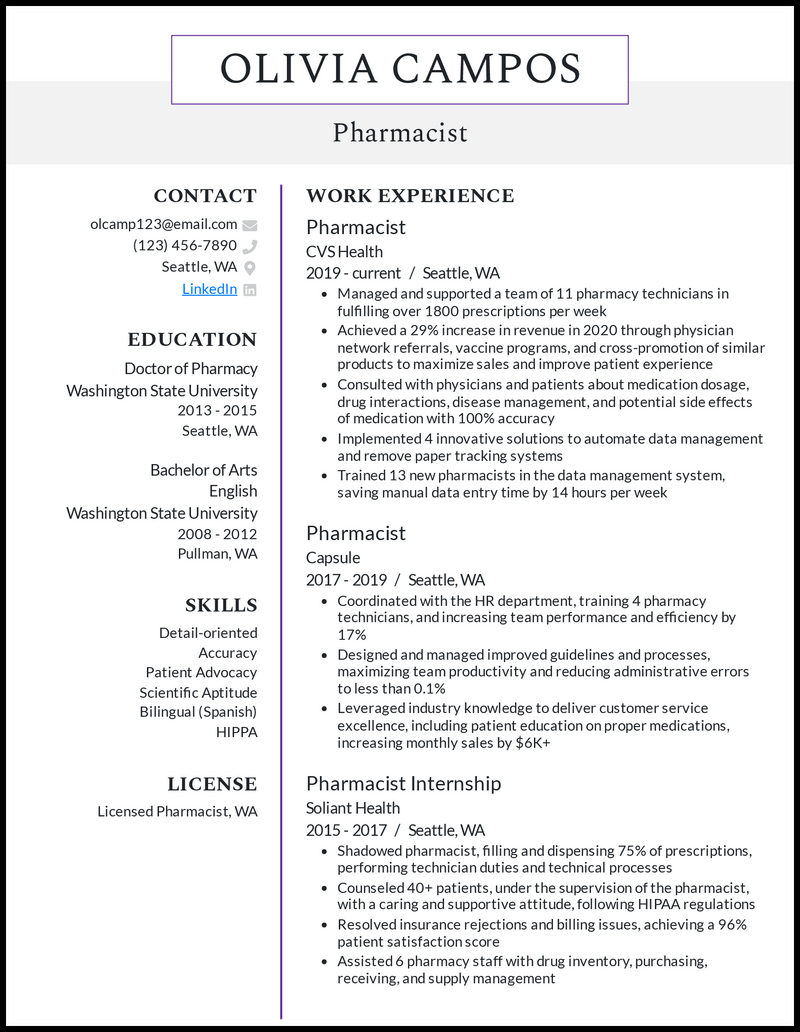
Whether you’re a retail pharmacist or a hospital pharmacist, it can be a challenge to know what to put in your resume, highlight your accomplishments outside of medication fulfillment, and properly format your resume to attract the attention of a recruiter or hiring manager.
We analyzed hundreds of resumes from different service settings and learned what works to help you get more interviews in 2026. We created nine pharmacist resume samples to help you build a professional resume or generate a cover letter.
The hardest part is getting started. These resumes are successfully helping pharmacists find jobs in retail and hospital settings.

Mirror the job description
- Instead of writing a resume with generic bullet points and haphazardly tying it to the job, take advantage of a bullet point generator to align your pharmacist resume with everything that the job expects from you.
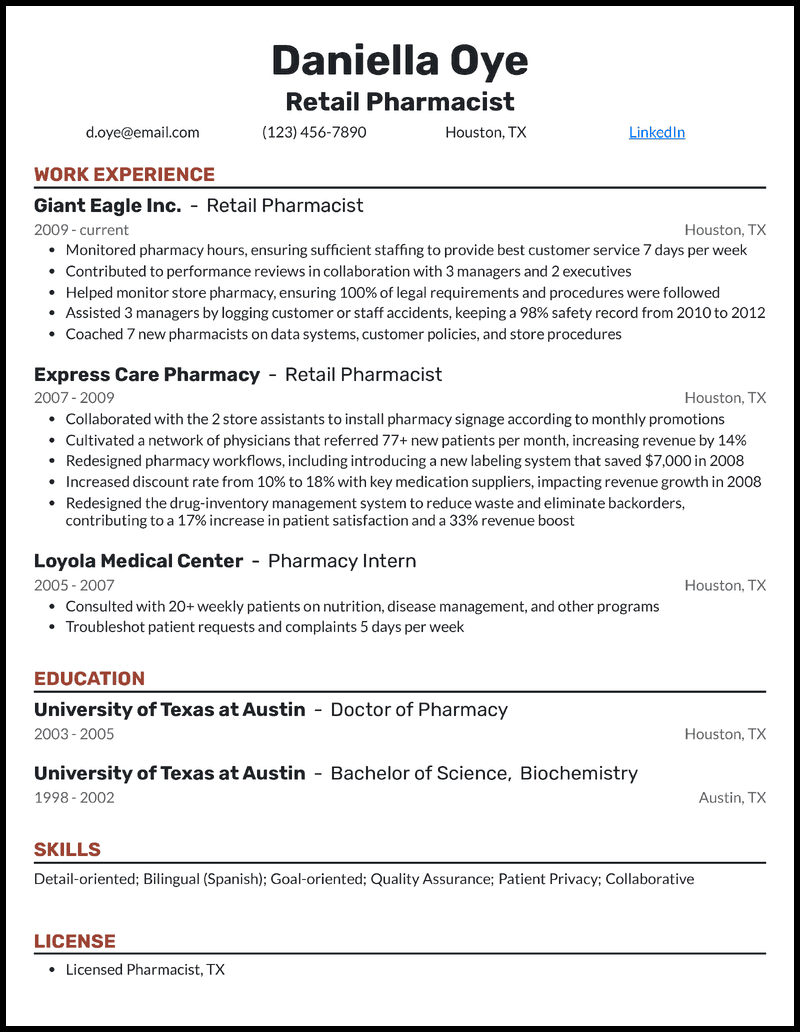
Add certificates to impress
- It’s good to include certificates like Board Certified Pediatric Pharmacy Specialist (BCPPS), Board Certified Ambulatory Care Pharmacist (BCACP), or Certified Specialty Pharmacist (CSP). Therefore, use a resume format that lets you add all certificates that prove you’re a trusted candidate who can take such specialized roles.
View more retail pharmacist resumes >
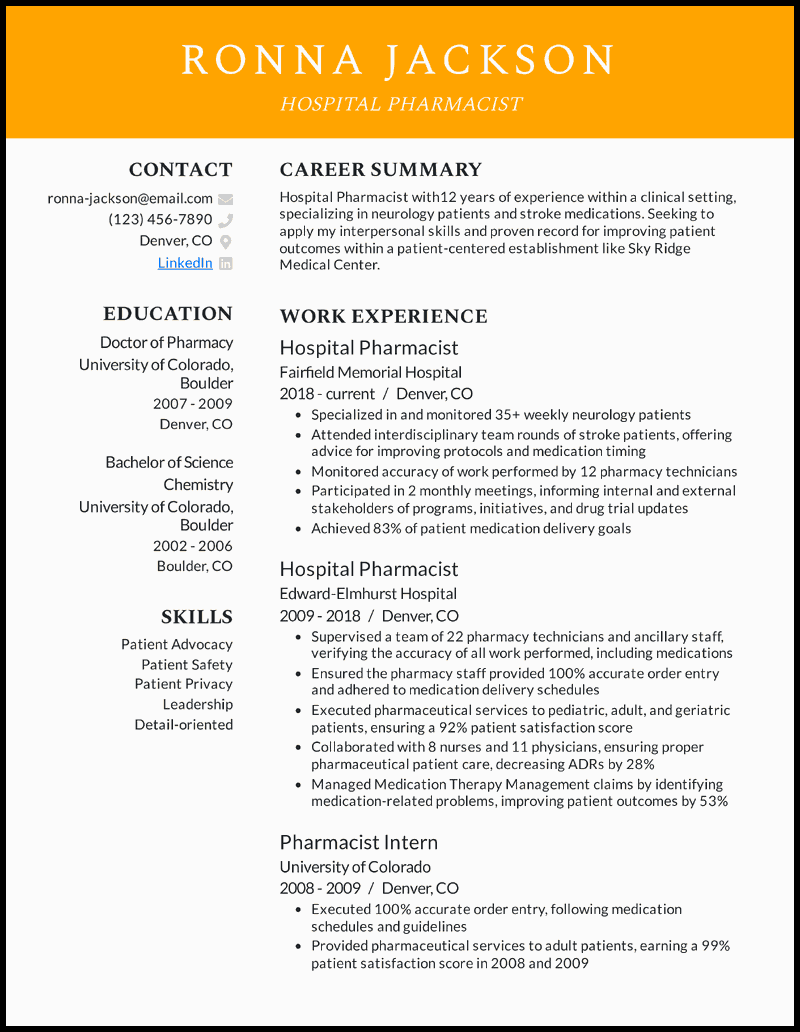
Highlight your education
- Use a resume builder to get extra space and mention relevant courses from your degree like Human Anatomy and Physiology, Medicinal Biochemistry, or Pharmaceutical Organic Chemistry. That sets a strong academic background for your hospital pharmacist resume.
See more hospital pharmacist resumes >

Radiate leadership
- Radiate confidence and leadership by using action words like Led, Initiated, Streamlined, Fostered, etc at the start of your work experience bullet points. E.g.: Led the integration of Epic Willow, reducing medication data entry errors by 19%.
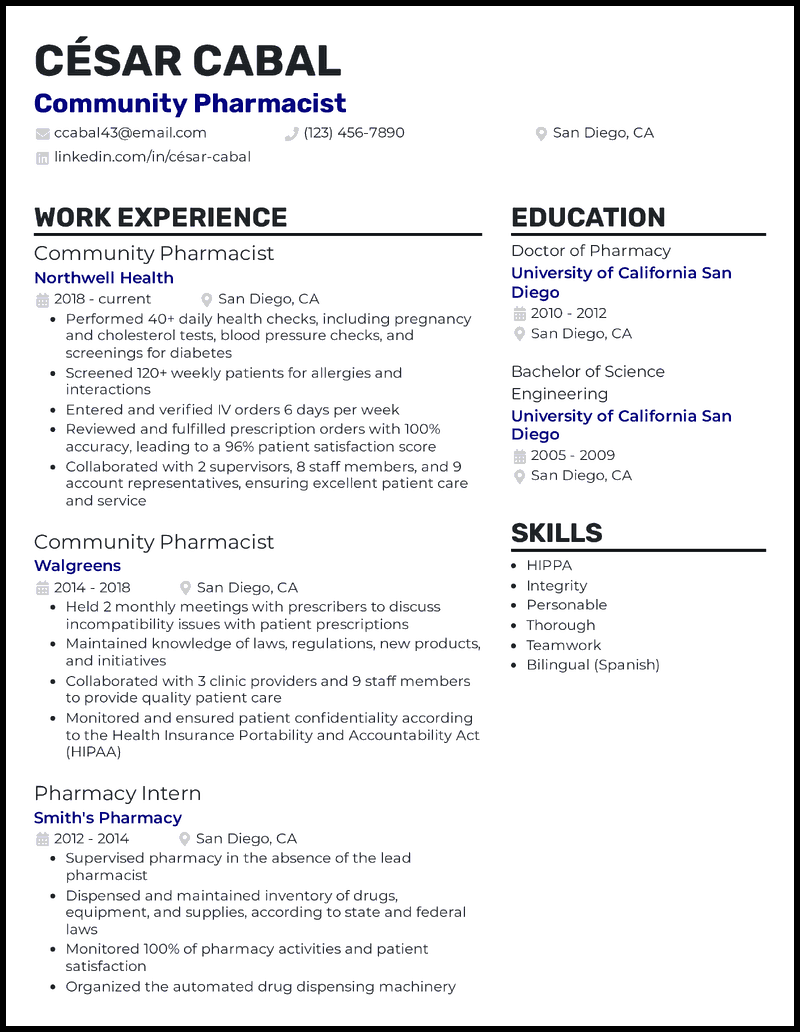
Show career growth
- While it’s good to include your present role in your community pharmacist resume, don’t let it be the only thing you talk about. Rather, use a reverse-chronological resume format to show your career growth. Include all junior/internship roles from your early days at the bottom and your most current role at the top.
See more community pharmacist resumes >

Quantify bullet points
- Instead of listing job duties, focus on quantifying the impact of your work as a pharmacist on previous workspaces.
- For instance, don’t say “Dispensed accurate medicine dosages to customers.” Instead, try something like “Consulted physicians to dispense accurate medicine dosages to patients, leading to an 82% customer retention rate.”
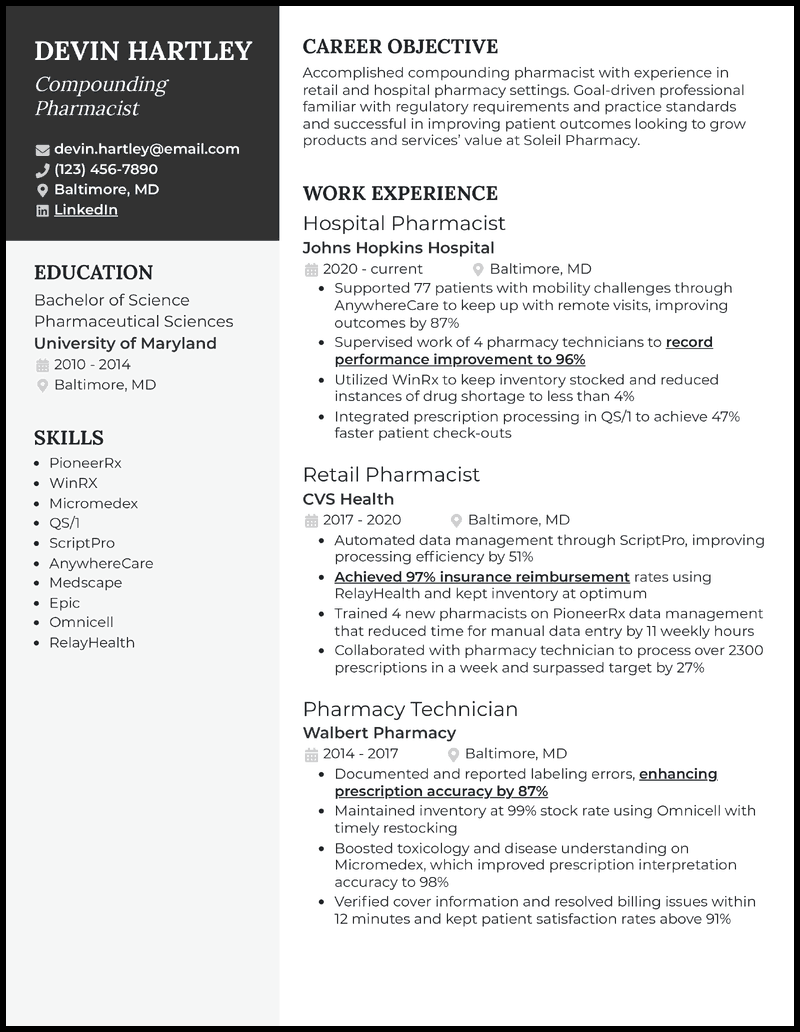
Unleash relevant skills
- With technology becoming more integrated into pharmaceutical practices, don’t shy away from being generous with your compounding pharmacist resume’s skill section and including all your technical skill.
- However, only add skills that are directly mentioned in the job description like Omnicell, DoseEdge, or Cerner Millennium.

Show your credibility
- Include your state’s license gives you the right to practice and oversee the safe use of medications. Additionally, it says you have a degree in pharmacy and pass the North American Pharmacist Licensure Examination (NAPEX) examination. Hence, having one shows your dedication to the field.
See more registered pharmacist resumes >

Leverage a career objective
- Leveraging a career or resume objective can be extremely helpful to jot down your abilities in your student pharmacist resume. For recise impact, tailor it to the hospital or pharmacy store you’re applying to.
Related resume guides
How to Write a Pharmacist Resume

Writing the a good resume starts with understanding exactly what hiring managers and applicant tracking systems (ATS) scan for. Pharmacist resumes typically include licenses, immunization certifications, and board certifications.
Whether you’re a retail pharmacist, hospital pharmacist, or recent PharmD graduate, your resume must highlight clinical expertise, medication safety, and patient care impact.
Start by building a resume to establish your strengths, explore tailored resume examples for inspiration, and get instant feedback of your final draft with our free resume checker.
In this section, we’ll cover:
- What to include in a pharmacist resume (and what to skip)
- How to write an impactful summary and work experience section
- Must-have skills for different pharmacy roles
- Formatting tips to beat ATS filters and impress recruiters
- How to customize your draft to the specific job you’re targeting

How to format your pharmacist resume right
How you format your pharmacist resume is just as important as the content you put in it. Recruiters skim resumes in 6–8 seconds, which isn’t the worst thing, because an ATS will reject your poorly structured document before a human ever sees it.
That’s why using a clean, modern, consistent, and scannable design has a significant impact on whether you advance to the next phase of hiring or not.
Resume format principles for pharmacists
- Stick to one page and two max if you have 10+ work experience across pharmacist roles
- Use reverse-chronological order to highlight your most recent and relevant experience first
- Keep margins consistent and between 0.5″–1″
- Use professional fonts (Calibri, Times New Roman, Arial) and keep font size between 10–12 pt
- Separate each section under a clearly marked heading such as “Summary”, “Experience”, “Education”, or “Skills”.
- Save and submit as a PDF or Word Docs unless otherwise requested
- Don’t use text boxes, tables, and images because they confuse ATS
What is the best pharmacist resume template?
The best resume design for pharmacists is the reverse-chronological format. It prioritizes your most recent and relevant experience, which hiring managers and ATS systems prefer.
Why this format works
- Employers want to see your current job title and recent accomplishments quickly
- It emphasizes your career growth and timeline clearly
- It’s an ATS-compliant order
Must-have pharmacist resume sections
- Header with name & contact info
- Professional summary
- Licensure & certifications
- Work experience (reverse-chronological)
- Key skills
- Education
- Optional sections: Publications, languages, volunteer work

Why accurate contact information matters on your resume
Make your contact details easy to spot. You’re sinking your chances if a recruiter has to dig for them.
Keep this crucial information accurate, up-to-date, and professional.
What to include
- First and Last name
- Professional email (not your old-school one)
- Phone number
- LinkedIn URL (optional)
- City/State (No full address needed)

How to Write your pharmacist resume’s professional summary
Your pharmacist professional summary is the next section after your contact details that hiring managers read, so use it to deliver value immediately. This 2–3 sentence snapshot should showcase your years of experience, specialized areas, and measurable impact.
You can also emphasize your pharmacy credentials, core competencies, and most impressive skills in a way that fits the level and role you’re applying for.
Think of it as your resume’s headline that quickly hooks both ATS software and real decision-makers.
What should be in your professional summary statement?
- Your title: Clinical Pharmacist, Retail Pharmacist
- Years of experience
- Specialties such as compounding or immunizations
- One quantifiable result
- Some keywords from the job description
Resume objective vs summary statement
Resume objectives and summary statements serve different purposes and in most cases, the summary is the better choice for pharmacists.
The table below summarizes when, why and how to use each one of them:
| Type | Difference | When to use |
|---|---|---|
| Resume objective | Focuses on career goals, transferrable skills, and passion for the profession, and eagerness to learn. | When fresh from PharmD, seeking first job, or coming from a different industry |
| Resume summary | Focuses on value to employers: Expertise and achievements | For experience pharmacists with 10+ years in the same career path |
Examples
Career objective (Entry-level pharmacist)
Recent PharmD graduate passionate about patient-centered care and medication safety. With a clinical internship at CVS Health and a medication adherence project. Eager to apply pharmacy knowledge and strong communication skills at Walgreens to support quality healthcare.
Resume summary (Experienced pharmacist)
Licensed pharmacist with 5+ years in high-volume work settings. Proven track record of reducing prescription errors by 33% and training new hires. Skilled in inventory management, patient counseling, and team leadership. Committed to delivering safe, efficient, and empathetic service.

How to quantify your pharmacist’s work experience
Your work experience section is what hiring managers refer to when deciding if you’re a qualified, high-impact candidate or just average, like most of the other applicants.
As a pharmacist, strong experience bullets should reinforce licensing, your clinical skills, and daily accuracy through measurable accomplishments.
This helps you stand out from other candidates while still meeting the expectations defined in the job description.
How to structure your work experience
These are the must-have components for each relevant role you list:
- Title for the role
- Employer + Location + Dates worked
- 3–4 bullet points build on quantifiable outcomes using numbers to show impact (whenever possible)
- Active verbs to begin each bullet
- Keywords specific to the job
How to quantify your impact
To make your pharmacist’s resume impactful, attach real numbers to your contributions. When done right, metrics turn vague claims into concrete proof of performance.
Example, instead of saying:
- Provided patient counseling on medications
Include patient satisfaction scores to demonstrate success:
- Counseled an average of 22 patients per day on drug interactions, adherence, and side effects, getting a 99% patient satisfaction rating in post-visit surveys
Common ways to quantify pharmacist experience
Here are metrics that measure the work and impact of pharmacists:
- Prescription volume
- Accuracy rate
- Patient impact
- Supervisory scope
- Cost savings
- Vaccination totals or immunization coverage
Why numbers matter in your pharmacist’s resume
Numbers are critical because they:
- Boost credibility: Anyone can claim to be “efficient,” but numbers prove it
- Pass ATS
- Clearly define your impact
Examples of bullets that quantify your past work
- Dispensed an average of 215 prescriptions daily, as per treatment plans while maintaining high accuracy in a fast-paced retail pharmacy.
- Trained 8 new pharmacists on McKesson and improved onboarding efficiency by 44%.
- Reduced medication wait times by 4 minutes through PioneerRx optimization and cross-functional coordination.

What skills matter for pharmacists?
The right skills are solid proof that you can do the job. For clinical roles, employers often expect experience with clinical interventions and interdisciplinary collaboration, especially for health system pharmacists who are responsible for safe medication management.
Patient advocacy is an essential skill for pharmacists. Similarly, you should find the keywords from the job posting or company’s website, put them in a section, and incorporate as many of them as possible in your role descriptions.
Top pharmacist resume skills:
- Medication Therapy Management (MTM)
- Drug Utilization Review (DUR)
- Patient Counseling
- Prescription Accuracy
- Inventory Management
- Regulatory Compliance
- Interpersonal Communication
- Mathematical Proficiency
- EMR/EHR Software (e.g., Epic, Cerner)
- Clinical Pharmacology
- Insurance Verification
How and where to include skills in your pharmacist resume
Pharmacist resumes that secure interviews do more than just list skills, they strategically position them where recruiters and ATS systems will find them first and quickly.
In hospital settings, health system pharmacists are responsible for clinical services, medication management, and patient advocacy.
So, here’s when to include your key competencies:
- A dedicated “Skills” section typically at the top or side panel: List 8-12 skills, including hard abilities and soft skills, with some drawn from the job description
- Professional summary: Mention some of your core abilities in your professional overview
- Work experience bullets: Integrate some of your technical capabilities in your work experience points, such as supervising teams and ensuring compliance with documentation, company policies, and regulatory standards
- Certifications & training section: It could be the title of a certificate or the name of a recent coursework

How to include your education and certifications
Your education and certifications prove you’ve fulfilled the academic requirements and met the pharmacy industry’s standards. Pharmacist education must list their:
- PharmD or BScPharm degree
- University Name
- Graduation Year
Start with your most recent/highest education level, licenses, and any other credentials you have under your belt.
Example
Doctor of Pharmacy (PharmD)
University of Michigan
Ann Arbor, MI
2021-2023
Certification example
Licensed Pharmacist
California State Board of Pharmacy: License #PH123456, Issued: 2023
Other relevant certifications for pharmacists:
- Basic Life Support (BLS)
- Immunization Certification (APhA)
- Certified Geriatric Pharmacist (CGP)
- Board Certified Pharmacotherapy Specialist (BCPS)
- Medication Therapy Management Certification

Key takeaways
- Use a reverse-chronological format
- Start with a tailored professional summary
- Focus on measurable achievements
- Include relevant pharmacist skills in a dedicated section and throughout your experience bullets
- Add licenses, certificationsif any
- Keep it to one page (two max if highly experienced)
- Customize each resume to match the keywords and requirements in the job posting
Pharmacist Resume FAQs

Yes. A professionally pre-designed resume template ensures that your resume is clean and readable, helping it sail past ATS and impress recruiters.
It also saves your time, as you’re not starting from scratch and instead dedicate more effort to applying for jobs. Also, remember: pharmacist resumes should be concise, ideally one to two pages long.
Start with a strong career objective, letting recruiters know why they should pay attention to you. Follow this with transferrable skills from coursework, group practical projects, clinical rotations, and internships. In your description, highlight your impact and passion for the sector.
Absolutely. A customized cover letter adds context, shows enthusiasm, and further connects your experience to the role. Wondering where to start? Use the BeamJobs cover letter generator to craft one in seconds.
Yes! But ensure you only stick with relevant ones. Soft competencies such as communication, leadership, or tool proficiency in Microsoft Excel or pharmacy software can strengthen your candidacy when paired with job success.

Stephen is the co-founder and CEO of BeamJobs. Frustrated with the challenges he'd faced in his own job search, he left the corporate world to start BeamJobs with his brother. Drawing on firsthand experience with hiring and getting hired as technical talent, he started BeamJobs in 2020 to help qualified job seekers land interviews with less stress. Since then, more than 4 million people have built their resumes and cover letters on BeamJobs. Stephen's insights have been featured in notable outlets, such as Fast Company, Business Insider, Yahoo Finance, MIT, and Zapier. Learn more about Stephen.