



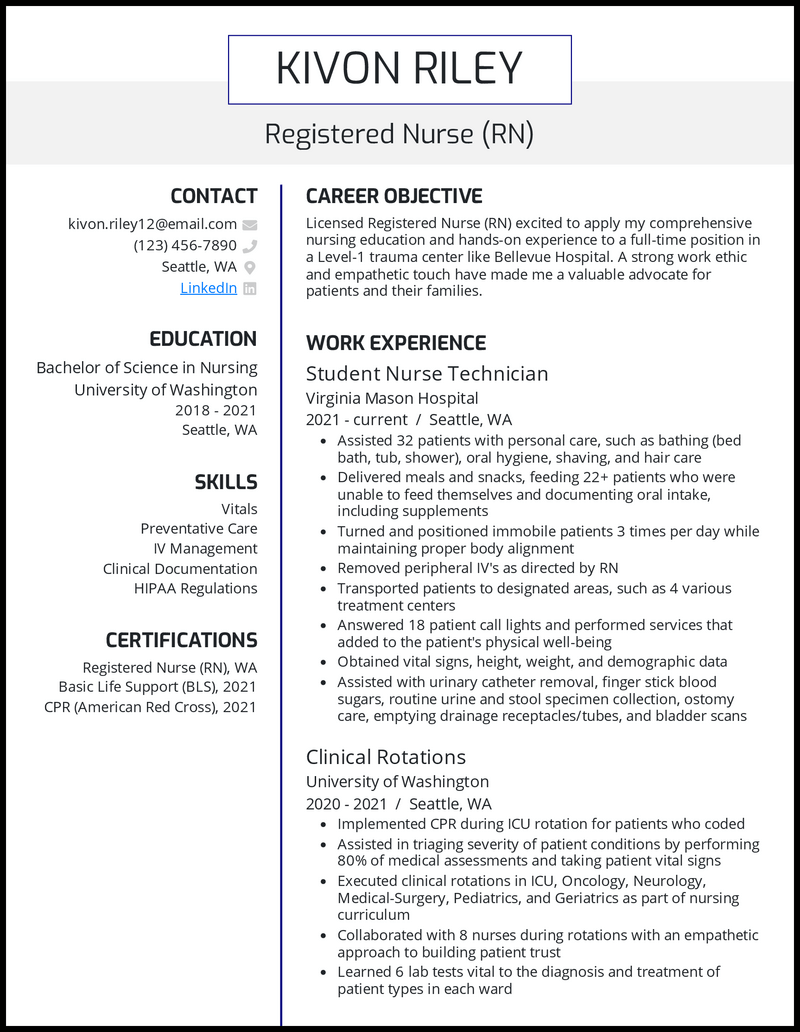
If you’re a nursing student—whether you’re in a BSN program, starting a pre-nursing course, completing your clinical rotations, applying for an externship, or preparing to graduate—your resume is the most important tool for landing your next opportunity.
To help you cut through the competition, we’ve broken down what makes a nursing student resume successful in 2026—even if you have no clinical experience yet. Get ready to build a resume and write a nursing student cover letter that presents your transferable skills, relevant experience, and achievements, and clearly communicates your potential to recruiters.
Here’s what this guide covers:
- 9 editable nursing student resume examples for beginner, graduate, externship, and clinical roles
- ↪ How to structure your resume to pass ATS filters and highlight clinical training—even before graduation
- ↪ How to use clinical rotations and coursework to stand in for formal work experience
- ↪ How to write results-focused bullets that reflect your strengths in communication, patient care, and teamwork
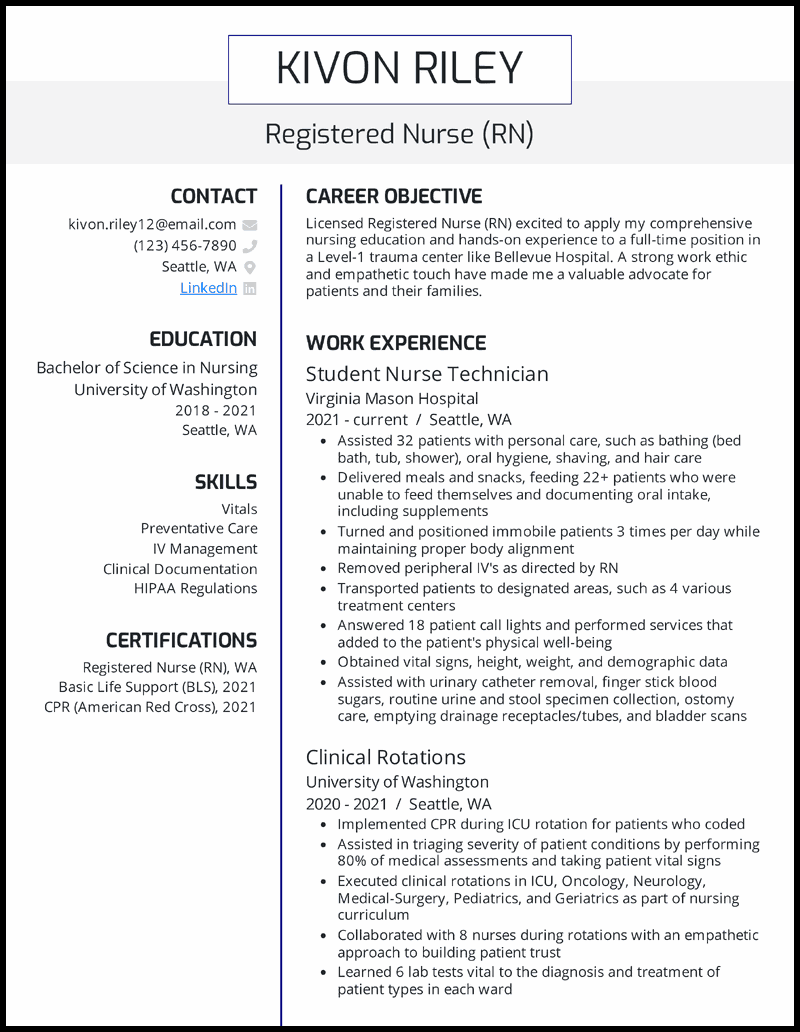
Why this resume works
- You’ll hear many arguments for and against having a career objective for your nursing student resume. However, we only recommend adding one if 1) you’re undergoing a career change or 2) you just finished nursing school, and this is your first full-time nursing job.
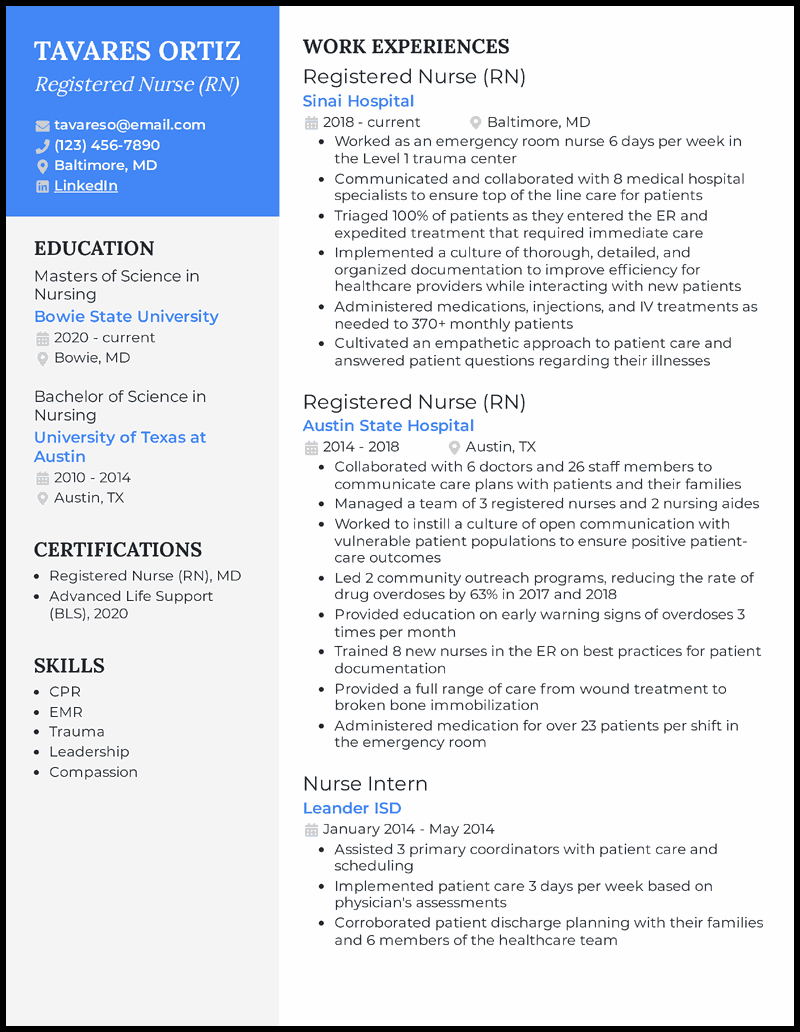
Why this resume works
- Try to keep your nurse practitioner student resume to a single page. If you’re on the border between one page and two, try some handy resume formatting tricks, like reducing the font size and page margins to fit more content (while keeping an eye on overall readability).
VIew more nursing student practitioner resumes >
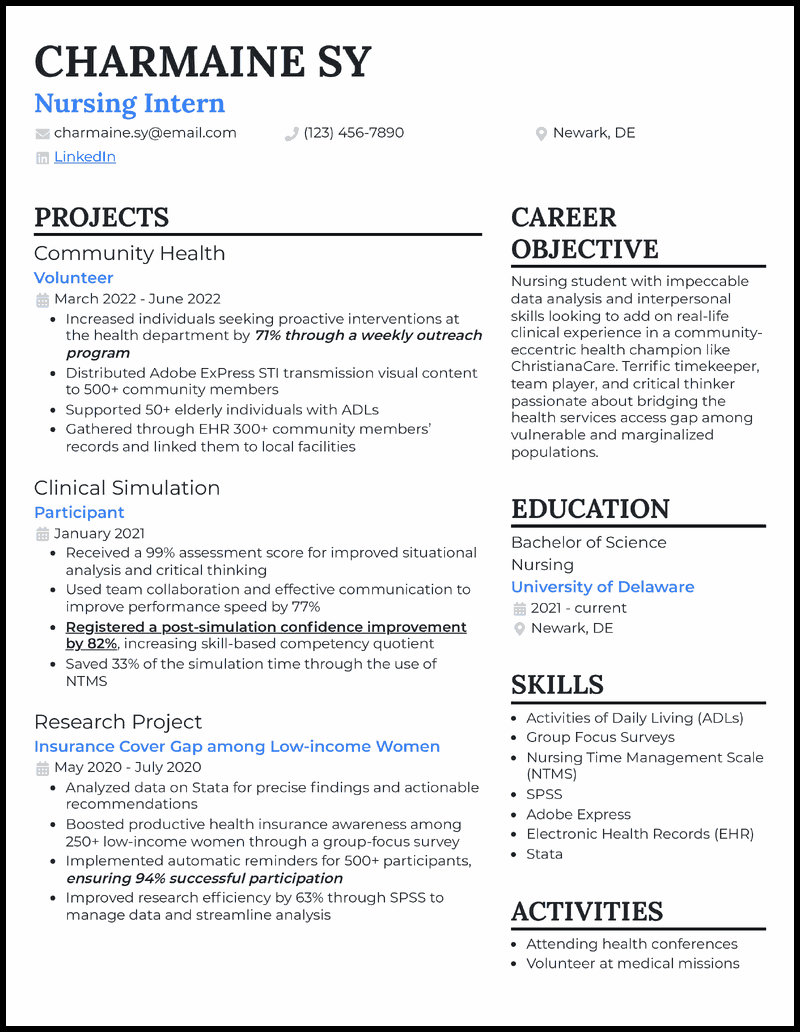
Why this resume works
- The absence of paid work experience shouldn’t create a hole in your beginner nursing student resume. Seize the opportunity to show skills acquired in practical classes, volunteer opportunities, and research projects.
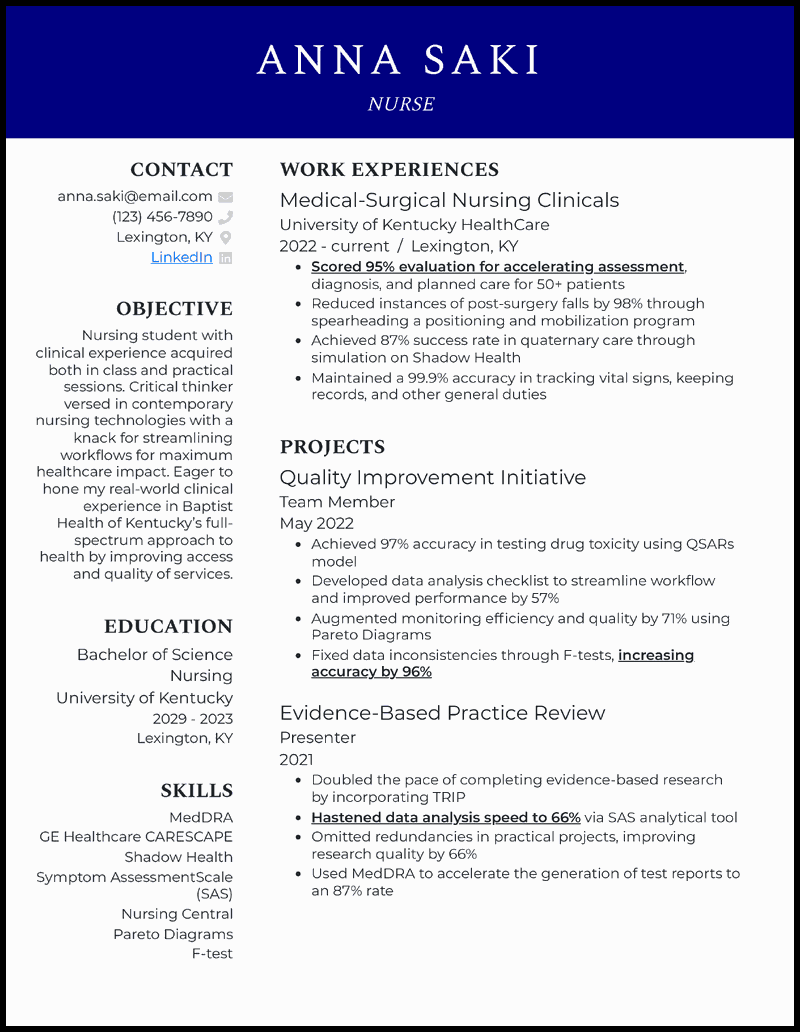
Why this resume works
- Show your research, communication, and problem-solving skills and crown them with adding your experience gained from clinicals on your nursing student clinical experience resume.
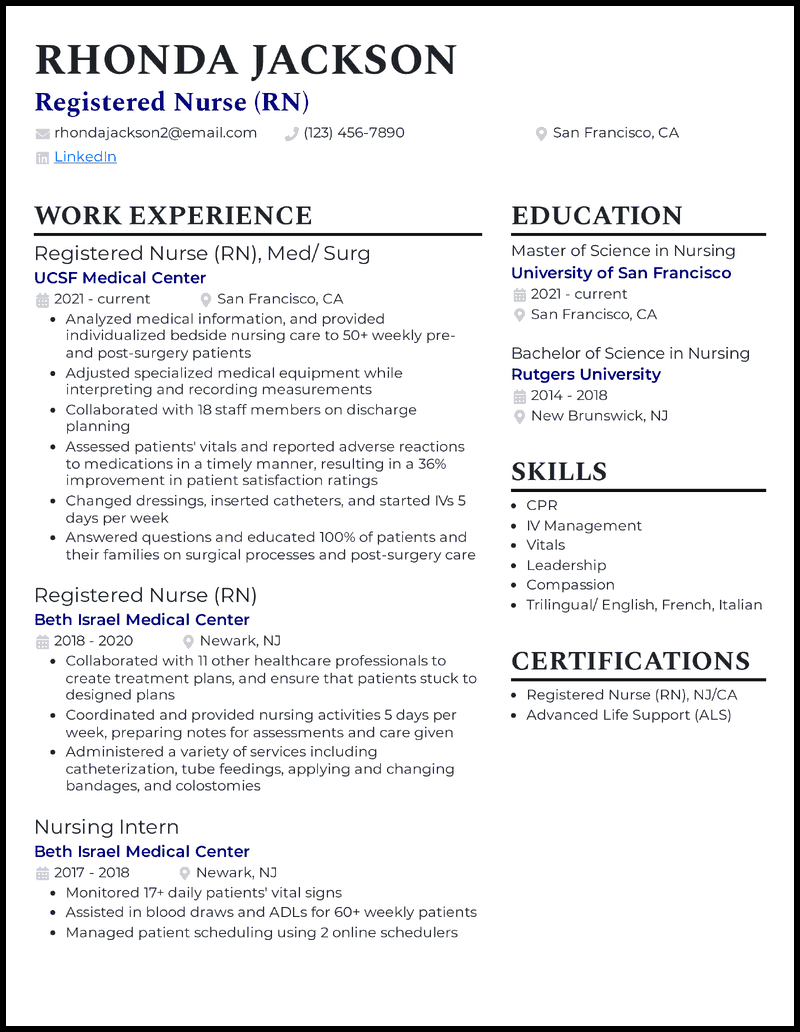
Why this resume works
- When creating a great graduate nursing student resume, the little things matter, so when it comes to fixing your resume, consistency is key. For example, your work experience bullet points should end the same, either with or without periods.
VIew more graduate nursing student resumes >

Why this resume works
- Your relevant educational background and license say you’re the ideal fit. However, the recruiter has probably seen another licensed vocational nursing student resume showcasing the same qualifications. So, what could be your saving grace here? Try highlighting transferable skills from past projects in reverse chronological order.

Why this resume works
- Be creative with the bullet points in your pre-nursing student resume and start each one with strong action words like Monitored and Undertook to be straightforward and convey your impacts from the get-go.
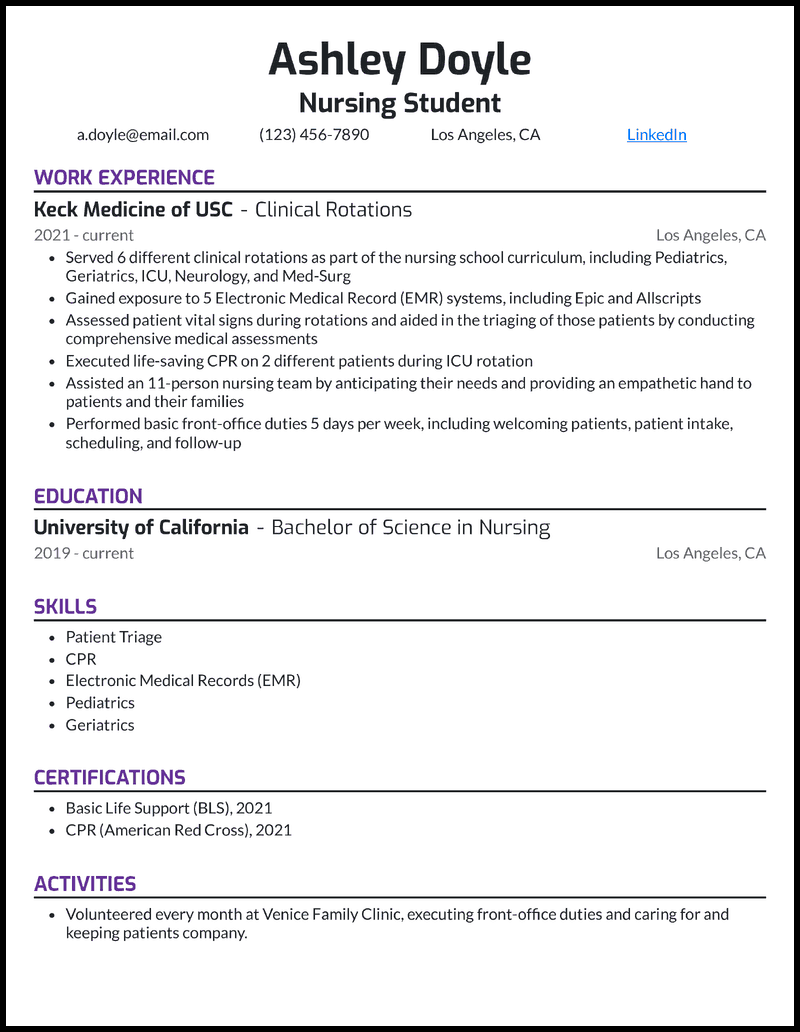
Why this resume works
- If you have any experience in the healthcare space or leadership expertise outside of healthcare, include them in a hobbies and interests section on your resume (also titled “activities”). Also, volunteer experience is a good idea, especially if it relates to healthcare.
View more nursing student for externship resumes >
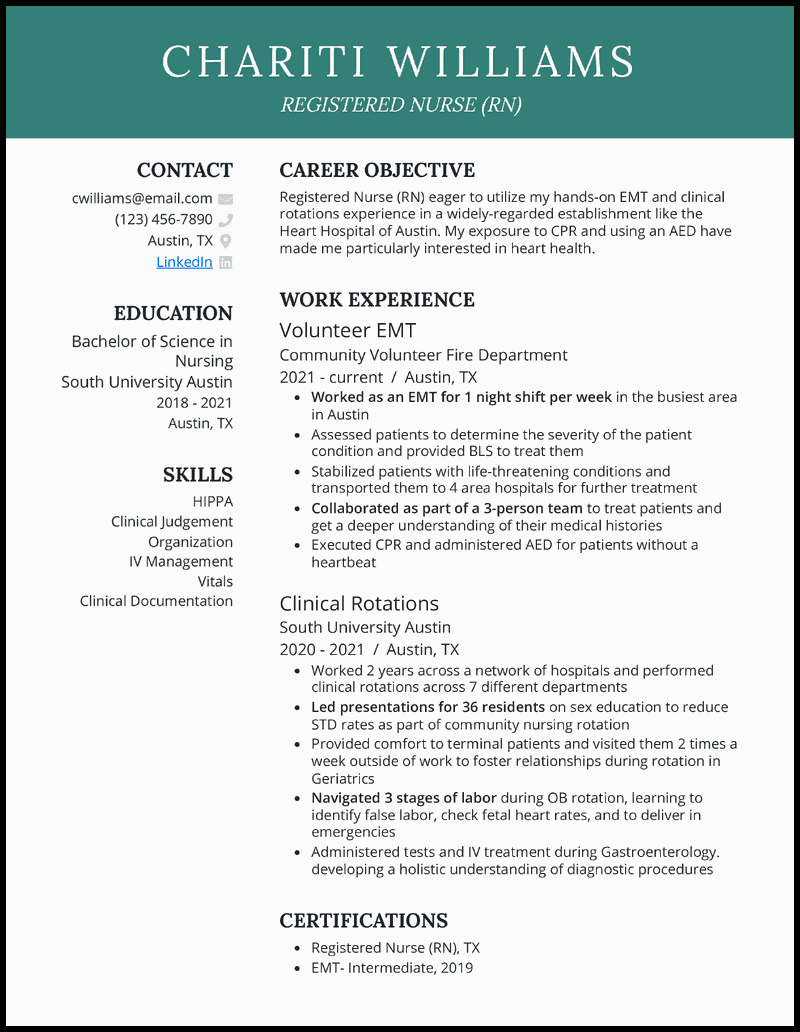
Why this resume works
- Your nursing student (no experience) resume works best if you include only a handful of relevant skills in your resume’s skills section. List any specialties you might have (like pediatrics or geriatrics), plus technical skills like clinical documentation.
Related resume guides
Need Help with Your Nursing Student Cover Letter?

It’s satisfying to finish writing your resume, but don’t forget about writing a cover letter, too! We’ve got you covered (get it?) with a cover letter template you can edit in Google Docs and Word.
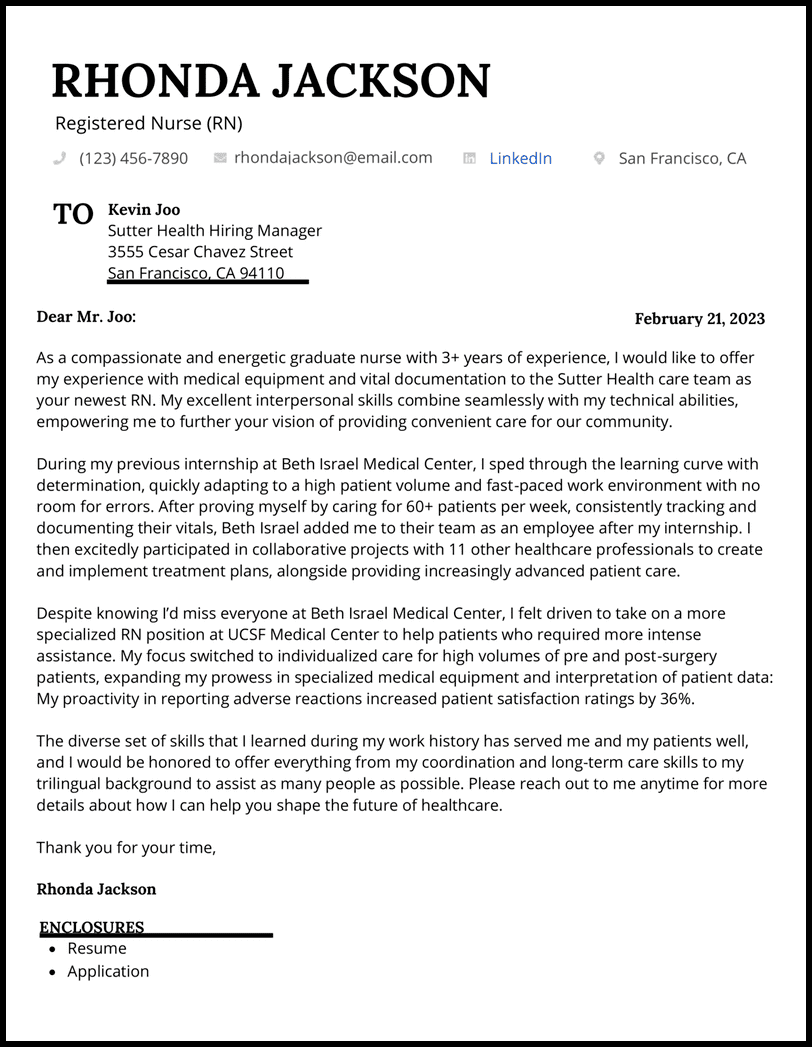
Why this cover letter works
- When writing your graduate nursing student cover letter, emphasize how your background will benefit the new company. For example, spotlighting technical specialization and adaptability in high-key work environments is great!
- Always tie your skills to the organization’s values by pulling phrasing like “shape the future of healthcare” from their website’s mission statement.
- If you have stand-out experience, like exemplary bedside manner or familiarity with a specialized area like pediatrics, showcase these.
- Always make sure you list your certifications in your graduate nursing student resume, of course—but it doesn’t hurt to mention them in your cover letter, too!
- It’s also ideal to establish how much experience you have alongside your qualifying certifications at the intro to your cover letter.
- An extra resume tip: your resume should be concise, but your cover letter should tell a story about your qualifying background.
How to Write a Nursing Student Resume

Writing a nursing student resume can seem tough when you have little clinical experience or formal work history. However, recruiters focus less on job titles and more on your ability to provide patient care, work well with a team, and handle the demands of healthcare.
This section will show you how to create a strong nursing student resume for 2026. You’ll learn how to format your resume for ATS systems, highlight your clinical training, and showcase the skills that set you apart. Start by looking at our nursing student resume examples, then use our resume checker and add a well-written cover letter to finish your application.
Here are the main steps to write a nursing student resume:
- Choose a simple, ATS-friendly format that quickly shows your strengths
- Start with your clinical rotations, labs, or healthcare projects. Remember, experience is not limited to paid jobs
- Showcase soft skills such as communication, teamwork, and attention to detail, and support them with real examples
- Write a career objective that matches the specific role or unit you want to join
- Whenever you can, use numbers to show your impact, but keep it balanced

How to write your nursing student resume objective or summary
With no direct work experience, you have more room to use a summary and talk more about your potential. Use this opportunity to showcase your enthusiasm, transferable skills, and goals for your career.
Also, align your professional summary with the job description. For instance, if the employer is looking for a patient-centered professional, you should showcase examples of how you put the interest of patients first in previous roles as an intern or during practical projects.
Understand the difference: objective vs. summary
A resume objective is particularly helpful if you’re a recent graduate with limited clinical experience. Focus on your professional goals and preferred work settings.
A resume summary is suitable for applicants with prior clinical work, rotations, internships, or externships. Highlight key achievements, skills, and eagerness to learn.
Customize for each role or clinical setting
A generic summary can feel impersonal. Instead, tailor it to the specific role and facility you want to work for.
For example, use the term “pediatric” if you are applying to a children’s hospital, or “geriatrics” for a long-term care facility. Try to match the employer’s expectations by using a similar tone to the job posting. Also, mention some of the skills and responsibilities listed in the job ad.
What are some examples of student nurse resume objectives?
Entry-level RN student resume objective:
“Dedicated nursing student seeking an entry-level RN position at Stanford Health Care. Eager to apply clinical knowledge, strong communication skills, and a patient-centered approach to provide high-quality care and support a collaborative healthcare team in delivering exceptional patient outcomes.”
Nursing student intern resume objective:
Nursing student with impeccable data analysis and interpersonal skills looking to add on real-life clinical experience in a community-centric health champion like ChristianaCare. Terrific timekeeper, team player, and critical thinker, passionate about bridging the health services access gap among vulnerable and marginalized populations.
Experienced student resume summary (with rotations):
BSN candidate with over 200 clinical hours in ICU and medical-surgical units at St. Mary’s Health Systems. Adept at monitoring vital signs, assisting with wound care, and ensuring patient safety under supervision.

How to format a nursing student resume
Your nursing student resume should be formatted to effectively present your strengths through education, clinical experience, and transferable skills in a clean, ATS-friendly layout. Your goal is to persuade recruiters to overlook your lack of formal experience by demonstrating that you possess the practical and academic foundations necessary to thrive in any clinical setting.
Choose a simple, profesional layout
The reverse chronological format is the best choice for your nursing student resume because it lists your qualifications from the most recent, showing your career progression and a timeline of your experiences that make you the most suitable candidate for the job. Also, this layout is ATS-friendly and gives recruiters an easy time when they review your resume.
Use headers for key sections
Lead with these key sections:
- Resume header: Full name, contact details, LinkedIn profile (only if relevant), and location
- Professional summary or objective: Give an overview of your skills, career goals, projects, and potential to convince recruiters of your strengths
- Education: List your degree (for example, Bachelor of Science in Nursing), your university, your expected graduation date, and your GPA if it is 3.5 or higher
- Clinical experience: Include your supervised rotations, the names of the facilities, the units you worked in (such as pediatrics or ICU), and bullet points describing your key accomplishments
- Skills section: List your main skills, like taking vital signs, patient charting, using EMR software, teamwork, communication, and empathy
- Certifications: Add any certifications you have, such as CPR/BLS, ACLS, or other specialty credentials
- Bonus sections: You can also include volunteer work, memberships in student nursing associations, and relevant coursework, especially if you are a recent graduate
Follow a clean, consistent hierarchy
Make your resume easy to read and parsable by:
- Bolding headers for each section
- Avoiding graphics, tables, and text boxes to make your resume easy to read and process
- Saving and submitting as a .docx or PDF (non-scanned) format for ATS compatibility (unless the employer asks for a different format)

H3 How to write your nursing student resume experience, even with no work history
You probably haven’t worked in a clinic or hospital, but that shouldn’t prevent you from building a nursing student resume experience section worth the time of hiring managers. Reflect on your academic project and clinical rotations to identify the lessons that equipped you with patient care readiness.
Don’t label this section as “Work experience” or skip it entirely. Reframe it in a title such as “Clinical Learning” or “Clinical Training”. It says that while you don’t have paid work experience, you’ve worked in a setting that reflects a real-world experience.
Replace “Experience” with “Clinical Learning”
For example, if you have a clinical rotation for 120 hours in the Med-surg unit, you can present that as follows:
St. Mary’s Hospital, Medical-Surgical Unit — 120 Clinical Hours
- Supported two senior nurses in monitoring 25+ patients daily for vital signs and wound care
- Tracked and documented assessments accurately in Epic EMR
- Implemented patient-centered communication strategies, improving satisfaction scores
Leverage academic projects and simulations
Academic case studies, nursing practicums, and lab simulations are part of your work experience arsenal to demonstrate your skills, and you can apply them to the job.
For example, you can present the outcomes of leading a team during a project that simulates a cardiac arrest situation and how to deal with it. Here’s an appropriate bullet:
- Led a 4-person simulation team through a mock cardiac arrest scenario, achieving a perfect record in response time and after-care medication and observation.

How to quantify impact on your nursing student resume
When you quantify your impact, you’re reframing your duties in terms of results. The outcome is giving recruiters and AI scanners one thing they both understand better: your achievements through numerical data.
Why numbers matter
Numbers paint the clearest picture of your capabilities by presenting something the healthcare sector can relate to. Pairing such outcomes with keywords and active verbs further aligns you with the job’s demands, which is beneficial for your resume’s visibility and retrieval by the ATS.
Picture this before vs. after scenario:
Before:
- Helped with patient care during clinical rotations
After:
- Supported a nurse and a clinical officer to care for 28 patients per shift, improving workflow efficiency for the hospital’s team.
What you can quantify, even as a student
You can add measurable details to almost any aspect of your training:
- Time: Clinical hours
- Volume: Patient interaction
- Practical projects: Problems solved
- Scale: Number of teams and members worked with
- Improvement: Patient satisfaction scores from post-visit surveys

How to include relevant education and certifications
You should add your nursing education, coursework, and training to boost your interview chances.
How to add education to your nursing student resume
Bachelor of Science
Nursing
University of Delaware
2021-Current Newark, DE
Also, if you have any certifications, awards for outstanding work, or special licenses, include them in your resume. They show your unique qualities and move you closer to getting the job. Only include them if they’re relevant to the role you’re applying for.
Examples of certifications/licenses for a nursing student’s resume:
- Basic Life Support (BLS) Certification
- Phlebotomy Certification
- Advanced Cardiovascular Life Support (ACLS) Certification
- Certified Nursing Assistant (CNA) License
- Medication Administration Certification

What skills should be on a nursing student resume?
Almost every employer uses applicant tracking systems (ATS) to screen applications before landing on a real-life hiring manager. That’s why you must include relevant keywords that describe skills and other clinical terms listed on the job description. There is a high chance that your resume won’t pass the screening phase if it lacks these crucial phrases.
Both direct and transferable skills will distinguish you from the other applicants. Highlight your competencies in nursing tools and soft skills acquired during internships, practical projects, and other activities outside the traditional classroom.
Examples of skills for a nursing student’s resume
- Time Management
- Critical thinking
- Problem-solving
- Pulse oximeters
- Lexicomp
- Cerner
- SPSS
- HIPAA
- Patient intake and discharge

Key takeaways
- Choose a clean, professional layout that works well with applicant tracking systems
- Start with a short summary or objective that explains your nursing focus and shows you are ready for clinical work
- List your education and clinical experience before any unrelated jobs
- Give examples of your impact using numbers or results when possible
- Point out your main nursing skills, such as patient care, EMR documentation, communication, and following safety rules
- Add certifications like BLS, ACLS, or CPR to show your qualifications
- Mention any community service that shows you are compassionate and work well with others
- Adjust your resume for each job or employer, such as pediatrics, med-surg, geriatrics, or different types of facilities
Land your next job with our AI-powered, user-friendly tool.
Gut the guesswork in your job hunt. Upload your existing resume to check your score and make improvements. Build a resume with one of our eye-catching, recruiter-friendly templates.
• Work in real-time with immediate feedback and tips from our AI-powered experience.
• Leverage thousands of pre-written, job-specific bullet points.
• Edit your resume in-line like a Google Doc or let us walk you through each section at a time.
• Enjoy peace of mind with our money-back guarantee and 5-star customer support.
Nursing Student Resume FAQs

Customize your nursing student resume to the specific job you’re applying for. You should showcase relevant skills, add education, coursework, training, and briefly summarize your professional profile.
One page is enough to show your strengths and convince recruiters you’re the right candidate for the job. Don’t include everything you can think of; only include your education, experience, projects, coursework, certifications, and contact information. Be brief and only add what adds value to your qualifications.
It’s a resume that includes the clinical experience that a nursing student acquired from a healthcare institution to learn hands-on skills from experts. Most importantly, the resume highlights clinical skills and unique qualifications that other candidates may not have.
BeamJobs has a comprehensive list of resume examples where you can find the perfect nursing student resume sample that you can use to write yours. We also help you, like many other successful job seekers, build a resume from scratch, optimize it for your dream job, and help you write a cover letter to complete your application.

Stephen is the co-founder and CEO of BeamJobs. Frustrated with the challenges he'd faced in his own job search, he left the corporate world to start BeamJobs with his brother. Drawing on firsthand experience with hiring and getting hired as technical talent, he started BeamJobs in 2020 to help qualified job seekers land interviews with less stress. Since then, more than 4 million people have built their resumes and cover letters on BeamJobs. Stephen's insights have been featured in notable outlets, such as Fast Company, Business Insider, Yahoo Finance, MIT, and Zapier. Learn more about Stephen.