



![9 MBA Resume Examples [& Templates]](https://beamjobs.wpenginepowered.com/wp-content/uploads/2024/01/mba-resume.png)
Getting an MBA isn’t easy, but having this degree can help you quickly grow your professional network, secure a leadership role, and earn more money, so it’s well worth it.
However, even with an MBA, you still have to write a compelling resume and create a cover letter to get the job you want.
Think of us as your resume helper, highlighting your knowledge, professional attitude, and talent in the business world.
If you’re applying for a job with an MBA already in hand (or while getting your MBA), use our nine MBA resume samples and writing tips to give you a competitive advantage in 2026. Get inspired and write the resume that will open the door to the job of your dreams!
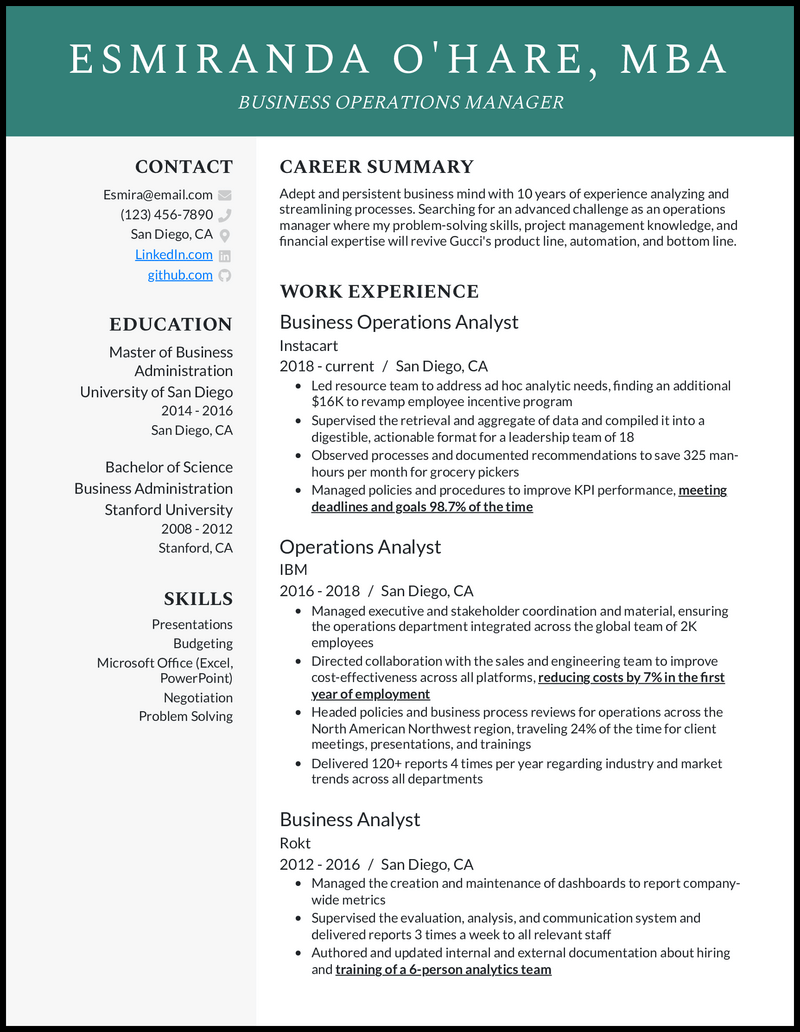
Skills define your profile
- Your resume’s first impression largely depends on the kind of skills you include. While it’s good to have things like Microsoft Office and other documentation tools listed, you ideally want to create a business-oriented skill set that matches the job description.
- For instance, it’s wiser to include skills like critical/strategic thinking, communication, and business intelligence for a business development role.
- Similarly, if you’re applying for a marketing role, adding SEO/SEM, competitive analysis, and brand awareness will be more beneficial.
Displaying career growth
- No one becomes a business expert right off the bat, thus; make sure your resume speaks volumes of how you’ve managed to reach your current level.
- To emphasize career growth, it’s best to use a reverse chronological resume format and tell your story from working in an entry-level business role to your current position.
- Also, keep an eye out for the way you frame your work experience bullet points. Start each sentence using strong action verbs like Managed, Directed, and Supervised to show progress in your working style.
See more MBA application resumes >

Position your education
- Since your education section is going to include a Master of Business Administration degree, you might as well go a little ham and place it in the most noticeable area of your resume.
- Got a GPA score of 3.75 or above? Add it in. This also helps to prove your academic excellence if you ever apply for higher studies like an Executive MBA Programme.
- Try leaving some extra space to mention relevant course topics such as Economics for Business Decision Making and Strategic Leadership.
Outsmarting the ATS
- The last thing you want to do is spend long hours creating a well-crafted resume and getting rejected within seconds because the ATS couldn’t parse your resume.
- First order of business is including all the education qualification listed in the job description like MBA, BBA, and BMS. If you can’t fit them all, only mention your degree and the university, you can discuss your grades during interviews.
- Secondly, avoid being too fancy with words and use keywords given in the job posting. Example: For a business development role, add skills like Product Development and Strategic Marketing.
Using a suitable format
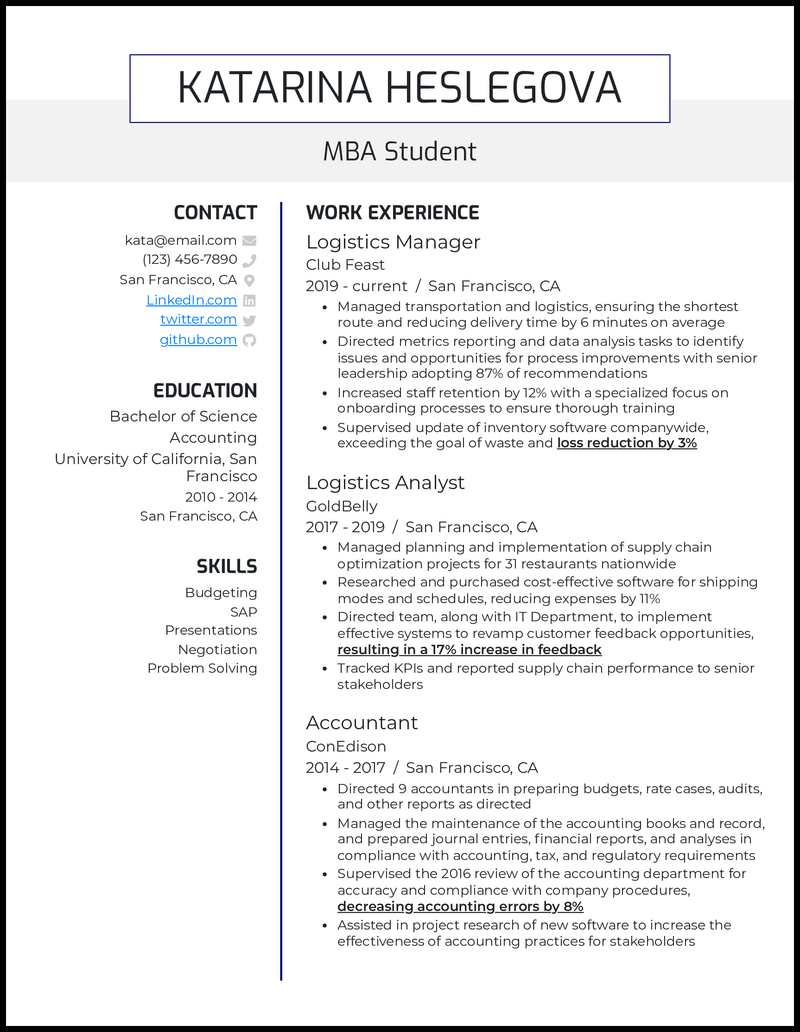
- For graduates, it helps to pay attention to the resume format you’re using.
- Employers generally expect newcomers in the field to have a variety of business-related university projects or internships, so ensure you’re using a reverse chronological format to provide ample space for every past experience.
- Include jobs/internships like business development associate/intern towards the top and add business management projects below. While not strictly necessary, aim to create a one-page resume to save reading time and consolidate your best points.
See more MBA student resumes >
Using a career summary
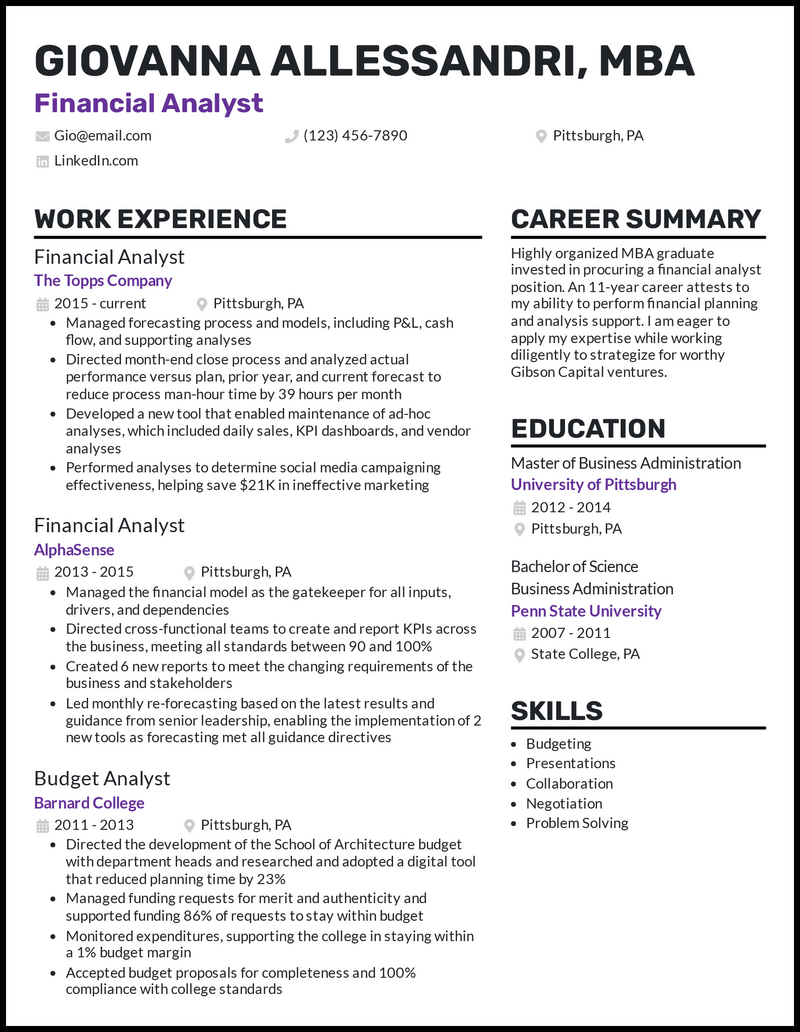
- Been in the business field for quite a while? Then using career summaries is one of the best ways to provide a quick recap of your entire career and top achievements.
- Ideally, what you want to do is kill two birds with one stone. Don’t simply use the summary section to talk about your achievements, find and tailor an achievement that best meets the job description.
- Here’s an example: Adept business professional with 10 years of experience, aiming to apply my business development, product marketing, and budgeting skills to revive your company’s product line and sales.
See more MBA graduate resumes >

Leverage career summary
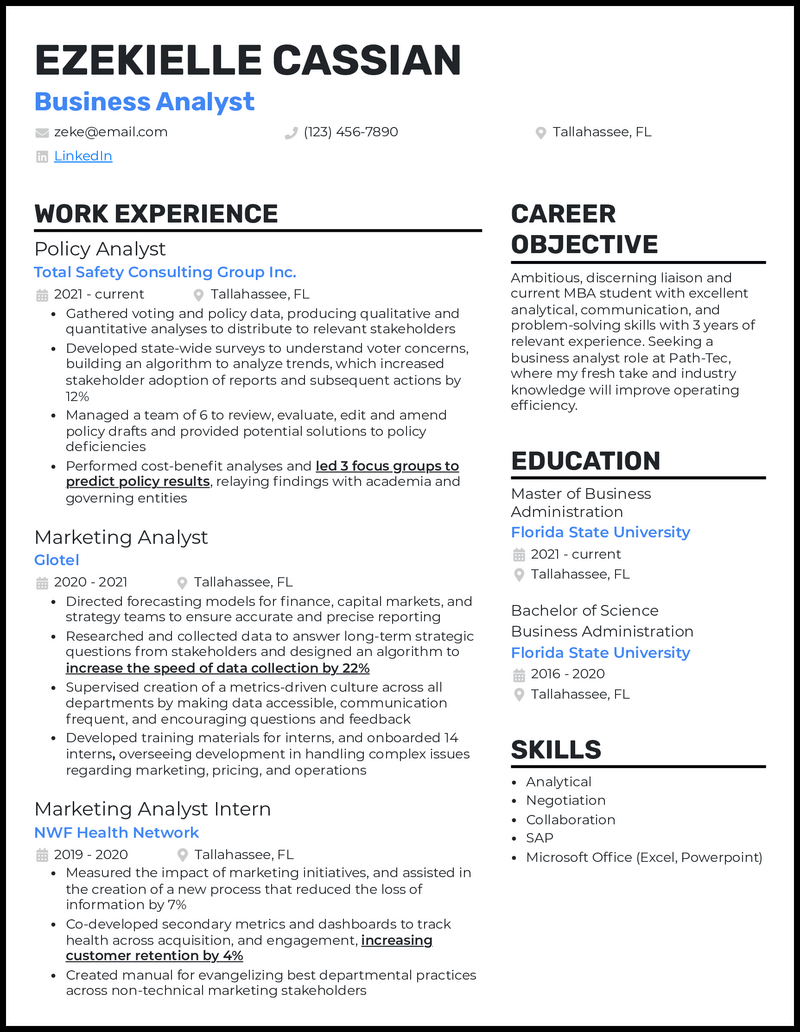
- Ready to level up your business skills? Great. But before you ace case studies, you’ve got to ace your MBA admission resume—starting with a killer career objective.
- Answer questions like why you are applying for this program and what makes you their next star student in the beginning but keep it short. Also, a little research on the college won’t hurt either—tie in what excites you about their program and prove you know what they’re all about.

Portray career progress
- When crafting your Stanford MBA resume, remember to let metrics do the heavy lifting. Sure, future visions are great, but Stanford’s admissions team is looking for proof that you’ve delivered results—and delivered big.
- Follow Cillian’s lead and skip the fluff by highlighting wins like “saved a Fortune 500 firm $366K+.” Remember, at Stanford, excellence isn’t a bonus, it is the baseline.
Impress with Numbers
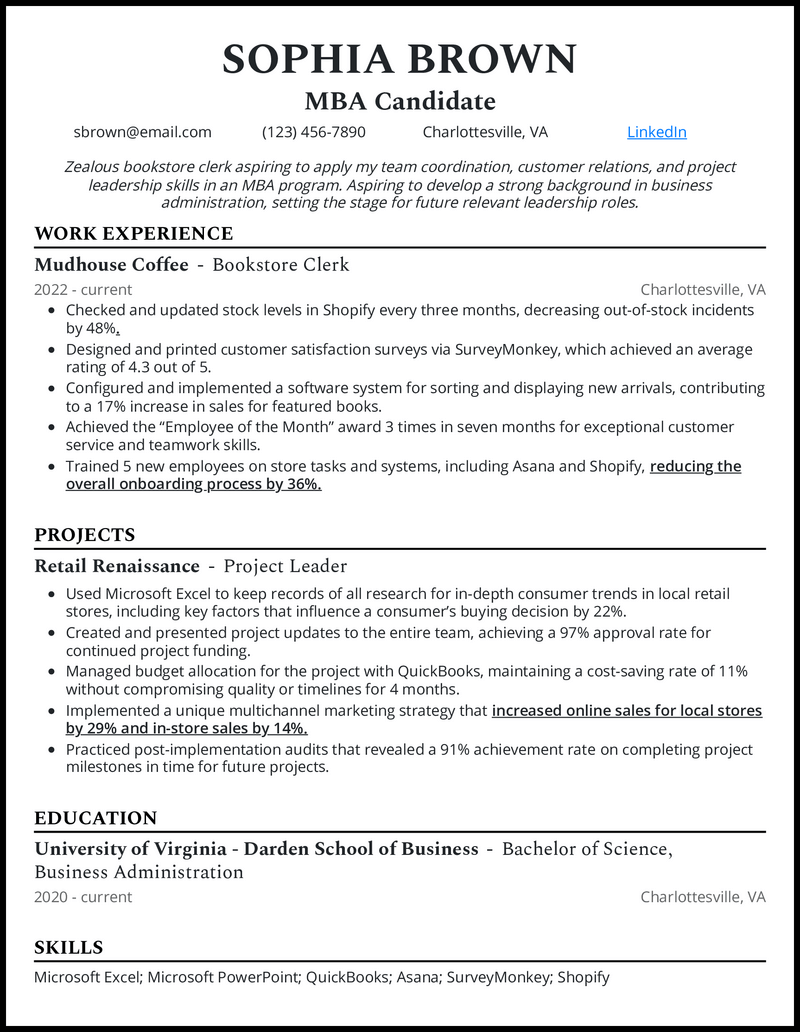
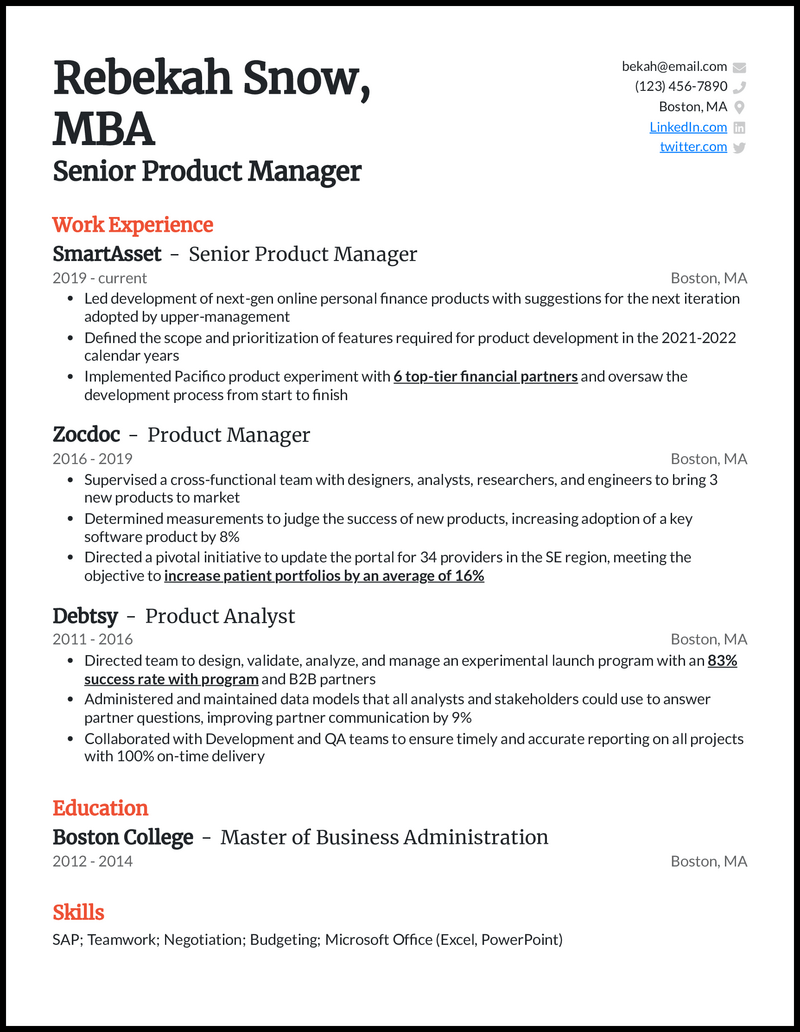
- Hiring managers know that candidates capable of making marginal improvements in a workspace are invaluable. So, don’t fret about unleashing your best quantified work experience bullet points.
- Ask yourself: Has any of my past efforts influenced a customer’s buying decision? Did I help a company lower its daily operational costs? What role have I played in boosting sales numbers?
- Consider this example as a headstart: “Implemented a unique multichannel marketing strategy that increased online sales for local stores by 29%.”
See more post-MBA resumes >
Related resume guides
How to Write an MBA Resume

Summary
Elevate your MBA application by showcasing leadership, impact, and alignment with program values through a strategically formatted, results-driven resume.
Ready for business school? While your experience and grades make you a top candidate, you must still write a resume that will impress admission boards. And no, it’s not a list of your work or academic history; you must showcase achievements, skills, and career mission and vision aligning with the school and program.
To give you an idea of the top ingredients of a standout MBA resume, review these resume examples and follow our advice to get your way into your dream MBA program and school.

Structure your resume correctly
Your resume design matters. A clean, professional layout will see your MBA resume pass through ATS (Applicant Tracking Systems) and compel human reviewers to take your application seriously. So you know 98% of Fortune 500 companies use ATS to screen for ideal candidates and so are top US universities.
What to include:
- Header and contact info
- Resume objective
- Work experience
- Education
- Skills
- Awards & achievements
Formatting tips:
- Keep it one page (two only if you have 10+ years of experience)
- Use clear section headers
- Choose a readable font and size (Arial or Calibri, size 10–12)
- Keep margins between 0.5”–1”
- Save and submit as PDF unless asked otherwise

Add contact information
Recruiters will call or email you to interview invites and admission offers. They get this information from your contact section—keep it visible, clear, and updated at the top.
What to include:
- First and last name
- Professional email address
- Phone number
- LinkedIn profile (only if relevant)
- City, State (no need for full address)

Open with a compelling resume objective
Use your MBA resume objective to grab the attention of admission board members. In 2-3 snappy sentences, tell them who you are, the impactful things you’ve done, and your career direction. Please align it with the mission and vision of the business school.
Include:
- Current role or background
- Relevant achievements or projects
- Program name
- Career philosophy and goals
Example
Data-driven marketing strategist with 4 years’ experience at a Fortune 500 company, leading cross-functional campaigns with $1.2M ROI. Applying to the Wharton MBA program to pivot into product management in the tech sector. Passionate about using data and innovation to build user-centered digital experiences.

Describe measurable work experience
Your impact through work, projects, coursework, or voluntary activities should go here. You must quantify your results with metrics, incorporate skills, and emphasize the impact of your past experiences.
How to write strong experience bullet points:
- Start with a strong verb such as Led, Launched, Optimized, etc.
- Mention role
- Use metrics for outcomes (percentages, revenue, growth, and time saved)
- Tie to business value or leadership
Examples:
- Spearheaded a team of 5 analysts to develop a market entry strategy that increased client revenue by 28% in Q2 FY2024.
- Led end-to-end product launch that contributed $2.5M in annual recurring revenue within 8 months.
- Implemented a process automation system that cut report turnaround time by 42%, enhancing operational efficiency.

Demonstrate core competencies
Your skills tell admission boards that you’re technical-savvy, a leader, and ready for everything that the business school and real work bring your way. Here, you align yourself with the program by showcasing your strengths and technical fitness for the rigorous undertaking.
Top skills for an MBA resume:
- Strategic Thinking
- Project Management
- Leadership & Team Collaboration
- Data Analysis (Excel, SQL, Tableau)
- Financial Modeling
- Digital Marketing
- Operations Management
- Public Speaking & Communication
- Change Management
- CRM & ERP Systems (Salesforce, SAP)

Include education and awards
Your education emphasizes intellectual depth and determination to succeed. List your degrees, starting with the most recent one, and indicate the college, field of study, location, and graduation date.
Honors and awards speak volumes of your excellence. Add them to highlight your knack for perfection and high performance.
Example education section
B.S. in Mechanical Engineering
University of Michigan
Ann Arbor
2017-2021
GPA: 3.8/4.0
Dean’s List (6 semesters)
Example awards/honors section
Deloitte Impact Award – Recognized for leading a CSR initiative impacting 522 underprivileged students
Employee of the Quarter – Q2 2023
National Case Competition Finalist – 2nd place out of 120 teams

Tailor your MBA resume to each program/school
MBAs and business schools aren’t the same. For example, Stanford may prioritize innovation and entrepreneurship, while Kellogg may emphasize collaboration and leadership.
How to tailor your resume to stand out:
- Capture the language/tone of the program in your objective and bullet points
- Highlight experiences that align with the school’s strengths/priorities
- Use keywords aligned to the program’s focus (e.g., tech, finance, social impact)
MBA Resume FAQs

A great MBA resume should highlight leadership, impactful achievements, and the potential and passion for growth. It should also be aligned with the program’s focus and the school’s priority areas.
Should you put a resume on your MBA application?
Yes, including a resume will set you apart from other candidates who may not have it. Besides, it’s an opportunity to directly talk to the admission board about your strengths and convince them of the value you’ll bring if you join the school.
Go for the reverse chronological format. It’s well-structured, scannable, and a favorite for admission boards and ATS. Besides, it divides your information into headings, making it easy for reviewers to spot your strengths from a glance.

Stephen is the co-founder and CEO of BeamJobs. Frustrated with the challenges he'd faced in his own job search, he left the corporate world to start BeamJobs with his brother. Drawing on firsthand experience with hiring and getting hired as technical talent, he started BeamJobs in 2020 to help qualified job seekers land interviews with less stress. Since then, more than 4 million people have built their resumes and cover letters on BeamJobs. Stephen's insights have been featured in notable outlets, such as Fast Company, Business Insider, Yahoo Finance, MIT, and Zapier. Learn more about Stephen.