



You may have years of experience as a construction manager or just be starting on the job. It can be challenging to condense or expand your history into a one-page resume.
You may be wondering how you can best describe your experience, demonstrate your responsibility, and convince hiring managers to interview you in an informative yet concise way.
Fortunately, you don’t have to create a cover letter or make a resume online on your own.
We’ve analyzed numerous construction worker resumes and have discovered what will help you land more interviews in 2026.
We created these nine construction worker resume samples based on what we learned to help construction workers at all experience levels write effective, professional resumes.
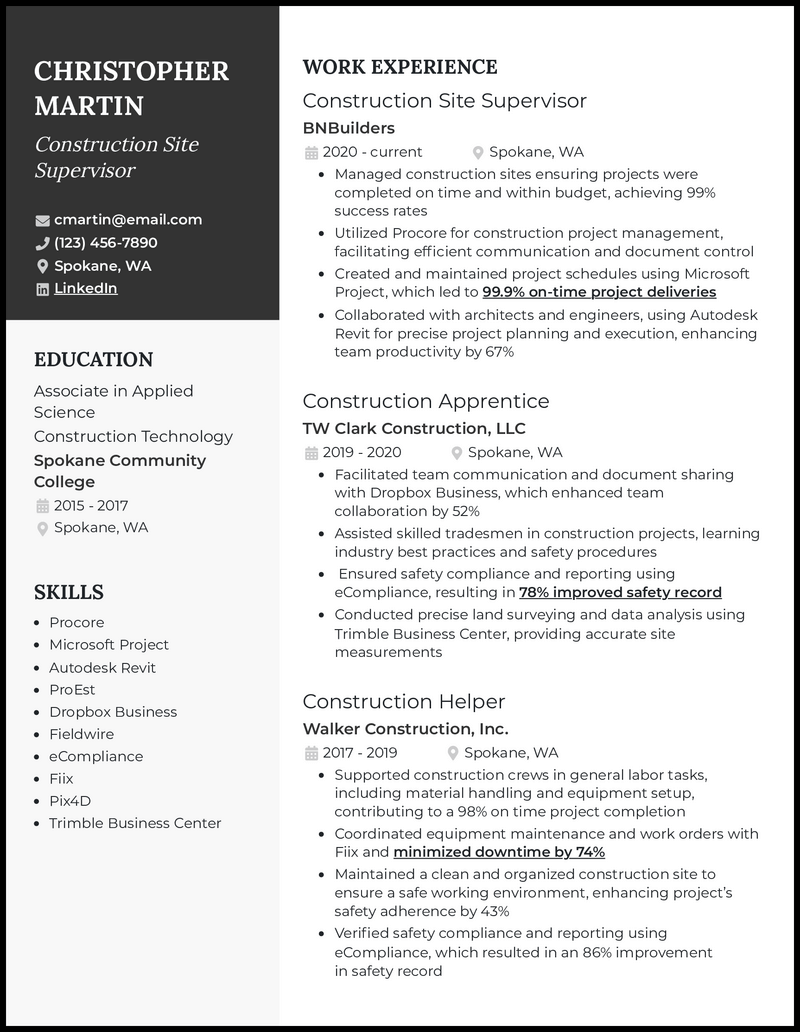
Why this resume works
- When analyzing construction worker resumes, one quality consistently generates the most interviews—quantified metrics. You must utilize numbers to show your value because, on average, hiring managers will only spend six seconds reviewing your construction worker resume.

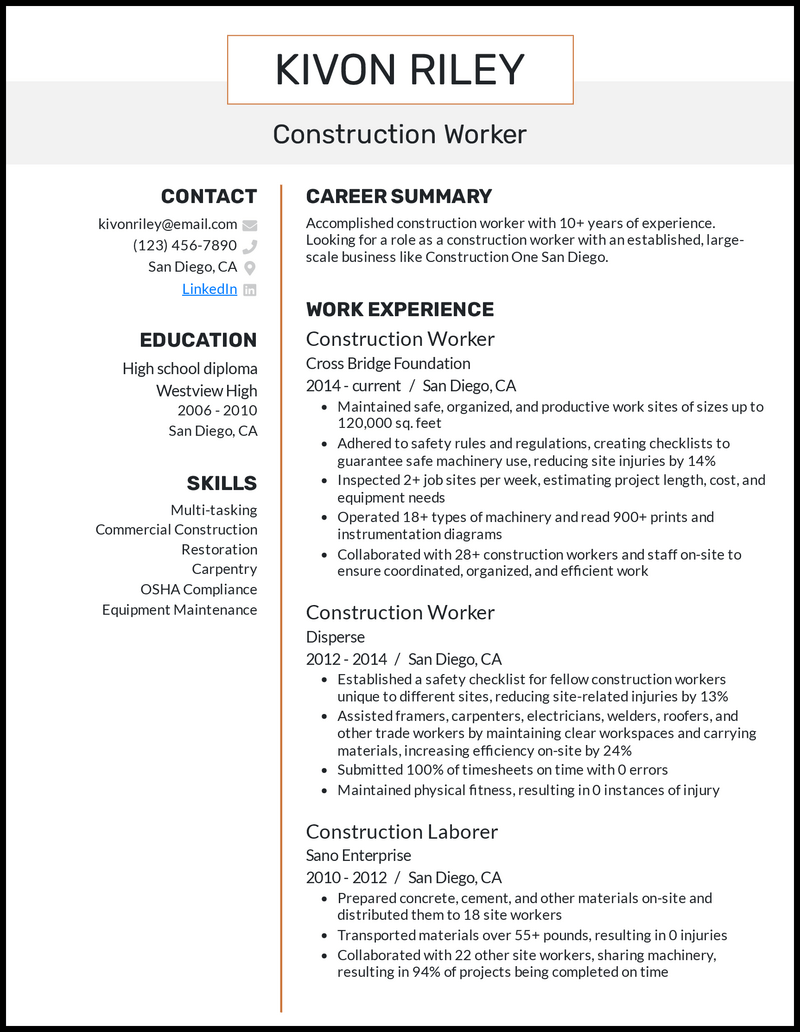
Why this resume works
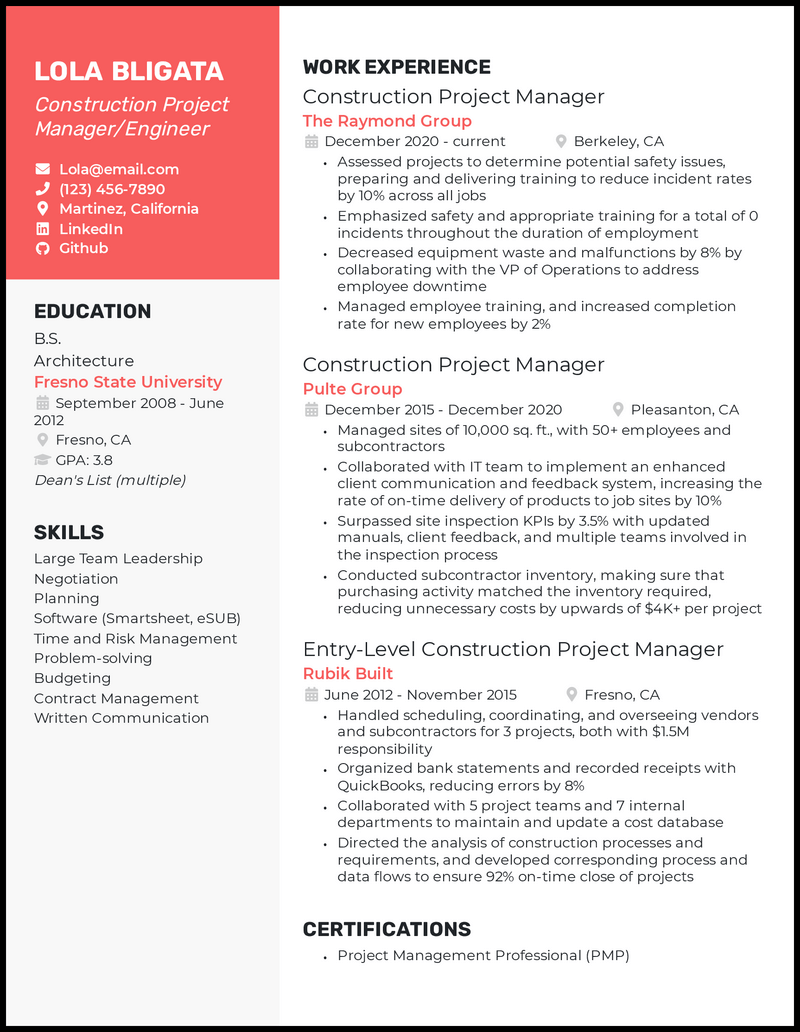
- For a construction project to succeed, there has to be clear efforts from different professionals including engineers, architects, and laborers. This is why your construction resume should show a track record successfully merging the efforts of different professionals to achieve high compliance ratings, and on-time completion of projects.
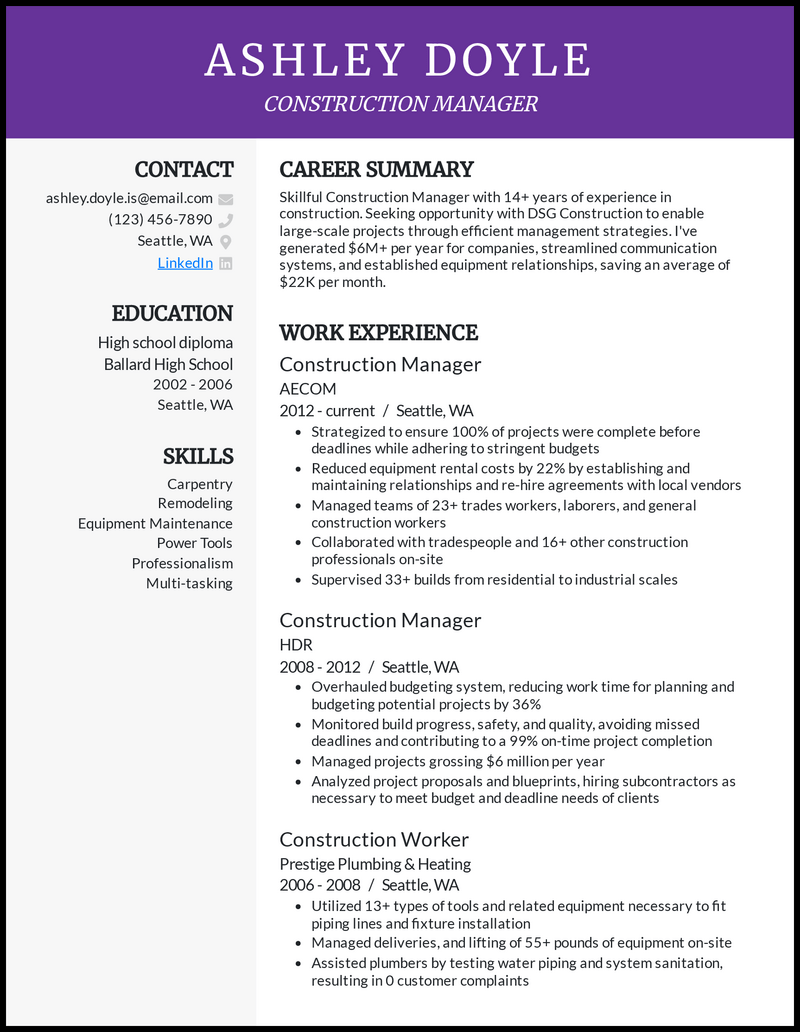
Why this resume works
- If you boast 10+ years in the field, consider including a resume summary. Following it up with your most relevant and recent work experiences, listing your roles in reverse-chronological order (with your most recent position listed at the top of your resume).
See more construction manager resumes >
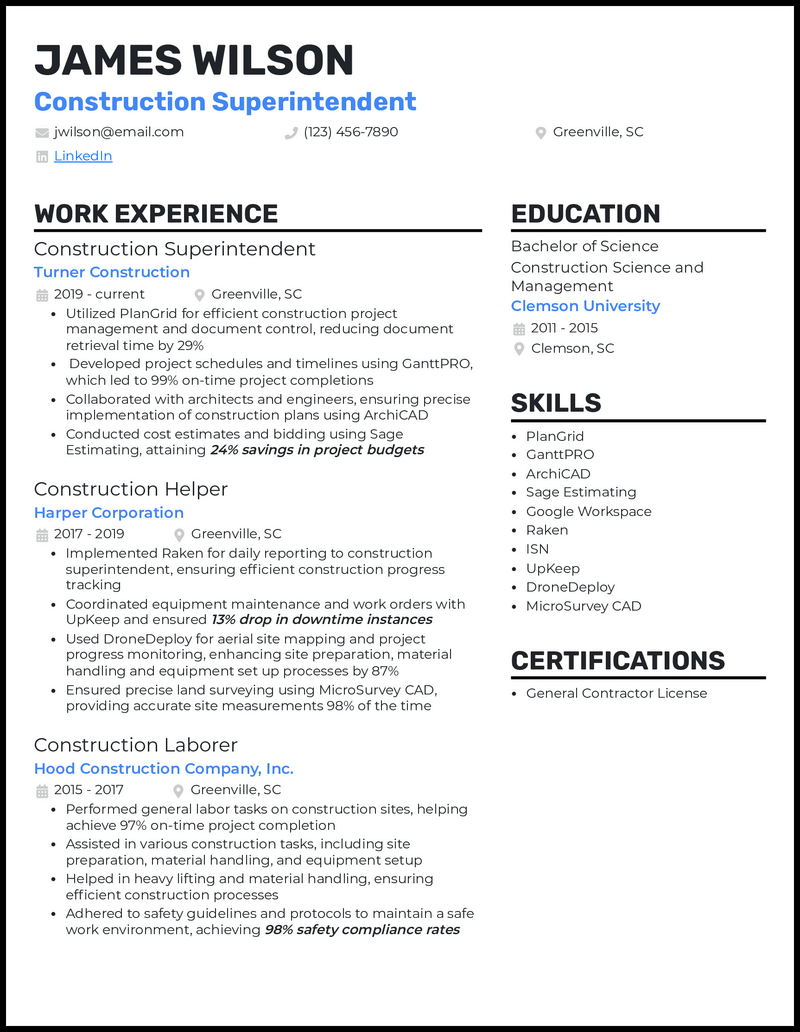
Why this resume works
- Nothing matters more in construction than ensuring structures meet industry compliance guidelines, and the workers operate under safety standards. These are two things that should be clear in your construction superintendent resume.
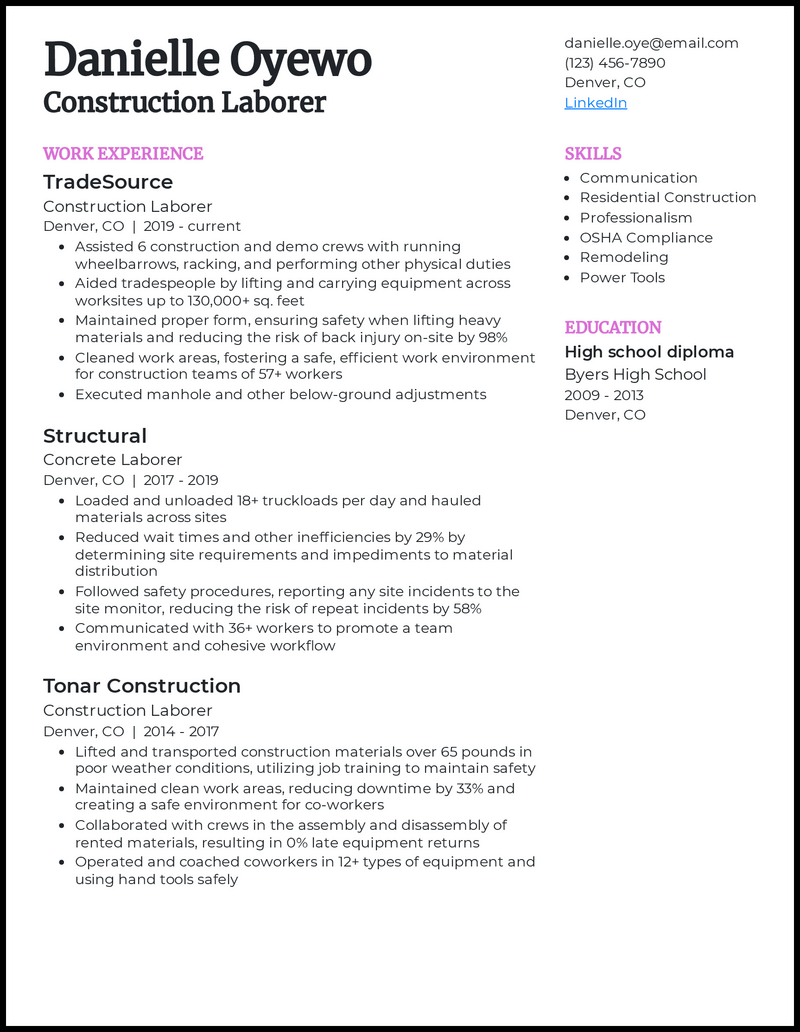
Why this resume works
- Make sure that each work experience you include contains three to six bullet points. Too few bullet points may cause the hiring manager to question the impact you had, and too many will make your construction laborer’s resume cluttered and cumbersome.
See more construction laborer resumes >

Why this resume works
- A rather simple way to stand out from any other general construction worker’s resume is by including your ability to operate the big league equipment like a SawStop PCS31230-TGP252 Professional Cabinet Saw. Fuse these skills with your bullet points and highlight tangible results using them.
Why this resume works
- A rather simple way to stand out from any other general construction worker’s resume is by including your ability to operate the big league equipment like a SawStop PCS31230-TGP252 Professional Cabinet Saw. Fuse these skills with your bullet points and highlight tangible results using them.

Why this resume works
- Focus more on creating impact-based work experience bullet points. For example, show how you used a tandem roller to achieve 93% soil compaction. That level of detail shows employers you don’t just smoothen out roads, you make sure they last.

Why this resume works
- Consider including a resume objective if you’re light on experience. A worthy objective should drive home your value in a power-packed snapshot of your experience or skills, however limited. It should also be customized to the target company by mentioning their name.
See more entry-level construction resumes >
How to Write a Construction Worker Resume

Summary
Stand out to recruiters with a results-driven construction worker resume that highlights your hands-on experience, measurable achievements, and job-ready skills.
Picture your resume as the perfect toolkit you need for work. Having the right pieces is necessary—in this context, it’s the correct format, handy skills, experience, and training. If any of these are missing, you’ll struggle to land an interview, despite your stellar hands-on experience.
No matter your experience, your resume should be able to stand tall in the crowd of applications.
That’s why we’ll show you how to write a resume that is not about building walls but about showcasing your value to recruiters and aligning it to industry-specific problems and solutions.
In this guide, you’ll learn:
- What to include (must-have sections)
- How to write a strong summary
- Key construction skills to list
- Highlighting certifications and licenses
- Describing work experience clearly
- Resume formatting basics

What makes a good construction worker resume?
A standout construction worker resume must clearly present your skills, demonstrating that you’re reliable and can maintain safety standards on any site. At the heart of every construction job is physical strength, working as part of a team, following instructions, and ensuring zero accidents.
To be the ideal candidate that recruiters and construction managers want, ensure your resume:
- Highlights your core skills in site safety, equipment operation and maintenance, reading blueprints, and any other expectations in the job posting
- Proves a safety-first mindset with certifications such as OSHA and Forklift operations
- Presents a track record of successful projects and jobs you’ve been part of
- Shows you’re reliable through working on any site, getting the job done on time, and being there when and where needed
- Is formatted for easy scanning by applicant tracking systems (ATS) and recruiters

How to format your construction worker resume
Your resume should be a clear and concise document that highlights your value. Since recruiters typically spend only a few seconds reviewing each application, let them quickly identify your strengths as soon as they open your document. First of all, you need to have the key sections that matter put in the correct order as follows:
- Contact information (top of your resume)
- A professional overview
- Key skills in bullet lists and in work experience descriptions
- Certifications and relevant licensures
- Work history (2-3 roles)
- Training or apprenticeship
What is the best format for construction resumes?
Relevance and currency are two key principles that can make your resume stand out from others. For this, use the reverse chronological format to prioritize your most recent and relevant roles first. This way, you’ll give both ATS and hiring managers an easy time finding why you’re the perfect fit for the job.
This order demands:
- 2-3 past and recent job titles, complete with employers’ names, dates, location, and work done
- 3-4 bullet points per experience that show results and impact from what you did
- Use of active verbs and core skills to align your resume with the demands of the advertised job
How long should a construction worker’s resume be?
Keep your resume to one page. You don’t want to bore the reader with details that don’t matter to the job. A one-age document is:
- Easy to scan at a glance
- Concise and focused on the specific job
- Perfect for fast decision-making
Use a two-page resume only if you have 10 or more years of experience and are applying for roles such as foreman, construction superintendent, or any other specialized/leader role.

How to share contact information
Be confident and start your resume by sharing your name and how to contact you if you land an interview. When you add the contact information section, make it visible, readable, and professional.
Include:
- First and last name
- Mobile phone number
- Professional email address (no nicknames or outdated domains)
- City and state
- LinkedIn profile or trade portfolio (optional, but a big plus)

What is a construction worker resume professional summary?
Hook recruiters with a snapshot of your value to their construction site. You can go with a career objective if you have direct work experience or a resume summary if you have the knowledge and accomplishments to showcase.
One secret to getting recruiters to like your resume is by giving them what matters first. That’s exactly what a resume summary does: presenting your skills, experience, and value at the top. Besides setting the tone for the rest of your resume, this powerful statement gives an overview of your abilities and the value you would bring to the job.
Career objective example (Entry-level)
Hardworking and safety-conscious construction worker with hands-on experience in basic carpentry, site cleanup, and equipment handling. Completed a 3-month apprenticeship under certified builders. Passionate about growing in commercial construction and contributing to quality builds at Turner Construction.
Career summary example (Experienced)
OSHA-certified construction worker with 10 years of experience in residential and commercial builds. Proven record of reducing project delays by 13% through early issue identification and communication. Skilled in power tools, framing, drywall, and blueprint interpretation. Committed to high standards of craft, safety, and productivity.

How to quantify your construction experience
Your experience section makes your resume stand the scrutiny of recruiters and land you a spot on the interview list. Therefore, you have to make it as solid as metal frame; keeping it polished, easy to scan, and fortified with your strengths.
For each entry, generate 3-4 bullet points reinforced with action verbs, skills, and measurable outcomes.
Example:
- Completed foundation prep and framing for 22 new-build homes, consistently ahead of schedule
- Operated skid-steers, jackhammers, and saws while maintaining a perfect safety record
- Reduced material waste by 12% through accurate measurement and site planning
Metrics that matter in construction work
As much as you want to quantify your impact, it must be in areas that matter to the construction industry. Here are metrics that would make your resume stand out:
- Number of projects you were part of
- Square footage of sites
- Team sizes
- Timelines exceeded
- Safety record

How to write a construction worker resume with no experience
If you’re starting, writing a resume without construction experience needs a strategic approach. Transferable skills, relevant training or apprenticeship, and a willingness to learn and work hard to prove your value are key pillars for impressing hiring managers.
You can start with a career objective to show your enthusiasm for the work and your plans for the industry as a whole. Follow this up by highlighting your skills from other relevant work or projects that would be beneficial in a construction workplace, such as teamwork, time management, and tool operation.
Also, certifications specific to the construction industry are a great addition. They not only demonstrate your professionalism but also show your discipline, determination, and willingness to continue learning to stay current.

What skills do you need to be a construction worker?
Here’s where you show recruiters what you’re made of. Ensure you bring in as many technical and soft competencies from the job posting as possible because employers and the ATS will use them to measure how much you align with the role’s expectations. It’s important to emphasize your strict adherence to construction design safety in your work to set yourself apart from the rest.
Top construction worker skills:
- Framing and Drywall Installation
- Concrete Mixing and Pouring
- Blueprint Reading
- OSHA Safety Standards
- Power Tool Operation
- Team Collaboration
- Physical Stamina
- Forklift Operation
- Time Management
- Job Site Cleanup

How to include education and certifications
You may have earned your skills on the job. You’re a diligent worker. However, that doesn’t mean your education and certifications don’t have a place in your resume. They do, especially when you’re applying for union or commercial roles. They can be effective tiebreakers and put you in the lead.
Example
High School Diploma
Westside High School
Phoenix, AZ
2018-2022
Certifications
✅OSHA 30-Hour Construction Safety
✅NCCER Core Construction
✅CPR/First Aid Certified
✅Forklift Certification

How to pick the right template
Like you wouldn’t accomplish much mixing concrete with a teaspoon, you can get ahead with a readymade resume template. Using tailored resume templates aligns you with industry standards and gets you on the right path to landing the job.
Pick one that’s:
- ATS-friendly with no graphics or complex formats
- Clean and professional: easy to read at a glance
- Focused more on skills and experience

Key takeaways
- Use a simple, clean layout
- Set tone with a strong summary
- Blend your skills with tools, equipment, and safety
- List certifications that matter
- Quantify your impact
- Tailor to the specific role
- One page is often enough
- If entry-level, focus on job-readiness
Construction Worker Resume FAQs
A construction worker’s resume that wins the job should include contact info, a career profile, quantified work experience, relevant skills, education, and certifications. Ensure that you customize it to your specific job by matching it with keywords from the job posting.
You should highlight your experience in large-scale projects where you interpreted blueprints, coordinated subcontractors, and ensured compliance with inspections and permits. Ensure that you quantify results to underscore the value you bring.
For a residential resume that stands out, emphasize fast turnaround, attention to detail, and building relationships with homeowners. For technical competencies, showcase your finishing, flooring, walling, and framing expertise.
One page is enough to convince construction site managers of your abilities through skills, work experience, and training. If you’re a senior worker with many years of experience and accomplishments, going over one page is acceptable as long you don’t add unnecessary information.

Stephen is the co-founder and CEO of BeamJobs. Frustrated with the challenges he'd faced in his own job search, he left the corporate world to start BeamJobs with his brother. Drawing on firsthand experience with hiring and getting hired as technical talent, he started BeamJobs in 2020 to help qualified job seekers land interviews with less stress. Since then, more than 4 million people have built their resumes and cover letters on BeamJobs. Stephen's insights have been featured in notable outlets, such as Fast Company, Business Insider, Yahoo Finance, MIT, and Zapier. Learn more about Stephen.