



![9 Architecture Resume Examples [& Templates]](https://beamjobs.wpenginepowered.com/wp-content/uploads/2023/02/architecture-resume-resume-example.png)
A well-structured architecture resume presenting your skills, tools, and experience to pass digital filters and impress human reviewers can be the difference between landing an interview and getting overlooked.
Whether you’re a fresh graduate or a seasoned architect, using an AI resume builder helps ensure your format, phrasing, and keywords match what firms are looking for. Pair it with an AI-generated cover letter to complete your application with compelling, targeted messaging.
In this guide, we’ll cover:
- ↪ 9 architecture resume examples to learn from and adapt
- ↪ How to match your resume to job descriptions and recruiter priorities
- ↪ What to include (and avoid) in architecture resumes for all levels
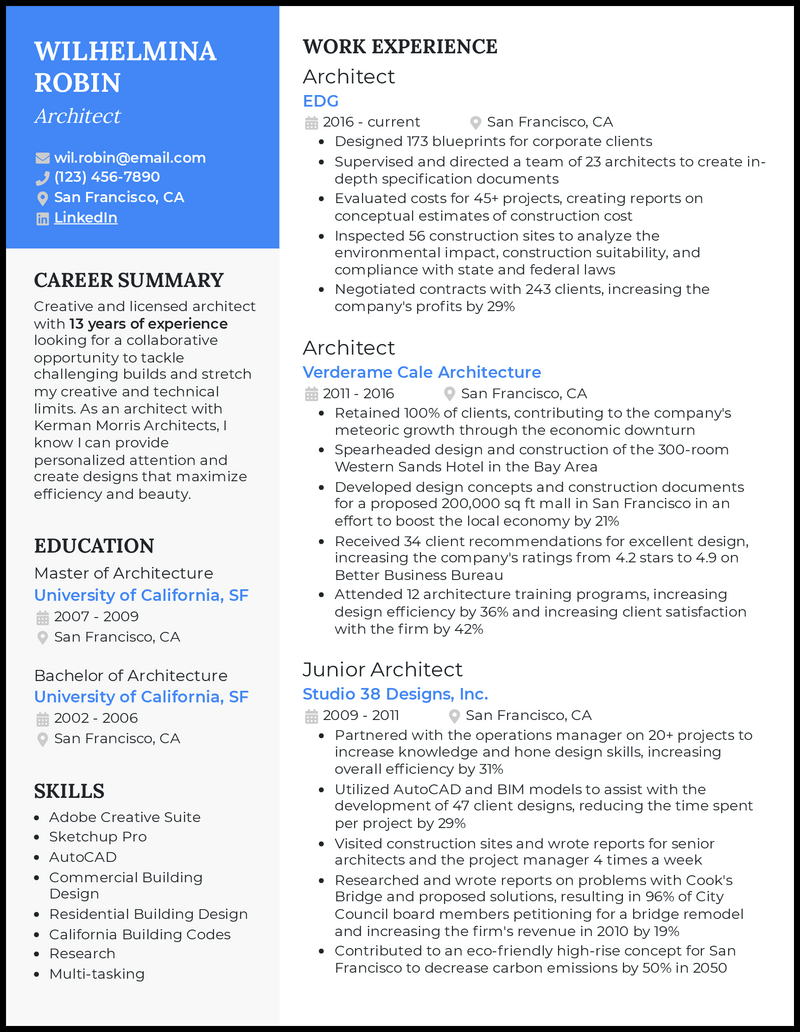
Why this resume works
- If you have more than 10 years of experience, you can generate a resume summary for your architecture resume, listing number of years you’ve worked as an architect, the ideals you shoot for, and the goals you’d achieve once you land the job at a particular company.
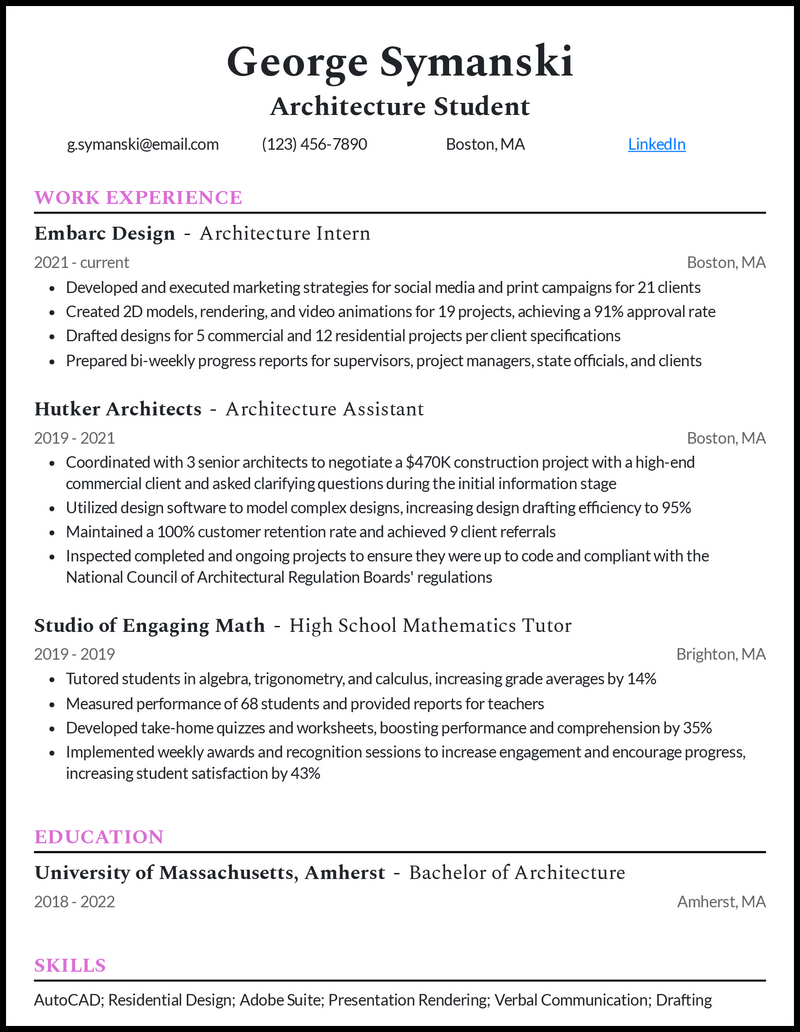
Why this resume works
- When writing your achievements and responsibilities on your architecture student resume, put your best foot forward by following one of the top resume tips: no detail is too small. Typos, verb tenses, and active verbs could make or break your dream.
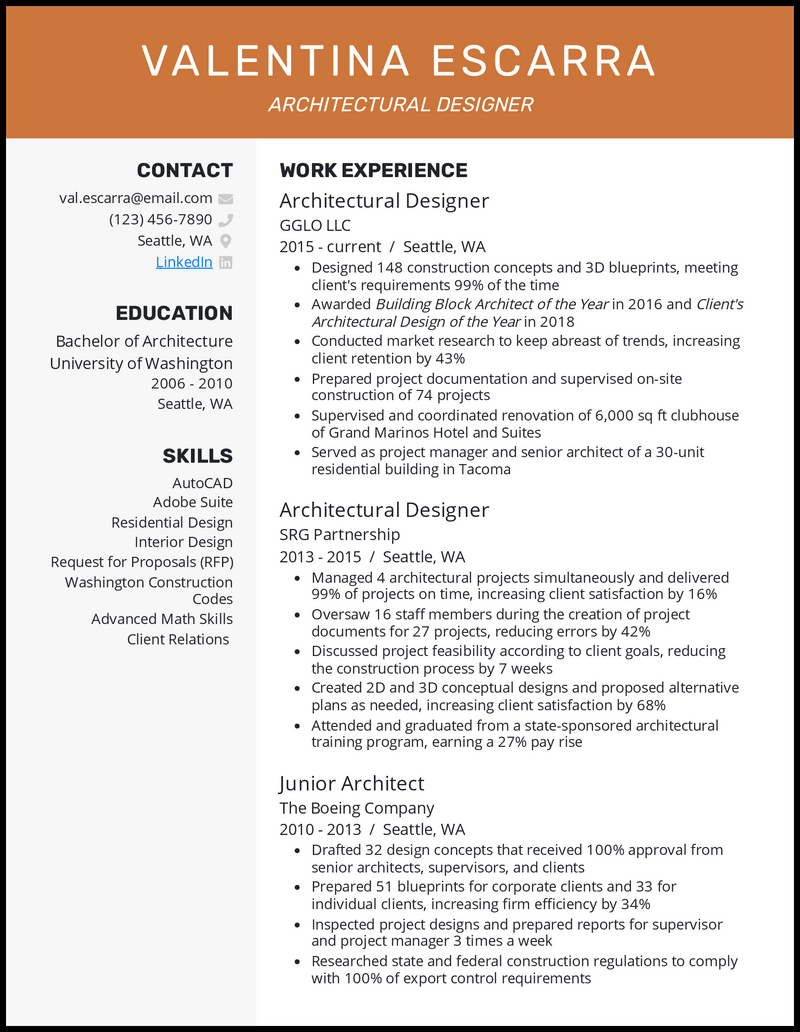
Why this resume works
- Proper resume formatting is one of the first things recruiters notice and you can then expound on the extras in your architecture cover letter.

Why this resume works
- Demonstrate how the integration of ArcGIS, Autodesk Civil 3D, and other tools has been deployed to streamline work processes and ensure optimal project outcomes.
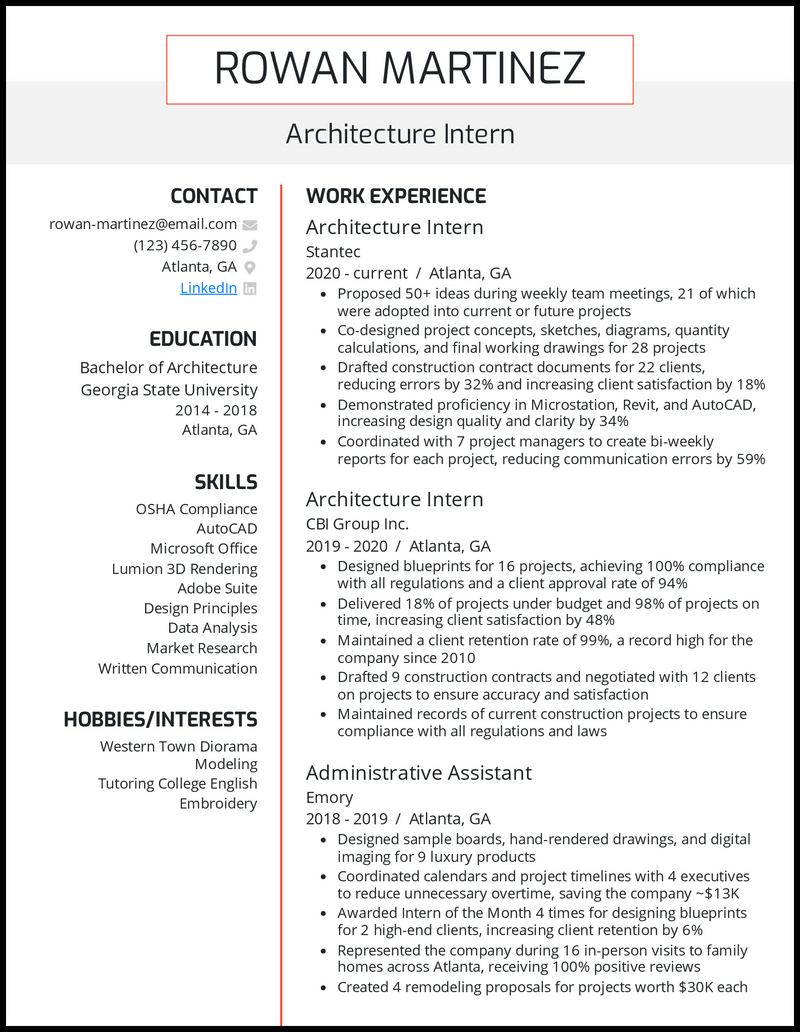
Why this resume works
- Customize your architecture intern resume for each position to which you apply to increase your chances of getting an interview. Adding a hobbies and interests section to your resume is a fast way to tell employers more about yourself.
See more architecture intern resumes >
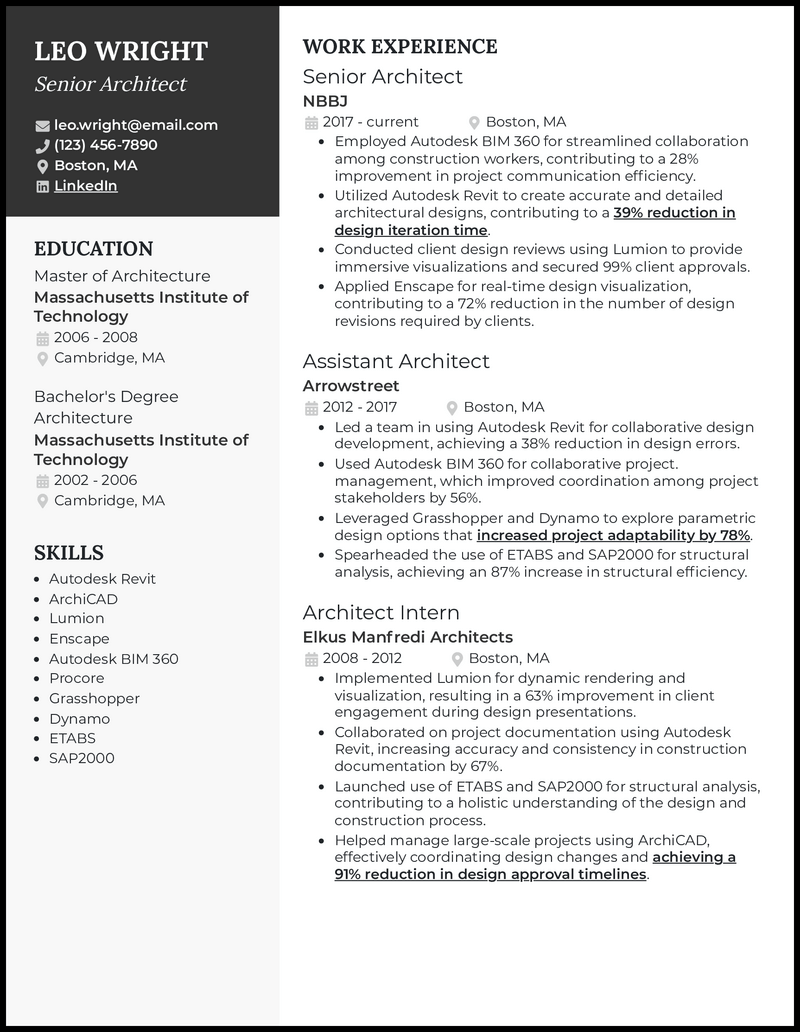
Why this resume works
- One noticeable thing about this senior architect resume is how the experiences across intern and assistant architects demonstrated progressive growth and adaptability in addressing various architectural challenges.

Why this resume works
- Polishing your architecture graduate resume with the right work experience can seem daunting when you don’t have too much experience to offer. Worked as a freelance graphic designer before? Tell them you “boosted positive client reviews by 27%”.
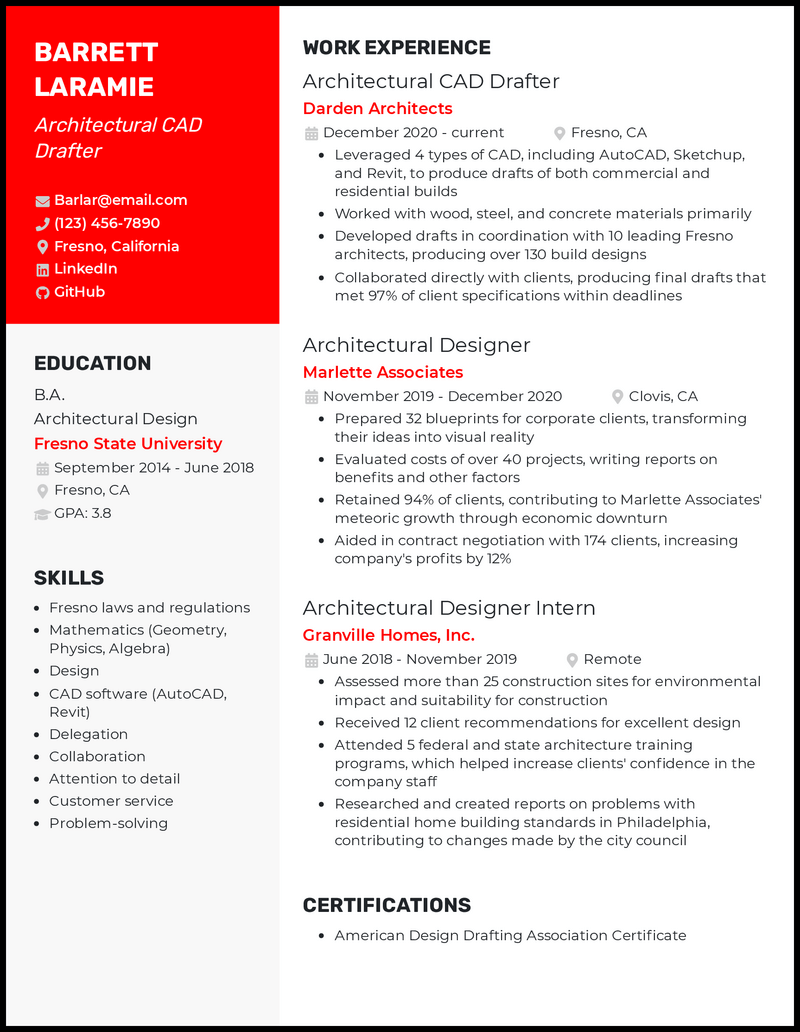
Why this resume works
- Focus on technical skills in your resume skills section. Good example of these kind of skills include “CAD Software,” “Laws & Regulations,” and “Mathematics.”

Why this resume works
- This director of architecture resume has tasks backed up with powerful metrics, so you’re not telling recruiters you did something, you’re SHOWING it!
Related resume guides
How to Write an Architecture Resume

To write an architecture resume that consistently lands interviews, optimize it for both a recruiter and a machine. The resume must be skimmable, keyword-aligned, and visually structured — communicating your design thinking and project impact. Every section should serve a specific function: to verify qualifications, reveal architectural focus, and hint at creative style.
Review resume examples that landed architecture jobs, and once you write your resume, remember to run it through an intelligent checker to identify areas of improvement to be confident in your chances.
In this section, you’ll learn how to:
- Choose the right format
- Use role-matching keywords
- Craft a high-impact summary
- Quantify design achievements
- Include software/tool proficiencies
- Showcase project relevance
- List credentials and affiliations
- Prove value with portfolio linkage

Start with the right format
A well-thought-out design speaks volumes about your passion, and that doesn’t apply to buildings or homes alone but resumes, too. Don’t settle for less or a cramped design for your architect resume. Besides not being aesthetic, it will lower your chances of getting past modern ATS.
Follow our top formatting tips to avoid falling into the abyss of generic resumes:
- Length: Imagine a house that’s extremely long with triangle edges and no windows. Off-putting right? Employers feel the same when your resume goes beyond one page, so keep things short and sweet.
- Using bullet points: Bullet points are the best way to explain your past experiences. They’re easy to read, break down information well, and give new information in every new line.
- Reverse-chronological format: While listing your job experience, add your latest work at the top to display your latest strengths and career growth naturally.
- Portfolio: This goes without saying, but in your personal details section, add a link to your portfolio where employers can view your past designs and outcomes.

Most in-demand architecture software skills in 2026
Applicant tracking systems (ATS) determine how close your resume matches the job postings. On the other hand, hiring managers expect tools aligned with modern workflows. From the job ad, identify the competencies they care more about, propel them to the top, and present them first in the “Skills section”. Go a step further and use them to build bullet points that are value-driven and align with what the potential employer is looking for.
Top tools/skills/software to list:
- Revit (BIM standard), AutoCAD, Rhino + Grasshopper
- SketchUp Pro, Adobe InDesign, V-Ray, Enscape
- Sefaira or similar tools for sustainability modeling
Eager to share that you can simply stand in front of an empty land and get started? Kudos. Just make sure you’re using language that the ATS doesn’t mind. Follow the examples below to learn the type of skills expected in an architect’s resume:
- AutoCAD
- SketchUp Pro
- Adobe Suite
- Commercial & Residential Building Design
- Presentation Rendering

How to quantify architecture achievements on a resume
Always translate design into value by using numbers. Visualize what you’ve done using stronger, more impactful words paired with metrics, precise results, and your direct input.
Writing phrases like “Was responsible for creating a house design” is a thing of the past. Visualize what you’ve done using stronger, more impactful words. Here are a few examples you can pull some inspiration from:
- Led the design process for a 200,000+ square feet mall in New York, boosting the local economy by 19% within one year.
- Used AutoCAD and BIM to model a luxury house design with 8 bedrooms and 3 floors, achieving a 98% client satisfaction rating.
- Used AutoCAD and BIM to model a luxury house design with 8 bedrooms and 3 floors, achieving a 98% client satisfaction rating
- Optimized HVAC zoning layout using Revit, reducing material waste by 12% and cutting construction costs by $84K on a 60,000 sq ft mixed-use project
- Streamlined permit documentation workflow in Bluebeam and BIM 360, eliminating redundancies and saving the design team over 122 hours
Read the job listing of the company you’re applying to and include quantified metrics for impacts that they value the most.
How do I write a resume for an architect with no experience?
Use an education-first layout and showcase achievements from academic projects, group activities, and internships
Follow these key tips:
- List studio projects and emphasize your input and impact
- Add internships, design competitions, or volunteer builds
- Lean more on soft skills such as teamwork, research, and presentation
- Use a short objective to tease your potential, skills, and passion for the profession

Junior vs senior architect resume differences
You should a different strategy when applying for a junior vs a senior architecture role.
Tailor your resume based on career stage as summarized in the table below below.
Table 1: Junior resumes vs senior resumes
| Emphasis-vs-Career Level | Entry-Level Architecture Resumes | Senior Level Architecture Resumes |
|---|---|---|
| Education | Built work | |
| Software proficiency | Leadership (teams, budgets, approvals) | |
| Conceptual and academic projects | Client-facing and regulatory coordination |

How to include architecture licensure and registration
Licensure is the block that builds trust. Therefore, don’t bury it in obscurity. Place right under education in its own section titled “Licensure”.
Use this format:
- Title of licensure
- State where issued
- Number
- Year issued/expiry
Examples:
- Registered Architect, Texas – License #6890, 2023
- NCARB Record Active – ARE Candidate (5/6 exams passed)

How to include your architecture education
A Bachelor of Architecture (B.Arch.) or equivalent and your state license is the bare minimum you should have on your education section. Both of them prove that you’ve passed the Architect Registration Examination from NCARB and are ready to take on projects.
How to showcase sustainable and green architecture skills
Sustainability and green practices are reshaping the principles of the real estate landscape, including the architecture sector. Your experience and certification in such practices are valuable, and you must clearly communicate them.
Create a separate section and label it “Sustainable Design Projects”. List the project name, certifications (LEED AP, WELL AP), passive design where applicable, scope of work, tools used, achievements, and impact as follows:
- Designed LEED Silver community center
- Used daylight modeling tools (Sefaira, Ladybug)
- Specified FSC-certified materials for renovation

How to tailor your architect resume to the job description
One of the top goals for your resume is to be visible to hiring software and instantly impress recruiters. To ensure that your copy does precisely that, use company-specific language to improve ATS and recruiter match rate by following this formula: Scan → Mirror → Prioritize = Tailored resume for the position, company, and industry
Here’s how to do it effectively:
- Identify the top 3 skills/tools or project types in the job ad
- Restructure bullets to match the tools and the employer’s expectations
- Reorder resume sections based on relevance and level of experience

Should I write a summary or an objective for architect roles?
Hiring managers expect mid- to senior-level architects to include a professional summary, not an objective. A summary highlights your experience scope, signature projects, and technical strengths in a few tight sentences.
An objective is better suited for entry-level architects or career changers who need to clarify their intent and showcase potential. In that case, be crystal clear about your career goals, credentials, and passion for architecture, while tying it back to how you’ll add value.
Observe these rules:
- Use a summary if you have 3+ years of architectural experience.
- Use an objective if you’re new to the field or shifting into architecture
- No fluff
- Use quantifiable, role-matched language
- Tailor to the firm and role niche
What is a good resume summary for an architect?
Example
“Licensed architect with 8 years of experience in civic and institutional projects. Managed 15-person teams on $30M+ designs. Seeking role in community-focused firm with BIM-first workflows.”
What is a good resume objective for an entry-level architect?
Example
“Entry-level architect skilled in AutoCAD and Revit, seeking to join Gensler to apply sustainable design knowledge and support innovative projects”

Common resume mistakes to avoid in architecture
“Entry-level architect skilled in AutoCAD and Revit, seeking to join Gensler to apply sustainable design knowledge and support innovative projects”
Don’t make any of these mistakes:
- Using a “creative” layout that breaks ATS and offends recruiters
- Leaving out portfolio or license details
- Vague bullet points without skills, value, and impact
- Weak verbs like “Helped,” “Supported,” “Part of”
- Skipping scope per project

Key takeaway
- Quantify every work experience and demonstrate your work’s impact. Tailor each point to the job description to be the preferred candidate.
- Craft strong skill,work, and experience sections that resonates with your passion for architecture and makes your profile unbeatable.
- Add your education, certifications, and state-issued license to prove that you’re a recognized architect professional.
- Incorporate our formatting tips to ensure your resume is not slashed by modern applicant screening bots.
Architecture Resume FAQs

Architects are judged by structure — your resume should be, too. Use clear hierarchy, white space, and consistent fonts. Avoid excessive design that hides content from ATS systems.
Ensure you:
Use grid-style, legible formatting
List projects with roles + tools
Avoid overdesign, support ATS
Always include a portfolio link
Your architecture graduate resume should highlight technical, design, and soft skills that align with the expectations of a real architect job. Some of the skills you should include:
✅ AutoCAD
✅ SketchUp
✅ Model making
✅ Report writing
✅ Team collaboration
✅Time management
To write a resume for an architecture with no experience, follow these four steps:
✅ Include a compelling career objective that highlights your passion and goals.
✅ Mention your current education details and coursework
✅Add any projects or volunteering work where you applied your architectural and technical skills.
✅ List the designing software you’re most proficient in, such as Revit or BIM360.
Opt for a one-column custom minimal template, using modern and readable fonts (e.g., Avenir, Helvetica, Lato), and maintain consistent spacing.
Use semantic headers and arrange the sections in this order:
Contact + portfolio Link
Summary/objective (if necessary)
Work/project experience
Technical Tools
Education + certifications

Stephen is the co-founder and CEO of BeamJobs. Frustrated with the challenges he'd faced in his own job search, he left the corporate world to start BeamJobs with his brother. Drawing on firsthand experience with hiring and getting hired as technical talent, he started BeamJobs in 2020 to help qualified job seekers land interviews with less stress. Since then, more than 4 million people have built their resumes and cover letters on BeamJobs. Stephen's insights have been featured in notable outlets, such as Fast Company, Business Insider, Yahoo Finance, MIT, and Zapier. Learn more about Stephen.