



As a travel nurse, a lot is expected of you: delivering care outside your comfort zone, remaining calm in the face of a medical emergency, and quickly adapting to the demands of the job.
However, to land your next job, your travel nurse must work twice as hard. You must demonstrate that, despite minimal onboarding, you possess the necessary credentials, flexibility, and clinical abilities to succeed in the job.
Through 7 travel nurse examples in this guide, you’ll learn how to build a professional resume that floats to the top even for competitive opportunities. You’ll also learn:
- ✅How to ensure your resume format is ideal for your target role, specialty, and jurisdiction
- ✅The must-haves to stand out, including multi-state licensure and EMR fluency
- ✅How to boost your chances with an AI cover letter that emphasizes the value you bring
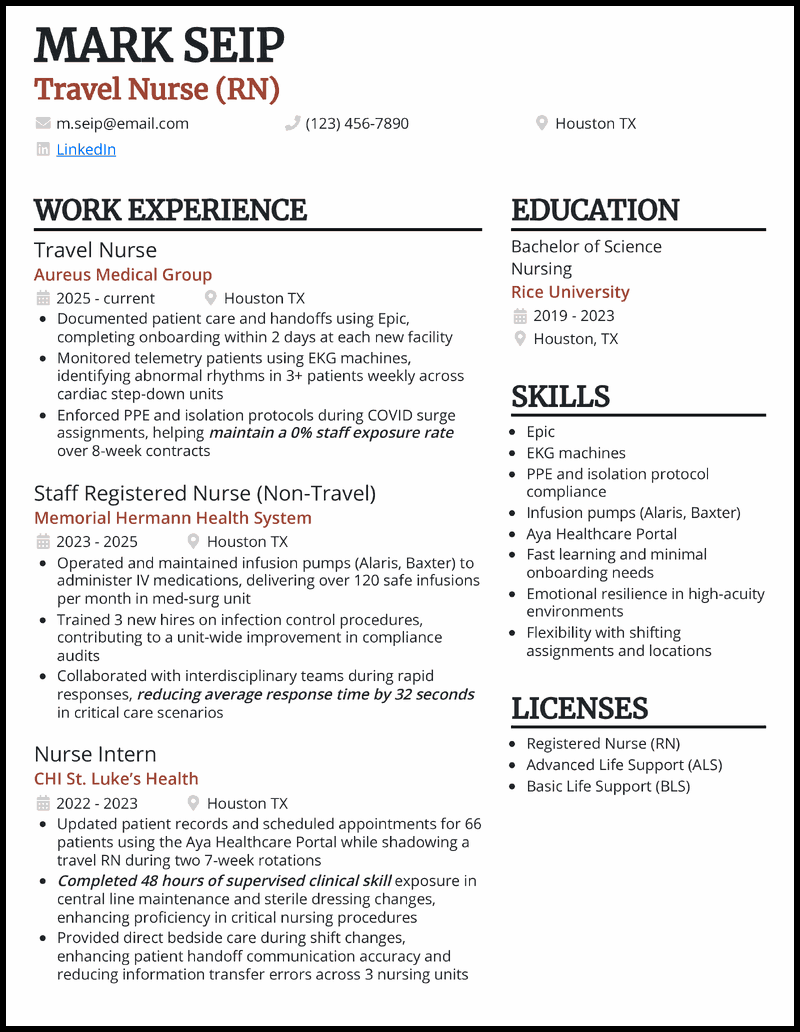
Why this resume works
- This role requires you to be flexible and ready to face any medical situation. So, don’t shy away from showing employers that you’re an expert at various healthcare practices.
- Instead of listing your Registered Nurse (RN) certificate alone, add others like Basic Life Support (BLS) and Advanced Life Support (ALS). These will expand your overall portfolio and will likely make your travel nurse resume more preferable over others.



Related resume examples
What Matters Most: Your Skills & Previous Experience

As you draft your resume for that travel nurse job you’re eyeing, the most important part is ensuring your skills align with what your potential future employer expects of you.
Not sure what skills to include? The best place to start is by closely reading the job description! They’ll probably mention some key hard and soft skills they expect employees to have, so it’s there, you need to include on your travel nurse resume!
If they’re not included, chances are high recruiters or applicant tracking systems (ATS) will skip over your resume. By taking the time to read the job description, you’ll be a step ahead of the competition!
9 Most In-Demand Travel Nurse Skills
- Multi-state nursing license
- Nurse Licensure Compact
- Registered Nurse (RN)
- Advanced Practice RN
- Licensed Vocational Nurse (LVN)
- Valid driver’s license
- Empathy
- Flexibility
- ASN or BSN degree
Sample Travel Nurse Work Experience Bullet Points
Without a doubt, the single most important part of your resume (which will often be the make-or-break factor for if you get that interview) is your work experience.
But wait! This doesn’t mean you need to list out every responsibility from your last several jobs. On the contrary, the focus needs to be on something else: impact.
Put it this way: you need to use this section to focus on what kind of actions you took, and what kind of benefit (or quantifiable outcome) that led to.
For example, this could be anything like improving company productivity or increased internal awareness on a clinical practice.
Not sure yet how to visualize that? Here are a few examples to get your creative juices flowing.
- Trained 20 1st year nurses in best gloving and gowning practices, resulting in 100% compliance in RNs who were previously not adhering to best practices
- Increased HCAHPS scores by 10% through regular feedback and feedforward cycles with oncology RNs
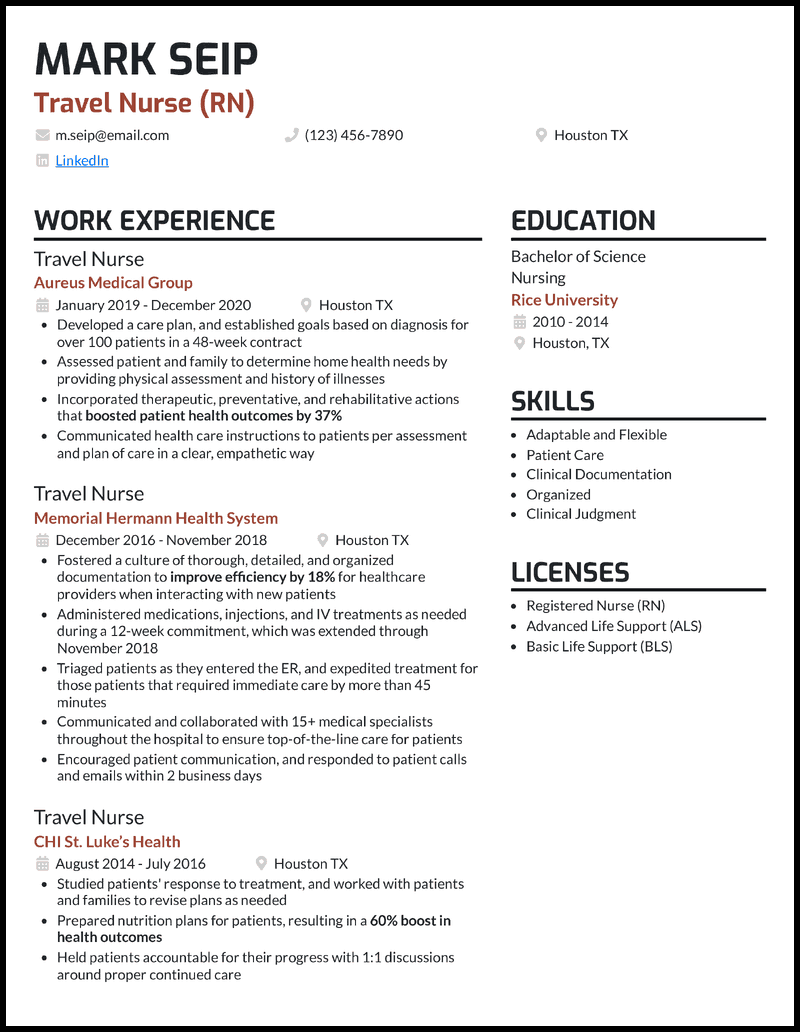
- Fostered a culture of organized documentation and improved efficiency by 18% for healthcare providers interacting with new patients
- Triaged patients entering ER, expediting treatment for patients requiring immediate care by an average of 35 minutes
- Led a team of 10 audit medical workers to ensure safety standards were met by all staff
Top 5 tips for your traveling nurse resume
- Clearly demonstrate your ownership.
- Being a travel nurse is a demanding job. Make sure it’s clear that you’ve undertaken a lot of responsibility, using active verbs like “led,” “contributed,” or “provided.” Don’t underestimate yourself!
- Use quantifiable metrics
- As much as possible, be specific. Don’t say you worked in an infectious disease ward, mention how many beds were in the ward and how long you worked there. Whenever possible, use numbers. If not sure, estimate (as long as it’s within reason!)
- Mention leadership experience
- If you’ve had any senior roles or helped to train or guide junior RNs, that’s good to mention. This can help show that you’re reliable and can handle the extra responsibility, which is always a good look.
- Less is more
- Recruiters skim through resumes, and if it’s too long, chances are high they’ll miss crucial information. Keep it short and sweet, while focusing on the unique aspects from each travel nurse job you had.
- Focus on your strengths
- A travel nurse resume is your place to shine, so focus on what you do well. Are you particularly skilled in advanced life support? Have you worked in satellite facilities more often than your peers? It should 100 percent be on your resume!
Travel Nurse Resume FAQs

A travel nurse resume focuses more on adaptability and flexibility to work in different environments, rapid onboarding, and features mostly short-term contracts. Unlike a traditional RN resume, the emphasis here is on multi-state licensure, history of assignments, and the willingness to relocate at a moment’s notice.
A good travel nurse resume should show your clinical specialty, history of assignments, state licenses, and certifications such as ACLS and BLS. The top goal is to prove you can deliver unparalleled care in a fast-paced environment.
Your travel nurse resume should at a minimum include the following sections: certifications/licensure, history of travel assignments, clinical and tech skills, and education. If you have a decade or more of experience, you may include a summary.
Choose a simple, clear format, divide the sections into headers (Skills, Education, Experience, Certifications), and use keywords from the job description, such as telemetry and travel contract.

Stephen is the co-founder and CEO of BeamJobs. Frustrated with the challenges he'd faced in his own job search, he left the corporate world to start BeamJobs with his brother. Drawing on firsthand experience with hiring and getting hired as technical talent, he started BeamJobs in 2020 to help qualified job seekers land interviews with less stress. Since then, more than 4 million people have built their resumes and cover letters on BeamJobs. Stephen's insights have been featured in notable outlets, such as Fast Company, Business Insider, Yahoo Finance, MIT, and Zapier. Learn more about Stephen.