



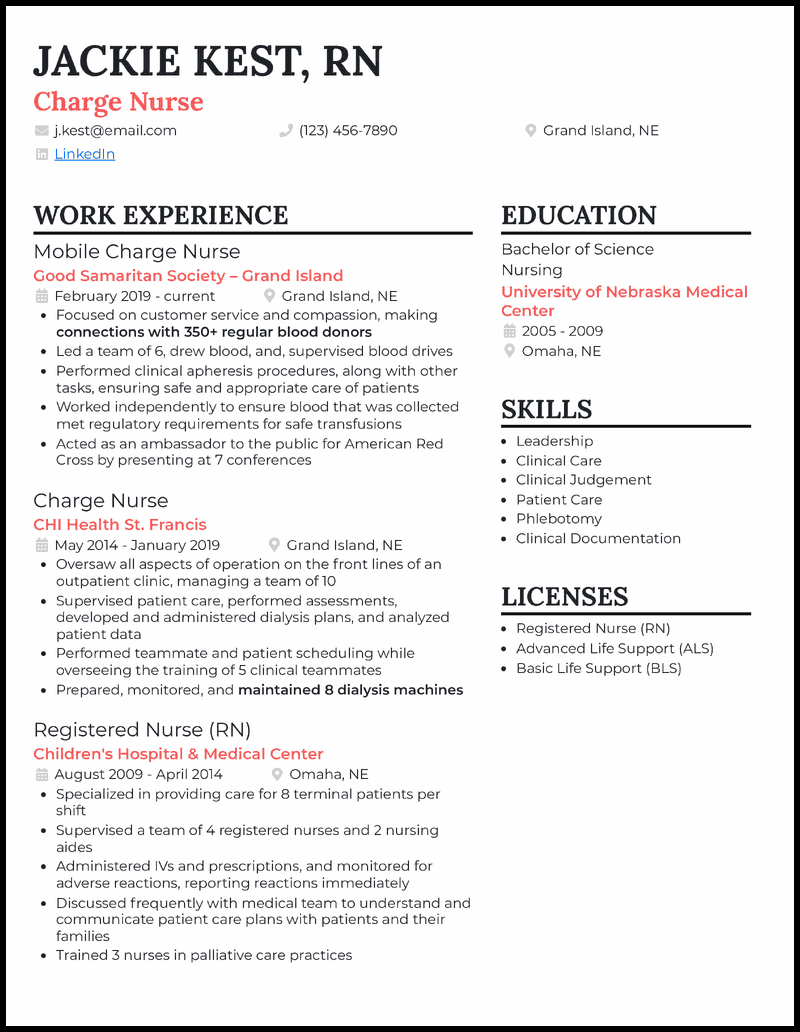
Step confidently into a leadership position by writing a charge nurse resume that proves your clinical skills and your ability to manage teams in demanding settings.
Whether you want to refresh your resume, create a cover letter that complements it, or ensure you have a truly good resume, this guide gives you the tools to make a strong impression in today’s competitive healthcare field.
Here’s what you’ll take away:
- ↪ 7 charge nurse resume examples that show effective structure, tone, and wording
- ↪ Proven ways to boost your chances for success, from design choices to highlighting the right skills and measurable results
- ↪ Clear guidance on what to include—and what to leave out, so your credentials and clinical experience work in your favor without distraction
Why this resume works
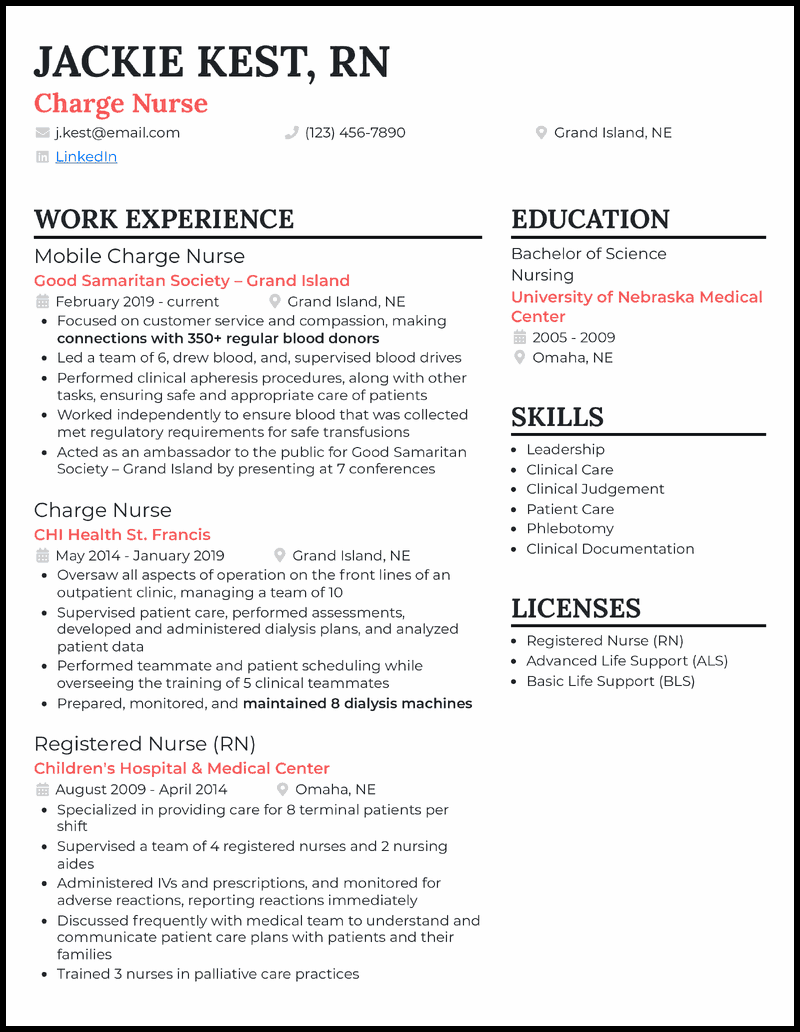
- You’re gonna act as the leader of the pack during shifts so make sure that your charge nurse resume exhibits authority in every point.
- Use action words to your advantage here and start every work experience bullet point using words like Led, Acted, Supervised, and Administered.


Related resume examples
How to Write a Charge Nurse Resume

Crafting the best charge nurse resume is about positioning your clinical expertise and leadership skills to immediately show employers your value.
Summary
Create a charge nurse resume that sets you apart in a competitive healthcare job market, highlighting both your clinical expertise and your ability to lead teams, showing employers that you can deliver safe, efficient, and high-quality patient care.
A strong resume should be clear, results-driven, and tailored to the role so it stands out in both human reviews and applicant tracking systems.
Key areas to cover:
- Select the right format to highlight both supervisory and clinical experience
- Put numbers, as much as possible, to what you’ve done
- Select relevant experience showing you can lead and adapt
- Incorporate targeted keywords from job postings to improve ATS compatibility
- Highlight certifications, licenses, and education to establish credibility
- Don’t overlook soft skills such as communication, critical thinking, and conflict resolution

Build the perfect resume header
The header sets the stage for your entire resume, so keep it sharp and professional. List your first and last name, phone number, professional email, and a link to your LinkedIn profile. City and state are enough for location; there’s no need for a full street address.
A clean, straightforward header shows attention to detail and immediately gives a recruiter confidence.

Make a lasting impression with a befitting professional summary
A well-written summary introduces you in just a few lines and tells hiring managers why you stand out.
For charge nurses, focus on leadership in patient care, the ability to coordinate staff, and results that show impact—such as improving workflow efficiency or mentoring newer nurses. This section should read like a confident introduction, positioning you as both an experienced nurse and a capable leader.
Example
Results-driven charge nurse with a decade of acute care leadership and experience optimizing staffing workflows for enhanced patient outcomes. Led a unit-wide initiative that increased patient satisfaction by 22% through team-based care coordination. Skilled in clinical oversight, crisis response, and mentoring multidisciplinary teams.

Properly format your resume
The resume structure you choose can make your strongest qualities shine. For most charge nurses, a combination (hybrid) or reverse chronological layout works best because they balance skills with a clear work history.
Use bullet points to keep information easy to scan, and stick to a consistent font and layout. If you need help, the LinkedIn resume builder is a practical tool for creating a professional structure without over-designing.

Demonstrate your clinical and nursing skills
As recruiters look over your charge nurse resume, there’s one main thing they’re trying to determine: do you have the right skills and mindset for the job?
As a charge nurse, you’ll need to have hands-on experience in providing patient care while also undertaking supervisory duties like coordination between RNs, physicians, and administrators.
In other words, you need to demonstrate you have strong leadership and delegation skills without being afraid to get your hands dirty.
To clear this section, make sure you closely read the job description and include any skills they want on your charge nursing resume. That way, you’ll be one step closer to an interview.
9 top charge nurse skills
- Emergency care
- EMR
- RN/MSN
- Patient/clinical care
- Leadership
- Medical software
- BLS, CPR, CENP, ACLS
- End-of-Life Care
- Patient triage

Quantify your accomplishments
So you’ve cleared the skills section. But it’s not yet time to call it a day.
Next, you need to show how your previous experience as a (charge) nurse makes you ideal for the position.
To do that, you need to focus on your impact. Basically, you want to use quantifiable metrics to clearly demonstrate what kind of change you brought about.
For a charge nurse resume, you’ll want to focus both on impact via patient/clinical care but also any impact through leadership or supervisory roles, since that’s what recruiters will be looking for.
Let’s make it concrete with a few examples:
- Prepared, monitored, and maintained 8 dialysis machines, reducing malfunction rate by 70%
- Specialized in providing care for an average of 45 terminal patients a week while supervising a team of 4 RNs and 2 nursing aides
- Trained an average of 5 nurses a week in palliative care best practices
- Supervised a staff team of 6 RNs, 12 CNAs, 6 LPNs, as well as interns, while evaluating an average of 12 patient care plans per shift
- Interviewed nurses, support staff, and ward team and launched an inventory management project bringing down costs by 15%

Emphasize relevant education, certifications, and ongoing training
Employers in healthcare want to see up-to-date educational qualifications. Your nursing degree, active license (RN, BSN, or higher), and any relevant certifications such as BLS, ACLS, or CCRN have their place here.
Leadership or management training is also valuable, as it reinforces your ability to oversee staff. Listing ongoing education shows dedication to staying current with patient care and safety practices.

Don’t forget high-value soft skills
Strong technical skills are essential, but soft skills prove you can succeed as a leader. Highlight qualities like communication, teamwork, adaptability, and conflict resolution.
These show that you can keep teams motivated, handle challenges under pressure, and maintain a positive environment for staff and patients alike.

Demonstrate your expertise with action verbs
Start every bullet point with verbs that show initiative and results. Words such as led, implemented, improved, supervised, and coordinated instantly demonstrate impact. For example, instead of writing:
Example
❌Responsible for staff management.
✅Led a team of 8 nurses and reduced patient response times by 18 minutes.
Pairing verbs with numbers makes your accomplishments more convincing.

Be specific, concise, and clear (refer to the job posting for tailoring)
A one-size-fits-all resume rarely works. Study each job posting carefully and adapt to its language, especially in your work history bullet points.
A job description resume match can help identify keywords and skills to include. By tailoring your resume this way, you increase your chances of passing ATS filters and showing hiring managers that you’re a strong fit for their role.
Top 5 tips for your charge nurse resume
- Focus on your unique skills
- As a charge nurse, you probably have an area you’ve specialized in over the years or a license not every RN has. Maybe you’re a NCSBN member, or you’re highly experienced in ACLS protocols. If it could make you stand out, it should be there!
- As a charge nurse, you probably have an area you’ve specialized in over the years or a license not every RN has. Maybe you’re a NCSBN member, or you’re highly experienced in ACLS protocols. If it could make you stand out, it should be there!
- Keep it short
- You might want to include every responsibility you ever had on your charge nurse resume, but you shouldn’t. Recruiters don’t have time to read long resumes, so keep it to one page, max!
- Emphasize your impact
- This is worth mentioning again, trust us! It should be crystal clear what kind of impact you brought about through your previous work experience as a charge nurse, so recruiters can see what benefits you could bring to the team.
- Don’t include a career objective
- Unless you’re going to personalize your career objective to each and every charge nurse job you apply for, it’s best to skip it. It adds little to your resume, and you can use that space for your skills or experience.
- Balance hands-on and supervisory experience
- You need to strike a fine balance when writing your charge nurse resume. Don’t focus only on leadership experience or patient/clinical care, because a successful candidate will have done both recently. A well-rounded experience section will go far!

Key takeaways
- Start with a professional and straightforward header
- Demonstrate leadership and measurable results in your summary
- Choose a format that brings out the best in your expertise
- List education, licenses, and certifications clearly
- Show soft skills that prove leadership and adaptability
- Use strong action verbs with measurable outcomes
- Tailor each resume to the job description for maximum impact
Charge Nurse Resume FAQs

Keep it to one page, and don’t use fancy graphics (the formatting could get messed up when uploaded). Use simple bullet points, have lots of white space, and use a clean font. Basically, make your resume easy to read. The recruiter will thank you!
That’s totally okay; less is more. It’s better to have 3/4th of a page than a three-page resume. But if you’ve included skills, certifications, licenses, and work experience, you’ll be covered!
All you need to do is read each job description, and make sure any skills mentioned that you have are reflected in your resume. Plus, highlight any relevant work experience or projects you did that are aligned with the profile they’re looking for.
A charge nurse resume goes beyond clinical skills—it shows your leadership, ability to manage teams, and track record in coordinating patient care. It positions you as a serious candidate for supervisory roles in today’s healthcare market.
When adding job descriptions, focus on responsibilities and outcomes.
For instance:
“Supervised 12 nurses, managed daily patient assignments, and introduced a triage process that cut wait times by 18%.” Keep every line specific, results-oriented, and leadership-focused.
A resume summary is well-crafted overview of your qualifications at the top of your resume highlighting your key strengths.
For example:
“Registered Nurse and charge nurse with 8+ years in acute care, experienced in staff management, workflow improvement, and delivering safe, patient-centered care.”

Stephen is the co-founder and CEO of BeamJobs. Frustrated with the challenges he'd faced in his own job search, he left the corporate world to start BeamJobs with his brother. Drawing on firsthand experience with hiring and getting hired as technical talent, he started BeamJobs in 2020 to help qualified job seekers land interviews with less stress. Since then, more than 4 million people have built their resumes and cover letters on BeamJobs. Stephen's insights have been featured in notable outlets, such as Fast Company, Business Insider, Yahoo Finance, MIT, and Zapier. Learn more about Stephen.