



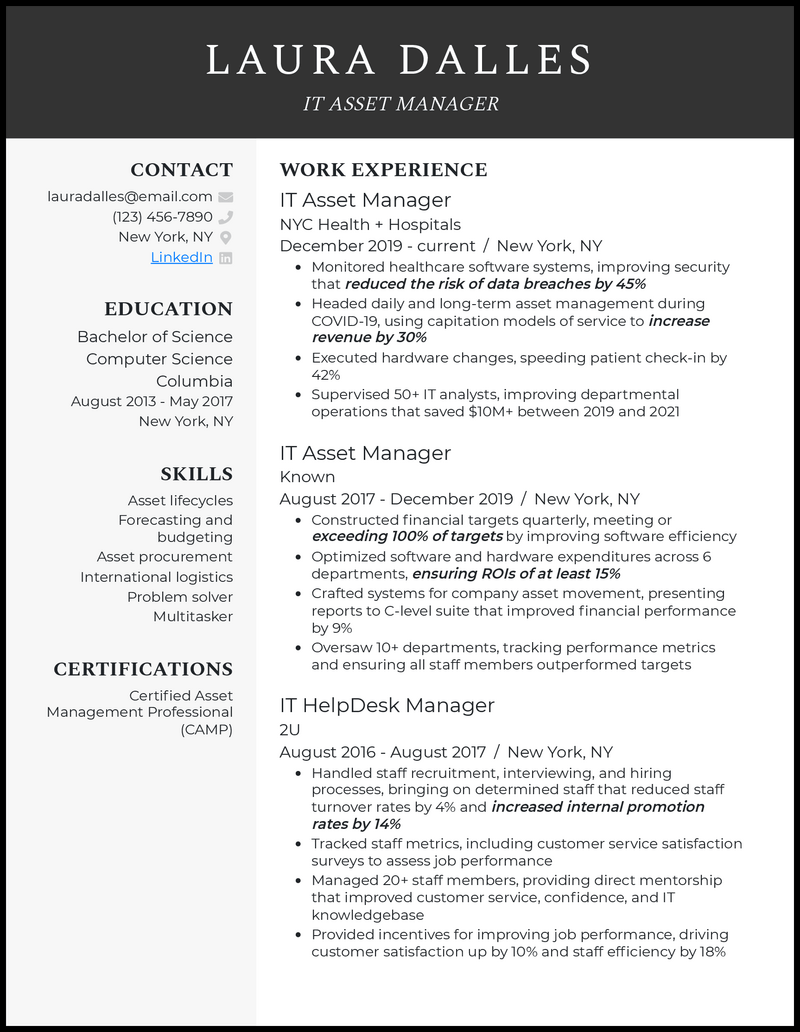
A standout IT asset management resume can be the key to unlocking roles that demand both technical precision and strategic foresight.
Whether you’re transitioning roles or refining your professional story, this guide helps you craft a compelling narrative—especially when paired with a well-written AI cover letter—to position yourself as a high-value candidate.
Here’s what we’ll cover in this guide:
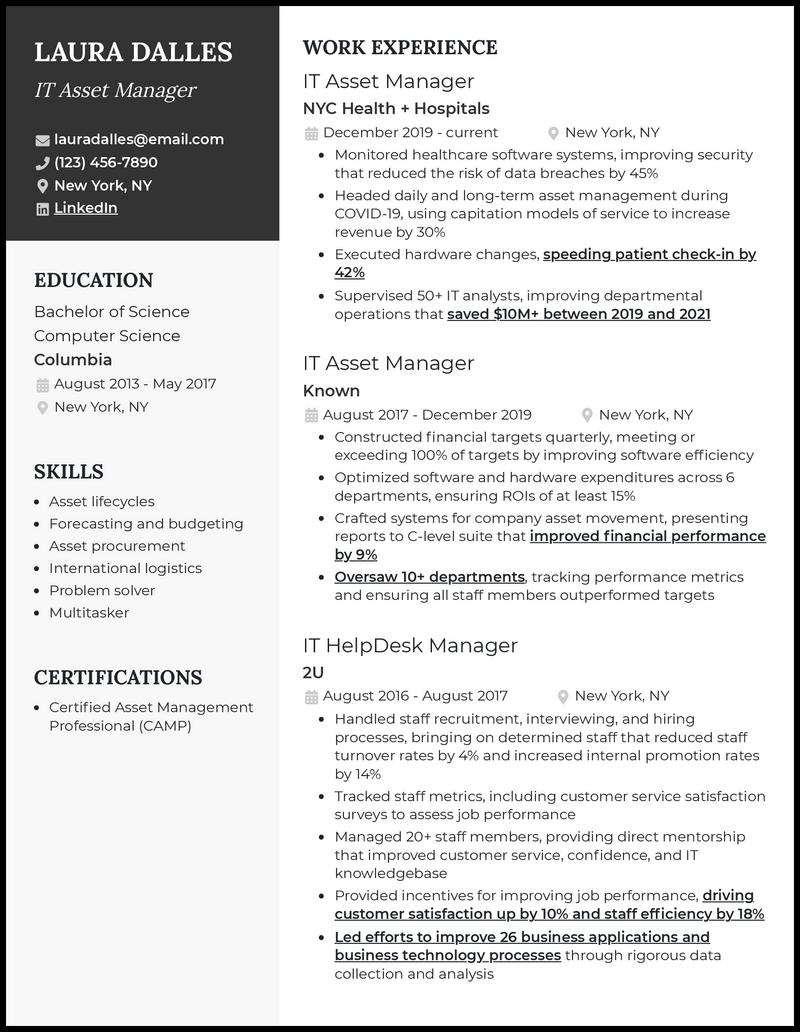
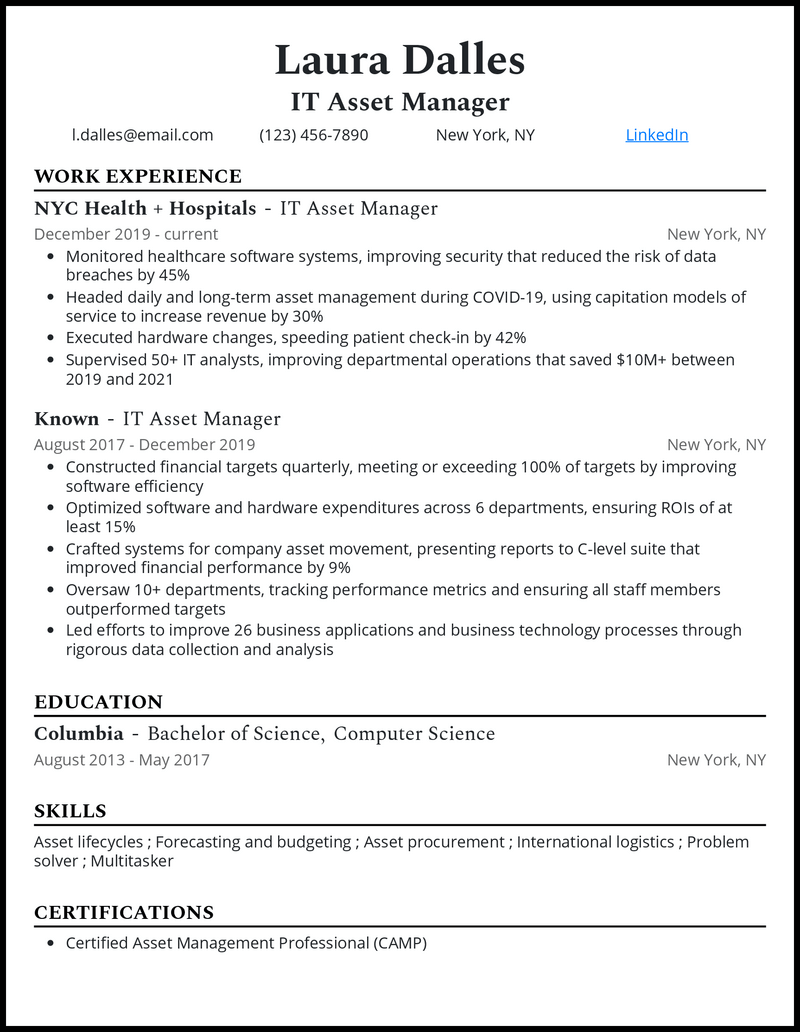
- ↪ 3 real-world IT asset management resume examples that showcase different experience levels and job goals
- ↪ Proven techniques to make your achievements more marketable, not just listed duties
- ↪ How to find a balance between technical skills and business value, so your effective resume appeals to both hiring managers and automated screeners

Related resume examples
How to Write an IT Asset Management Resume

Writing a strong IT asset management resume isn’t just about listing past roles—it’s about clearly showing how your work has driven results, streamlined systems, and supported broader business goals.
Summary
Elevate your IT asset management resume by aligning every section—from summary to skills—with clear, quantifiable results that prove your impact on efficiency, cost savings, and system performance.
This section walks you through the essentials of getting it right, from layout choices to using smart resume templates that help your strengths stand out fast.
Key elements to get right:
- Keep the format simple and easy to scan—clean lines, clear headings, and no clutter
- Show what you’ve actually accomplished by using numbers, outcomes, and before/after scenarios
- List tools and certifications you’ve used, like ServiceNow, ITIL, or any asset tracking platforms
- Call out technical skills that tie directly to the job—don’t assume the reviewer will read between the lines
- Start with a punchy summary that makes it obvious what you do, who you help, and how

Grab attention with a best-fit professional summary
Start your resume with a concise, targeted summary that immediately tells the hiring manager who you are and what you bring to the table.
This section should reflect your years of experience, relevant industries, and the unique value you deliver in managing IT assets.
Example
❌Experienced in asset management.
✅IT asset management professional with 7+ years optimizing hardware/software inventory lifecycles and reducing overhead by 34%.
If you’re not sure where to start, a resume summary generator can help shape a compelling intro based on your background and goals.

Showcase your IT asset management skills
Your expertise in overseeing IT resources and managing data is what makes you valuable to your team. In your resume skills section, you can demonstrate this by listing a mixture of skills you have and the tools you use.
Highlighting your proficiency with tools like ServiceNow ITAM or Microsoft SCCM helps validate your expertise and show industry knowledge. If the job description you’re applying to asks for experience with a specific tool, make sure you include it at the top of your list.
Don’t forget to emphasize your leadership skills in mentoring and training junior asset specialists, plus your vendor management experience and flair for reporting and analytics.
9 most popular IT asset management skills
- IBM Maximo
- ServiceNow ITAM
- Vendor Management
- Cost Optimization
- Microsoft SCCM
- Flexera FlexNet
- IT Procurement
- Risk Management
- Oracle Assets

Set a winning tone with your most outstanding achievements
Your skills as an asset manager lie in efficiently managing and optimizing your organization’s IT resources throughout the lifecycle, and your resume should highlight examples of your successes in this area.
It’s crucial to showcase your accomplishments and back them up with hard numbers that catch the eye of anyone who reads your resume. Phrases like “50% increase” are guaranteed to grab the recruiter’s attention and pique their interest—much more so than a complete lack of metrics.
Remember to cover all of the main areas of your role, like optimizing expenditure, improving processes, procuring assets, and leading teams. You can switch out bullet points depending on what each job description asks for, but make sure your core duties are always covered.
Here are a few examples to get things rolling:
- Optimized software and hardware expenditure across 6 departments, ensuring ROIs of at least 19% over 3 years
- Oversaw the consolidation of software licenses across departments, resulting in a 20% reduction in licensing costs and a 31% improvement in efficiency
- Streamlined the IT procurement process, reducing procurement cycle time by 37% and ensuring timely delivery of critical assets to support project deadlines
- Led a cross-functional team in the successful disposal of end-of-life assets, generating $100,000 in revenue from asset sales while adhering to environmental regulations

Power up your value with industry-specific active verbs
Avoid generic phrases like “responsible for” and “worked on.” Instead, use action verbs that match the language hiring managers and applicant tracking systems (ATS) are scanning for.
Words like implemented, optimized, audited, tracked, forecasted, and reconciled communicate initiative and expertise in IT asset environments.
Pair those verbs with clear outcomes to make your impact obvious. For example: “Audited over 4,000 assets across three data centers to reduce loss and improve tracking compliance.”

List your education
Your education section doesn’t need to be long, but it does need to be accurate and relevant. Include your degree, school name, and graduation year (unless it’s been more than 10–15 years).
If you took coursework in IT systems, project management, procurement, or data analytics, feel free to mention that. Even if your training isn’t directly in IT, you can position it well by emphasizing transferable skills and linking it to your hands-on experience.

Demonstrate credibility with certifications
Certifications are proof that you know your tools, your frameworks, and your field. For IT asset managers, top certs include ITIL Foundation, Certified Hardware Asset Management Professional (CHAMP), and Certified Software Asset Manager (CSAM).
Listing these upfront or in a dedicated “Certifications” section adds weight to your application—especially when parsed by automated systems. Make sure your resume is formatted cleanly so that a resume parser can easily extract these credentials.

Tailor everything to the role
No two IT asset management roles are exactly the same. That’s why you need to customize your resume for every job you apply to. Match the language of the job description and reflect the employer’s specific priorities—whether that’s lifecycle management, software compliance, vendor negotiations, or budget forecasting.
Use a resume job description match tool to compare your resume against the posting and identify gaps. A job tracker can also help you keep tabs on which version you submitted to which company, so you can follow up with confidence.
Top 5 tips for your IT asset management resume
- Show off your achievements
- Illustrate your ability to manage IT resources effectively by quantifying your accomplishments, such as reducing hardware and software costs by a specific percentage or improving overall productivity. Don’t be afraid to brag—instead, use financial figures and various KPIs to hammer down the point that you’re an effective IT professional.
- Highlight software license compliance
- Demonstrate your expertise in managing software licenses by providing metrics on maintaining 100% compliance with vendor agreements and minimizing legal risks through diligent tracking and auditing. Companies love an employee that can keep costs and risks down.
- Exhibit data-driven decision-making
- Emphasize your proficiency in data analysis and reporting by showing how your insights influenced strategic decisions, such as identifying cost-saving opportunities or streamlining procurement processes.
- Illustrate ITAM system implementations
- Feel free to get technical and detail the successful ITAM system integrations you have led, specifying the reduction in manual data handling and improvements in asset tracking accuracy you achieved. Technical recruiters will appreciate you going into detail.
- Quantify security enhancements
- Highlight your role in conducting security assessments to demonstrate your commitment to security and compliance. Include measurable results like the percentage reduction in security incidents to really make it pop.

Key takeaways
- Start strong with a clear, tailored summary
- Use active, specific verbs to show impact
- Include relevant education and certifications
- Match your resume to each job posting
- Make your resume ATS-friendly and easy to parse
IT Asset Management Resume FAQs

A great IT asset manager resume is tightly focused, easy to scan, and backed by real results. It highlights your ability to manage inventory, reduce waste, ensure compliance, and support business objectives through smart technology asset use.
Yes—ITAM software classes as an important technical skill for IT asset managers. Check the job description to see if they ask for experience in specific software and if they don’t, you can just mention the industry leader or the one you have most experience with, such as ServiceNow, Snow, or Ivanti.
Certification sections are a great addition to any resume. If you have relevant certs like the CITAM (Certified IT Asset Manager) or CSAM (Certified Software Asset Manager), you should definitely include them—pick a resume template that lets you add them in a separate section.
Resumes are most effective when they’re focused and concise. To achieve this, it’s always best to aim for a single-page resume and zone in on your varied skill set as an IT asset manager.
Because hiring managers skim quickly, your summary is your first and best chance to position yourself. It captures your expertise, key accomplishments, and value proposition in 2–3 lines, helping you stand out from the pile immediately.
This is where you list the hard and soft skills that qualify you for the job—things like ServiceNow, asset lifecycle management, compliance auditing, stakeholder communication, and procurement. This section is crucial for passing ATS scans and aligning with the job’s core requirements.

Stephen is the co-founder and CEO of BeamJobs. Frustrated with the challenges he'd faced in his own job search, he left the corporate world to start BeamJobs with his brother. Drawing on firsthand experience with hiring and getting hired as technical talent, he started BeamJobs in 2020 to help qualified job seekers land interviews with less stress. Since then, more than 4 million people have built their resumes and cover letters on BeamJobs. Stephen's insights have been featured in notable outlets, such as Fast Company, Business Insider, Yahoo Finance, MIT, and Zapier. Learn more about Stephen.