



To land your first role as a social media manager, your resume should tell a clear, confident story about your digital instincts, content savvy, and growth potential.
This guide explains how to build a compelling entry-level social media manager resume from scratch (or even update your existing one) and emphasizes why writing an effective cover letter can strengthen your application.
What we’ll cover:
- ↪ Five entry-level social media manager resume examples that got real jobs
- ↪ What must be on your resume for recruiters to pay attention to your application
- ↪ Proven resume creation process tailored to first-time applicants in social media leadership roles


How to Write an Entry-Level Social Media Manager Resume

Were you the student who always knew how to promote university events on Instagram and Facebook? Or the trendy person that has worked in social media and has mastered the art of spreading the word? Or maybe just someone who simply loves sharing life’s best moments?
Summary
From social skills to past projects, create a trendy resume that keeps every hiring manager on their feet!
Saying yes to any of those questions makes you eligible to become an entry-level social media manager. But without a scroll-stopping resume? You’re just shouting into the void. You need to know how to write a resume that proves you’re the social media maestro!
Some key elements that you need to consider are:
- Career objective
- Skills
- Work Experience
- Education/Certificate

Share your profile handle & links
The first order of business is getting your details right. Keep in mind that normal social media gimmicks or language won’t work here. That means no “Joe” for “Joseph.” Spell out your name entirely and include:
- Phone number
- Address (city, state)
- Any relevant social links
Only add social links to your profiles if you also post previous employer recommendations, or if they contain your best work achievements.

Create your highlight reel: The career objective
This section right here is your elevator pitch and chance to hook the recruiter in a few lines. Think of it like an actual Instagram reel, you only get a few lines to convince the employer that the rest of your resume is worth reading.
Here’s an example of a well-worded career objective:
Example
Tech-savvy graduate passionate about fashion and social media, eager to become SBH Fashion’s next entry-level social media manager. With project experience in overseeing my university’s official social media and in-depth research, I bring analytical skills needed to create impactful marketing campaigns.

Emphasize your unique value through niche skills
Your skills are some of the most essential building blocks of your resume, especially at an entry level. Since they’re such key elements in painting a picture of your qualifications, you’ll need to make sure they’re relevant and specific.
Don’t use generic skills like “communication” that could apply to any job role. Instead, look deeper and consider what you use your communication abilities for and which tools you use to do it.
What programs do you use to reach your audience? What technical tools do you use to analyze data and share your findings with others?
Check out some examples of what we mean:
9 top entry-level social media manager skills
- MS Teams
- Slack
- Google Docs
- Hootsuite
- HubSpot
- Paid Advertising
- SEMrush
- Adobe Photoshop
- Adobe Analytics

Strategically position your most outstanding achievements from the past
Many entry-level applicants worry about making themselves sound credible once they reach their resume’s experience section. But don’t worry! There are plenty of ways to show solid examples of your value.
Obviously, you’ll want to pull the best experience points from any job you’ve had, even if it only loosely relates to social media. You can still include relevant experience points that used overlapping skills, no matter what your job was.
The best thing you can do to bolster your experience points (whether you pull them from previous jobs, internships, or school projects) is to quantify them. Use metric data to highlight the impact you’ve had.
Here are some examples:
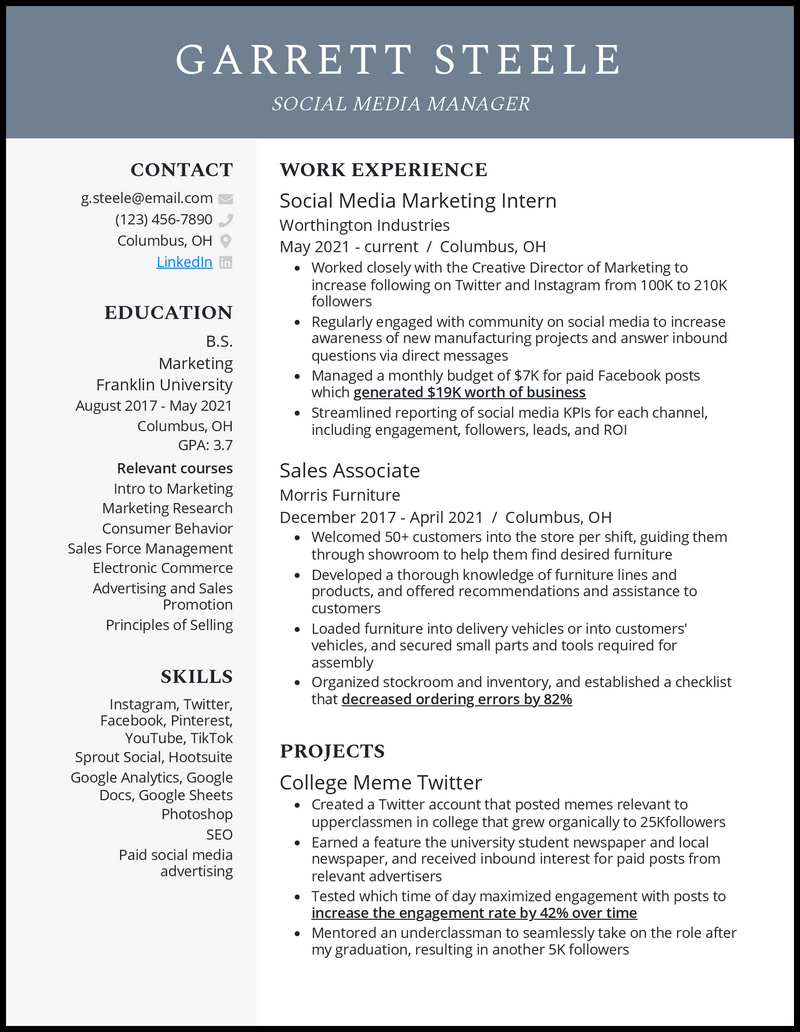
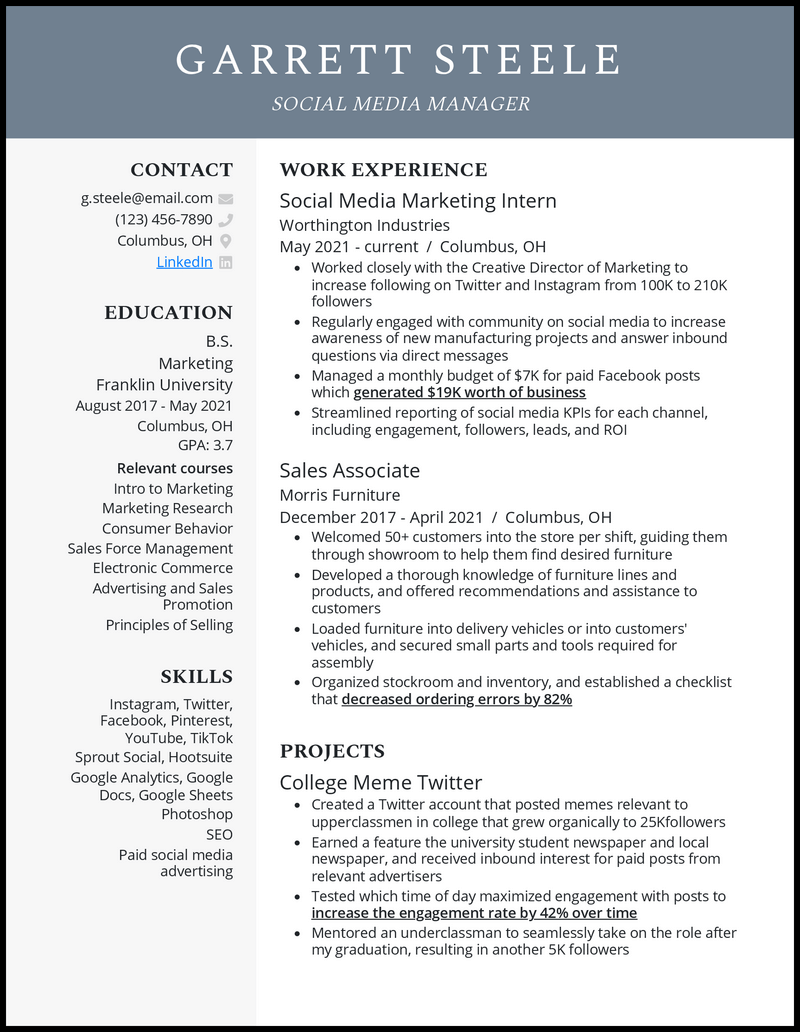
- Created Twitter account to post relevant content that grew organic follower count to 24.7K
- Tested which time of day maximized post engagement to increase engagement rate by 42%
- Organized inventory management system, establishing a checklist-based system that decreased ordering errors by 83%
- Managed a monthly budget of $7K for paid Facebook posts, generating $19K worth of business
- Worked closely with the creative director of marketing to increase following on Twitter and Instagram from 114K to 217K followers
This is just one way of crafting a strong resume objective. Ideally, you should begin with verbs/adjectives and avoid leading with personal pronouns. The list below contains a few suitable opening words:
- Motivated
- Detail-oriented
- Passionate
- Analytical
- Budding

Unlock the potentional in your past trending projects
Since you’re applying for a manager role, chances are, you already have work experience in social media. But in case you don’t, try including some of your best college projects. They don’t need to be things you only did in class; even group projects count.
Here are some different types of projects you can consider adding:
- Mock brand launch
- Social media case study
- Consumer behavior analysis
Don’t restrict yourself to these alone. In fact, read the job description thoroughly and see if the company requires real-world experience or allows internships/projects.

Don’t forget your creator credentials
Credentials are like customer testimonials of your personal brand. It shows employers that you’ve learned the necessary skills professionally in college/courses. Whether it be industry-relevant certifications or a bachelor’s in marketing, add everything that can add to your case.
A few certificates worth considering are:
- Social Media Marketing Certification Course (HubSpot Academy)
- Social Media Marketing Professional Certificate (Meta)
- Content Creator Professional Certificate (Adobe)
Top 5 tips for your entry-level social media manager resume
- Set off your resume with an objective
- For anyone who’s breaking into a new career or freshly graduated, a personalized objective could add some game-changing value to your resume. Just ensure that it provides fresh, non-repetitive info to make it worth the page space.
- Include relevant courses if you lack experience
- Your education section doesn’t have to be limited to your degree! Don’t let it get lonely: Add any other independent courses or certification classes you’ve taken that are relevant to social media management.
- Keep it professional
- We know it’s tempting to make your resume look cool with lots of colors and fancy fonts, but it’s really important to keep things readable. Recruiters won’t skim for long, so keep color minimal and fonts crystal-clear so that you’re taken seriously.
- Cover all the bases with a cover letter!
- A social media manager cover letter is the perfect place for you to expand upon how your resume bullet points qualify you for your dream job. Use your cover letter to tie in odd job experiences or other projects that have improved your social media management skills.
- One page only
- Your resume should always be limited to one page or less. And don’t worry, you don’t have to fill the entire page, either!

Key takeaways
- Package your potential in role-specific skills
- Tap your past for the best achievements that align with the job
- Put all your information in a professional, easy-to-review format
- Focus on the role you want
- Projects, internships, and volunteer work add to your impressive portfolio
- No room for errors
Entry-Level Social Media Manager Resume FAQs

Play around with various resume templates to see which ones make each section look the most powerful. You’ll want to minimize large areas of white space on your resume but still leave some breathing room.
The first step to getting hired is getting any kind of credential (degree or course certificate) and creating a strong resume. Once you find different job opportunities, you can use a job tracker to keep track of all the companies you’ve applied to.
Remember: Any objective statement must provide unique, fresh value. That means only new information about your personal abilities and background and no repeating bullet points from the rest of your resume! Always avoid redundancy.

Stephen is the co-founder and CEO of BeamJobs. Frustrated with the challenges he'd faced in his own job search, he left the corporate world to start BeamJobs with his brother. Drawing on firsthand experience with hiring and getting hired as technical talent, he started BeamJobs in 2020 to help qualified job seekers land interviews with less stress. Since then, more than 4 million people have built their resumes and cover letters on BeamJobs. Stephen's insights have been featured in notable outlets, such as Fast Company, Business Insider, Yahoo Finance, MIT, and Zapier. Learn more about Stephen.