



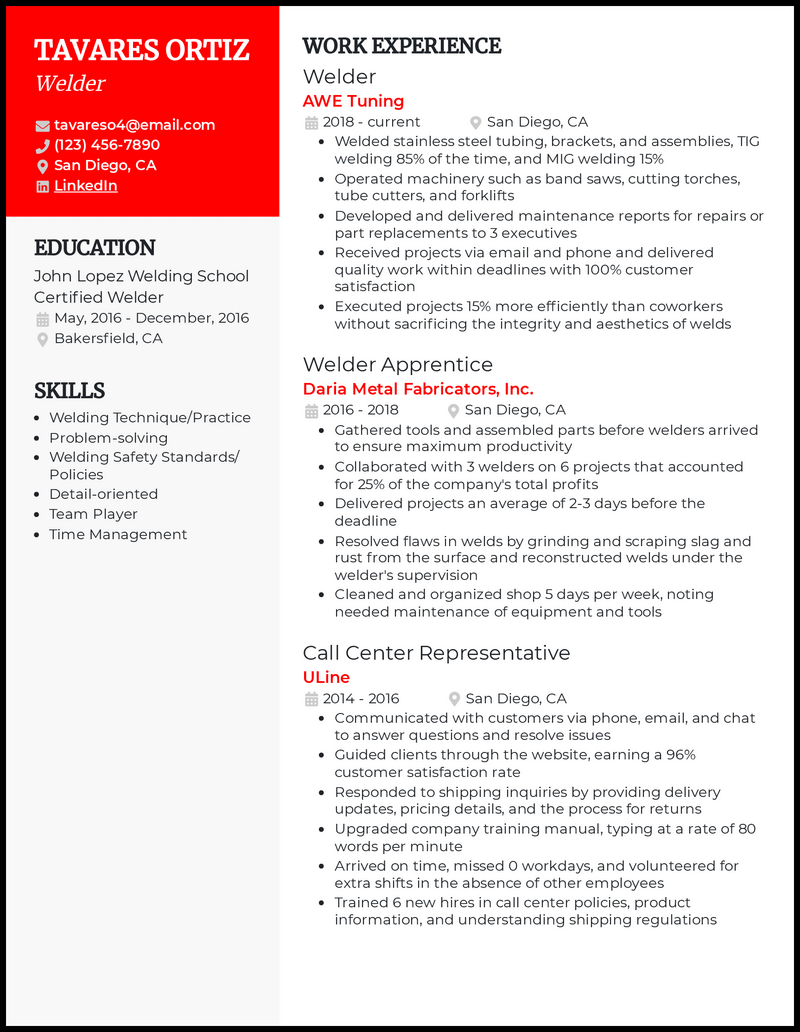
Writing the perfect welder resume means showing employers you’ve got the technical skills, certifications, and work ethic to get the job done right.
Use our expert tips, plus tools like a free cover letter builder and essential resume skills, to stand out from the competition.
Here, you’ll find:
- ↪ 9 job-winning welder resume samples
- ↪ How to organize all your career documents professionally
- ↪ Ways to show how your specific skills will benefit the company
Why this resume works
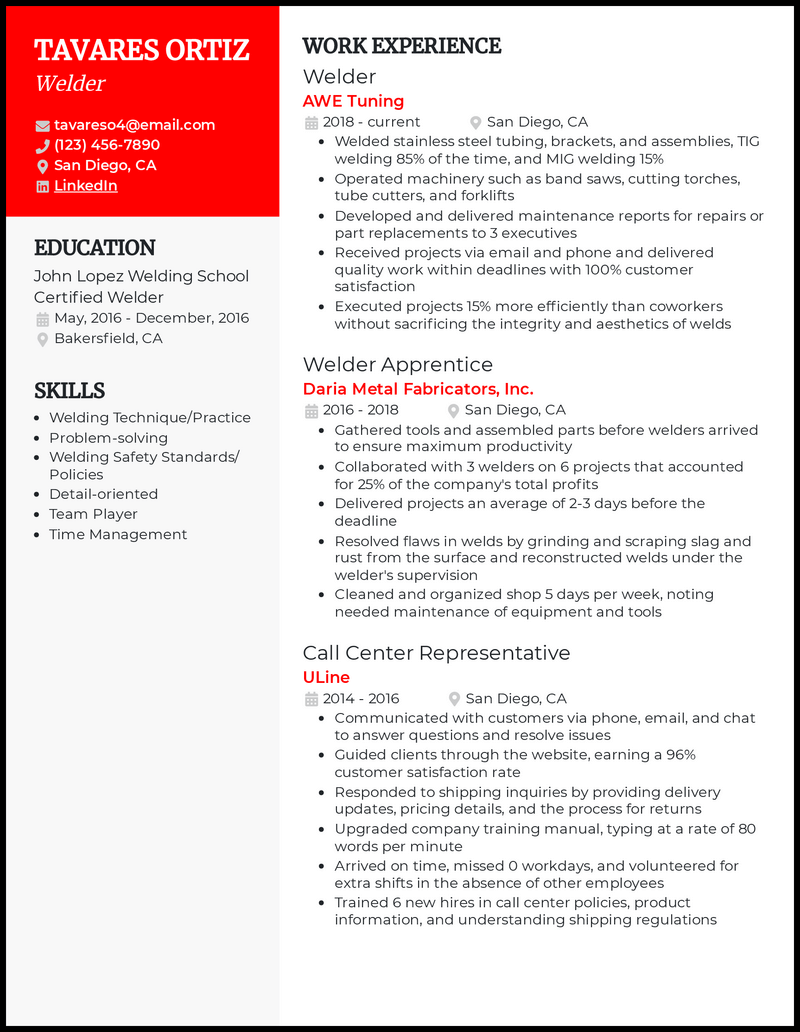
- Your “Skills” section should be evidenced throughout your welder resume’s progressing career history.
- For example, your “Skills” section might read, “experienced in various practices and techniques.” Looking through the contents of your resume, it should be easy to see your experience with MIG and TIG in various projects.

Why this resume works
- If you’ve been welding for a while, use your structural welder resume to show advancement, scaffolding responsibilities, and abilities from job to job.
- Under each position, include similar duties that demonstrate you still depend on and use your core background.

Why this resume works
- What are your thoughts about the template for this pipe welder resume? It’s structured precisely for recruiters to see everything they need.
- Besides, the highlighted achievements make it easy to follow things that matter most to the hiring team.
Why this resume works
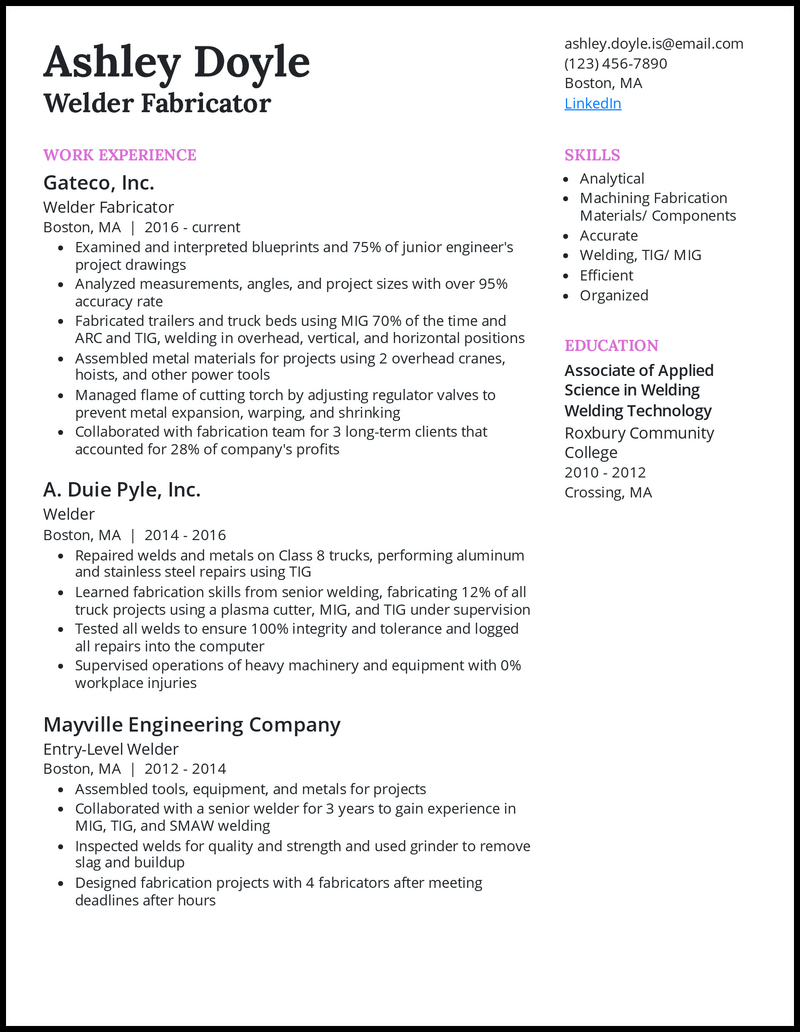
- If you have higher education in your field, include it in your welder fabricator resume. Welders who have certifications and education in the field may stand out among the competition, yet employers increasingly value proven skills over degrees.

Why this resume works
- Don’t simply focus on adding past relevant welding experiences in your MIG welder resume. Remember to have job-specific skills that no employer can afford to overlook. Include tools like the Miller Filtair 130 for fume extraction or the 3M Speedglas 9100 helmets for workspace safety.

Why this resume works
- Jessie’s welder helper resume deployed the assembler internship to showcase mastery in operating relevant tools and achieving impressive results. You can borrow a leaf from this approach.

Why this resume works
- Don’t shy away from showing some career growth in your shipyard welder resume. Add earlier roles like metal fabricator, where you only assembled basic structures, to your current level of handling full-scale welding tasks like quality inspections and managing junior welders.
Why this resume works
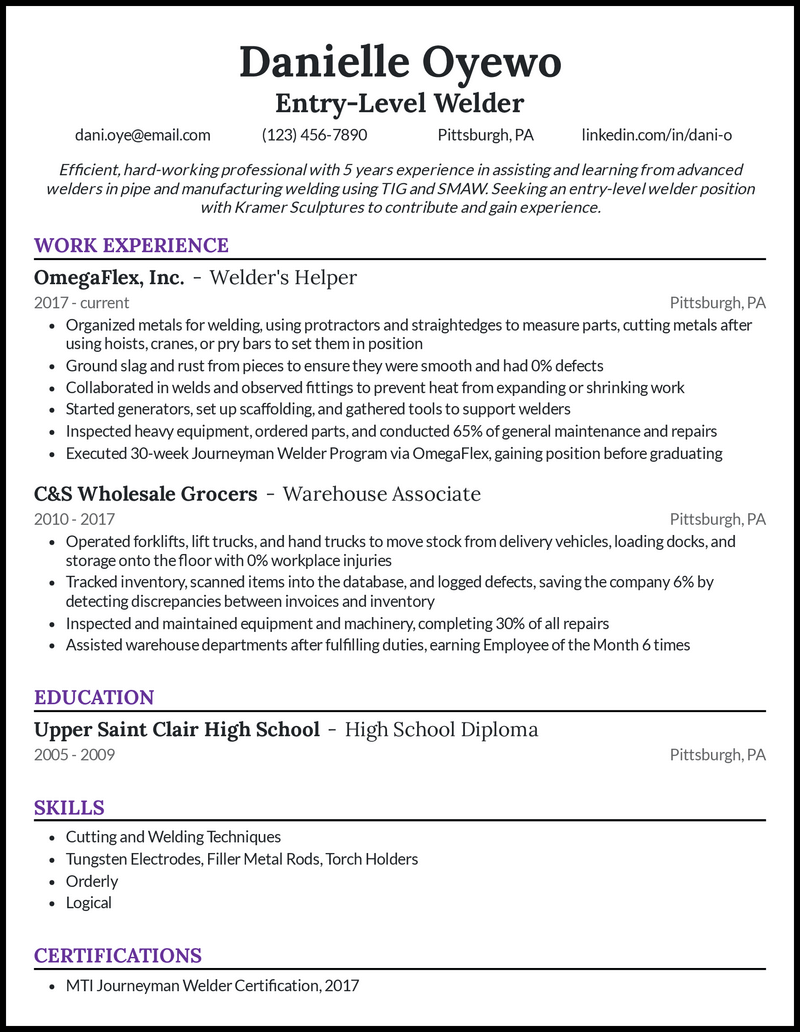
- The objective adds value to your entry-level welding resume when you advance or change careers. It’s appropriate to include an objective if you’re seeking an entry-level position and are coming from working as a welder’s helper, assistant, or apprentice.
- Here’s a ton of objective examples and a welder cover letterto get you started.
Why this resume works
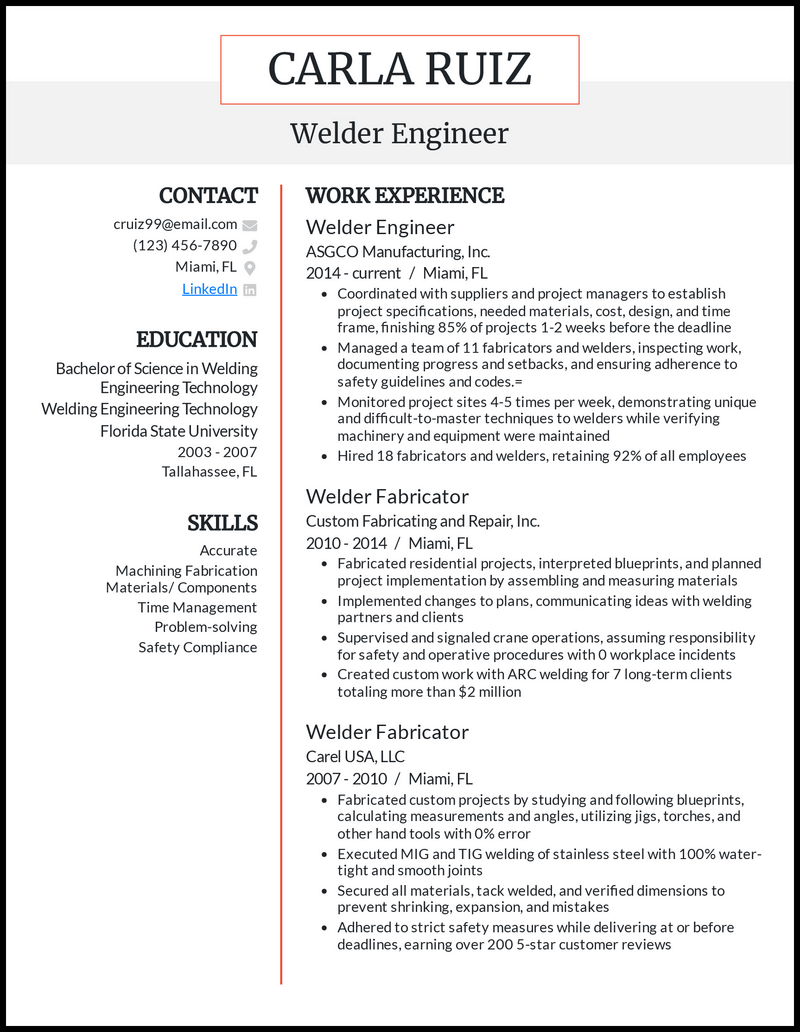
- Remember to add your education to your welder engineer resume. A welder engineer will need to prove they have the education, training, and background to do the job.
Related resume guides
How to Write a Welder Resume

A career in welding isn’t your average craft where you can fake your way up the pecking order; you must prove yourself through exceptional work. The precision and finesse of your pieces tell a story of a winner.
Summary
Forge a resume that sparks attention by showcasing your precision, grit, and technical expertise—designed to land interviews in the welding industry.
When you write a resume, inspirational stories have no place here. The number of your welds, accuracy rate, time saved, tasks completed before the deadline, and glowing reviews from many happy clients get you the job.
Here, we’ll show you how to make your craft nail the job without sweating. Adding each element of a welding resume one by one, let’s take your application from impressive to exceptional.
We’ll help you know how to:
- Use certifications like AWS or OSHA to show you’re qualified
- Confidently showcase your strongholds
- Highlight your hands-on skills without overexplaining
- Present your resume in a clean, professional format
- Bring your strong safety record front and center
- Make every part of your resume match what the job is asking for

Start with the right layout
A welder’s resume needs to mirror the qualities of good metalwork: structured, uncluttered, and strong under pressure. Use a reverse-chronological format to highlight your most recent experience, especially if you’ve been in the field for a few years. For those new to welding, a hybrid layout that combines your training and practical skills up top can put your best foot forward.
Keep margins clean, use a single professional font (like Arial or Calibri), use clear section headings, and present achievements in a skimmable way.
Want to avoid formatting stress? Try any of these resume examples for inspiration tailored to your trade.

Make a firm handshake with a resume header and contact information
How do clients know about your great work? By the first thing they see on your pieces. That’s precisely what you need to have on your resume. Put your resume header up first with the rest of these details to make the perfect connection with the recruiter:
- Your name
- Job title you’re in for
- Professional email, nicknames don’t belong here
- An active phone number
- City and state (optional, but helpful if applying locally)
- LinkedIn profile or personal website (if you showcase projects or certifications)

Grab attention with a professional profile
Your professional summary is your welding torch—ignite interest in a few strong lines. This is not the place to list everything. Focus on:
- Years of experience
- Specialty areas (MIG, TIG, Stick, Flux-Core, underwater, etc.)
- Industries worked in (construction, shipbuilding, oil and gas, etc.)
- Any safety certifications or standout qualifications
- A value statement—what do you bring to a team?
Example of a career objective for an entry-level welding resume

Struggling to write this part? Use a headline generator to spark ideas.

Impress with your hands-on skills
Less talk, more work is the slogan that defines the stellar expectations in the welding sector. You won’t pass the test if you don’t have the proper skill set to do the job.
Your technical chops have to align with the responsibilities the potential employer is looking to hire for. Whether it’s blueprint interpretation, MIG, TIG, or pipe cutting welding, you must prove yourself with work done with the same techniques.
Your soft competencies also have their say, though to a lesser degree. You have to lead a team, communicate with clients, supervise juniors, articulate reports on paper, etc. If the job expects these of you, you must present proof from past roles.
The right skills for your welder resume


Qualify your impact with metrics
Too often, welders undersell their work by only listing duties. Instead, show measurable impact.
Numbers matter—use them to back up your claims. Don’t guess. If unsure, estimate conservatively or speak in project scope (e.g., “fabricated steelwork for $2M commercial development”).
You can always use hard figures, but as long as you show your contribution and business impact, you’re on your way to getting the job.
However, don’t just throw metrics around because you can. Recruiters will put you to the test during interviews, and you won’t be the same invincible candidate you are on paper.
Example
✅Completed 150+ precision MIG welds per week, cutting rework time by 22% and saving the company $18,000 annually
✅Repaired and reinforced 124 feet of structural steel in 48 hours using TIG welding, restoring full safety compliance ahead of schedule
✅Trained 5 junior welders on blueprint reading and plasma cutting, boosting team output by 43% in three months

How about when you don’t have welding experience?
Your first winning strategy is to tailor your resume to each job using a resume-to-job-description match. How?
Find the most impactful outcomes from your projects, apprenticeship, training, volunteer work, and coursework. Look to what the job expects of you and match it to what you’ve achieved.
It’s also a great strategy to give your training the upper hand as long as it is directly related to the role and industry.

Include relevant training and certifications
Welding is one of the few trades where certifications can make or break your resume. Feature them prominently.
List your certifications under a separate section, and include the issuing body and year of completion. Training programs, trade school diplomas, and military welding experience are all valuable.
Example of certification for a Mig welder resume
🎓AWS D1.1 Structural Welding Certification

Key takeaways for your welder resume
Let’s revisit what you’ve learned here:
- Tailor each resume using tools like a job tracker or keyword matchers to get past ATS filters
- Use a clean, easy-to-read format that lets your experience speak
- Craft a compelling summary that highlights what you bring to the job
- Quantify achievements—let your work output do the talking
- Highlight certifications and specialized training to show you’re job-ready
Welder Resume FAQs

Yes. Whether you’re applying to a union job, an independent contractor role, or a manufacturing plant, a professional resume helps you stand out—especially when employers receive hundreds of applications. A resume shows what you’ve done and how well you did it.
It should be straightforward and clean—just like a good weld. Next, highlight certifications, techniques, and quantifiable achievements. Avoid long paragraphs. You can prove your worth through action: metrics, skills, and measurable results.
It must blend your experience, skills, one outstanding achievement, and the business value you would bring if hired.
For example:
“Seasoned MIG/TIG welder reputable for delivering 250+ welding projects ahead of time, cutting reworks 31%. Exceptional in quality control, Oxy-fuel cutting, and Plasma arc cutting, with a commitment to mentoring juniors to always meet the highest work standards.”

Stephen is the co-founder and CEO of BeamJobs. Frustrated with the challenges he'd faced in his own job search, he left the corporate world to start BeamJobs with his brother. Drawing on firsthand experience with hiring and getting hired as technical talent, he started BeamJobs in 2020 to help qualified job seekers land interviews with less stress. Since then, more than 4 million people have built their resumes and cover letters on BeamJobs. Stephen's insights have been featured in notable outlets, such as Fast Company, Business Insider, Yahoo Finance, MIT, and Zapier. Learn more about Stephen.