



![9 Landscape Worker Resume Examples [& Templates]](https://beamjobs.wpenginepowered.com/wp-content/uploads/2024/01/landscape-worker-resume.png)
In a competitive job market, don’t treat your resume as a formality—it’s your first impression and credibility, and often, your only shot at landing the interview.
This guide shows you how to build a professional landscape worker resume that instantly gets noticed, using smart tools like an AI resume builder and personalized AI cover letter support success.
Here’s what we’ll cover:
- ↪ 9 standout landscape worker resume samples
- ↪ The specific elements that dramatically improve your chances of getting hired
- ↪ Proven formatting, phrasing, and section strategies that recruiters actually respond to
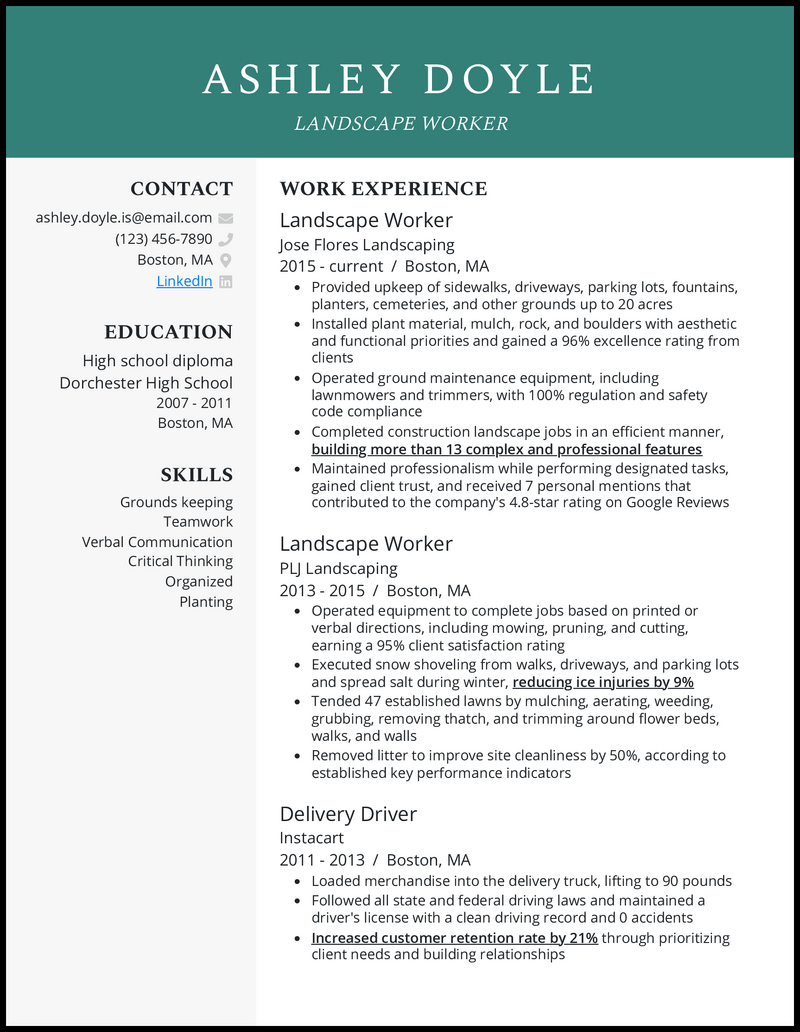
Why this resume works
- Your landscape worker resume should showcase your work experience. It should be clean, concise, and use active language. The work experience section is, arguably, the most important part of your resume.

Why this resume works
- Do you want to create a landscape designer resume that’s unique and personable? You must think outside the box and include something that will stand out and set you apart.
- How about including an achievement such as enhancing green spaces by 28%? No doubt, such an inclusion will catch the attention of recruiters.

Why this resume works
- If you have one, add a bachelor’s in landscape architecture degree to your landscape foreman resume. Not only does it serve as a testament to your knowledge, but it also shows that you’ve spent years honing your talent.
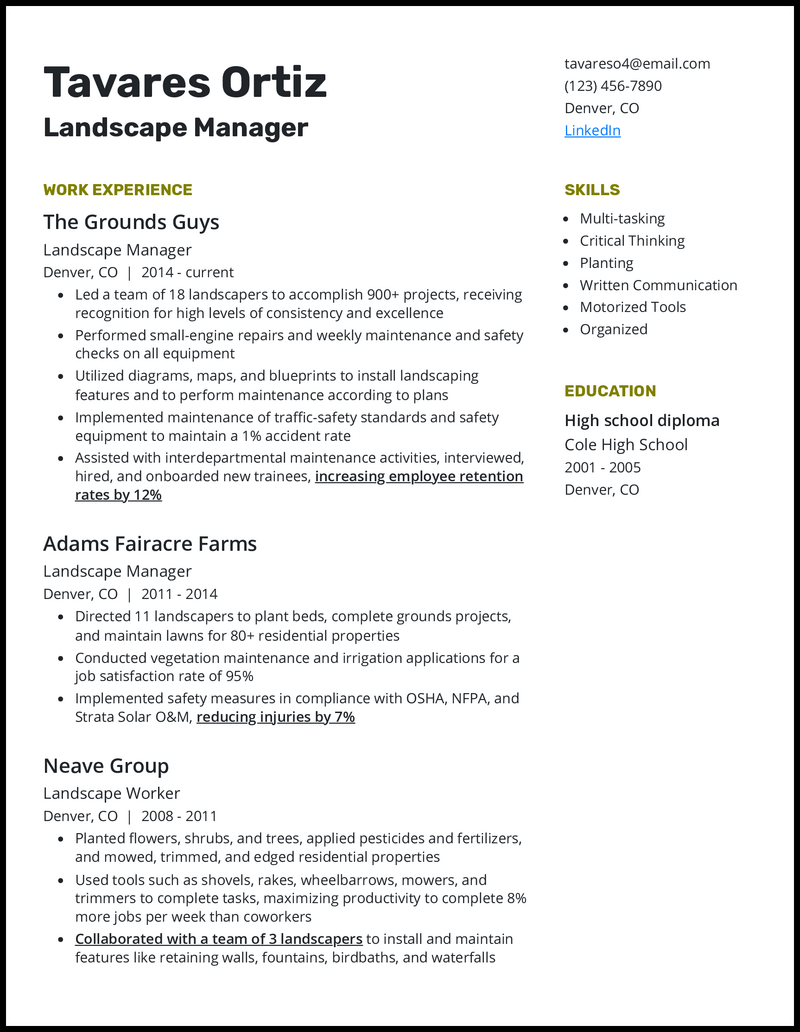
Why this resume works
- Your landscape manager resume should strike a balance between personalization and professionalism. A hiring manager may look at hundreds of resumes daily, so you want your resume to be visually unique.

Why this resume works
- For a landscape owner resume to win over and retain clients, you must stand out. In any case, you’re not the only one offering this service in your locality. Customers want you to go over and beyond the typical landscaping services.
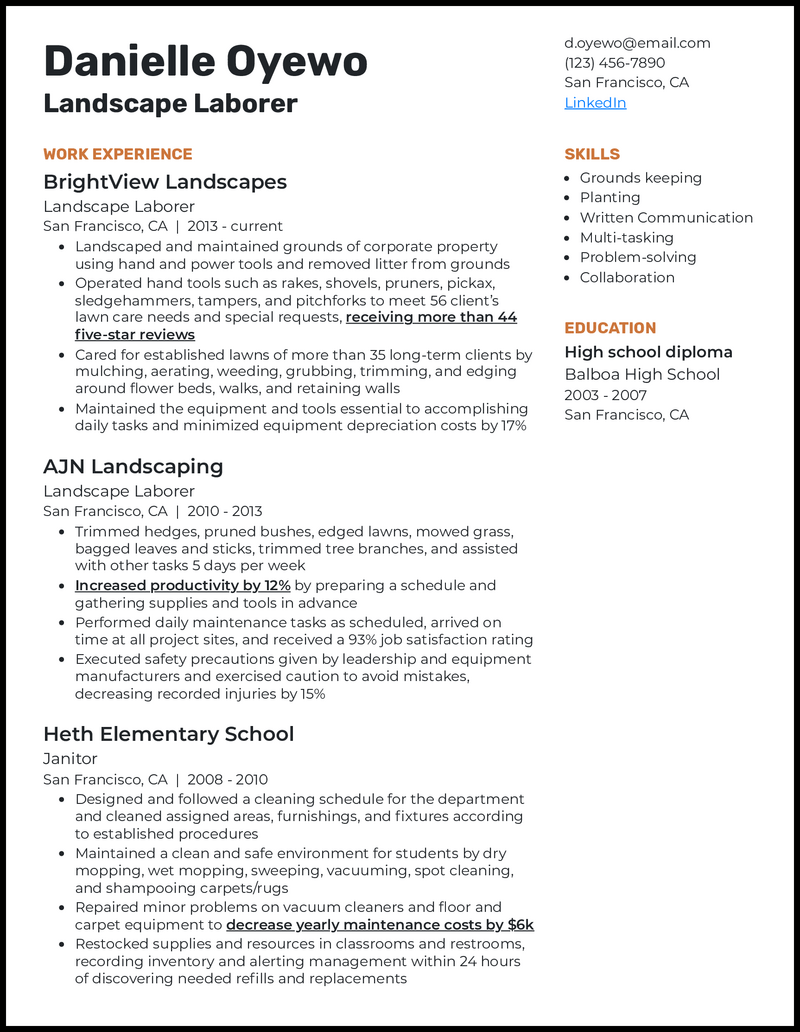
Why this resume works
- Even if your relevant experience is limited, the skills section for your landscape laborer resume can showcase your value. List technical skills for landscaping, people skills, and personal skills that impacted your previous employers.

Why this resume works
- Look at Anselm’s landscape supervisor resume and see how they’ve included industry-leading tools such as AutoCAD. Follow their footsteps to highlight that you’re well-equipped with the latest landscaping tools.
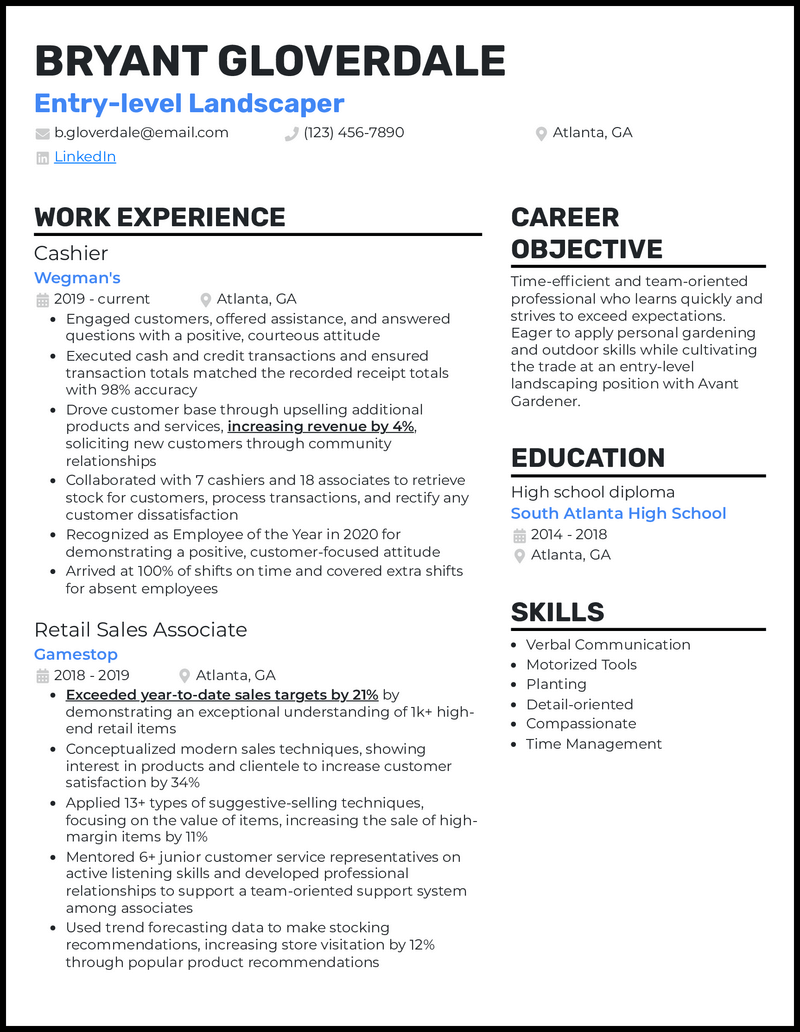
Why this resume works
- Your entry-level landscaper resume can do a great job of filling the page, even if you have limited experience. If you lack previous job experience, don’t sell yourself short. You still have skills, abilities, and expertise that can serve you and a future employer well in a landscaping job.

Why this resume works
- You can include a resume summary if you boast at least 10 years of experience in your field. Use it to highlight your specializations and offer a snapshot of your best self while customizing it to the target business.
Related resume guides
How to Write a Landscape Worker Resume

Your resume must do more than list jobs; instead, it must show hiring managers exactly why you’re the right fit—and fast.
Summary
Set yourself for success by crafting a landscape worker resume that highlights your hands-on skill, dependability, and the real results you bring to every job site.
In this section, we’ll break down what makes a landscape resume truly work, backed by practical resume examples and an expert resume checker to ensure your application is complete.
Here’s what we’ll cover:
- The most valuable landscape skills to highlight (beyond mowing and planting)
- How to present your hands-on experience that speaks directly to the job
- Proven resume format for a clean, scannable, and professional layout
- Why it matters to tailor your resume to each company and role
- Where and how to list education, certifications, licenses, or relevant training

Provide accurate and clear contact information
Leave recruiters with no doubt about how or when to reach you. Provide them with clear and accurate details for the following:
- Your first and last name
- Professional email address
- Active and current phone number
- Location (your city and state will suffice)
- And if applicable, your LinkedIn profile URL
Double-check for typos because a wrong digit could mean a missed opportunity.

Craft a compelling professional profile
By virtue of coming at the top third of your resume, your professional summary holds a lot of sway over whether a recruiter will read the rest of your resume.
This short but powerful segment should quickly introduce you, share your strengths, and align you with the expectations of the role. Therefore, let the 2-3 lines be about the value you would bring if hired.
If you’re having challenges figuring out what to write here, try a resume summary generator for ideas. However, customize the draft to mirror that position you’re going for.

Showcase your best outcomes from past roles
If you’ve been in landscaping, your work history has many examples you can use to demonstrate your value. Go through your career and identify the three most recent and relatable experiences.
For each experience, generate impactful bullet points paired with skills and active verbs to paint a clear picture of what you can do.
The best approach is to use the STAR (Situation, Task, Action, Result) strategy, which means accompanying every task with measurable outcomes.
Recruiters care about numbers, so instead of giving them details about your responsibilities, share your direct quantifiable results from the past.
Example
✅Revamped 28K sq. ft. complex with AutoCAD, cutting irrigation costs by $18K with native plants and drip systems
✅Supervised 38 projects, boosting client satisfaction by 33% and reducing labor time by 3.4 days

Align your skills to what the job needs
Recruiters are looking for specific skills for every landscaping role. Of course, there will be some points of convergence, but you must have most of the core skills for a landscaper.
To get this right, review the job posting closely for repeated phrases and keywords such as “irrigation system installation,” “turf maintenance,” or “team supervision.” Some of those words are what the potential employer cares most about.
Use a resume skills generator to see if your resume aligns with the essential competencies the job is looking for.

Include relevant education and certifications
You don’t need a degree to know your way around landscaping. Nevertheless, relevant training and certification can boost your chances of getting noticed ahead of other applicants.
From the start, let employers know if you have training in horticulture programs, OSHA certifications, or state-required licenses.
Leverage a tool like a resume parser to format this section correctly so it’s easy for ATS software to read and be noticed by hiring managers.

Format your resume to beat ATS and impress recruiters
Keeping the layout clean, scannable, and professional is the key to getting your resume read and impress a recruiter. Divide your content into clear headings, use consistent spacing, and apply the reverse-chronological order for your work history.
Images, graphs, and multi-column layouts are a no-no because they will confuse ATS systems. Here, simplicity and professionalism come above all else.

Reflect exactly what the job ad wants
Every job posting is a cheat sheet; you should study it keenly. Use as many key phrases, responsibilities, and skills as possible that they mention and work around them to match your background.
Be careful not to stuff your copy with keywords. The duty is to present yourself as a natural fit. Each of the tiny details can set you apart from tens of generic resumes.

Review your resume before submitting
Don’t be in a hurry to submit your resume. Set aside a few minutes to thoroughly examine your document to ascertain correct spelling, formatting, and consistency.
Remember, a final proofreading can determine the difference between an interview and silence from hiring managers.

Key takeaways
- Lead with your landscaping skills
- Show your competence with niche tools and software
- Focus your resume on the specific job you’re applying for
- Keep your formatting simple and clean
- Get rid of any errors before you submit your application
Landscape Worker Resume FAQs

A strong landscape resume should boldly show your strengths in a compelling profile, relevant work history with results, technical and soft skills, certifications, and clean formatting. Use role-specific examples to emphasize your fitness for the job.
One page is enough to pitch your value and have potential employers want you on their team. If you have over a decade of work experience, it’s acceptable to go beyond the page, but only if you add valuable information.
The primary responsibilities of any landscape worker include designing, installing, and maintaining outdoor spaces. Your daily tasks will include planting, pruning, irrigation setup, lawn care, hardscaping, and seasonal cleanup. For some roles, you will be involved in equipment operation and team supervision.

Stephen is the co-founder and CEO of BeamJobs. Frustrated with the challenges he'd faced in his own job search, he left the corporate world to start BeamJobs with his brother. Drawing on firsthand experience with hiring and getting hired as technical talent, he started BeamJobs in 2020 to help qualified job seekers land interviews with less stress. Since then, more than 4 million people have built their resumes and cover letters on BeamJobs. Stephen's insights have been featured in notable outlets, such as Fast Company, Business Insider, Yahoo Finance, MIT, and Zapier. Learn more about Stephen.