



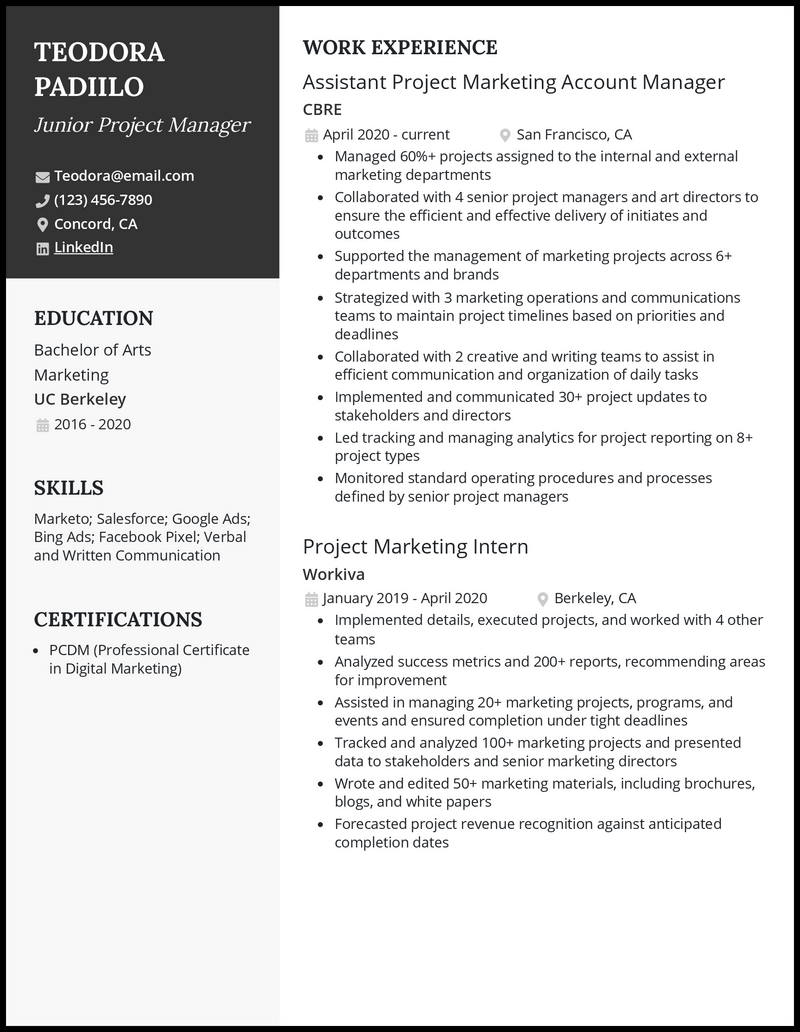


Junior Project Manager


Best for senior and mid-level candidates
Resume Builder
Like this template? Customize this resume and make it your own with the help of our Al-powered suggestions, accent colors, and modern fonts.
 Build my resume
 You need a standout junior project manager resume to secure more interviews and boost your odds of landing the job.
Here we will show you how to write a resume that gets noticed and share top resume tips to ensure that you move up in project management.
This guide helps you learn:
- ↪ Five junior project manager resume samples that actually work in 2026
- ↪ How to successfully advance in project management
- ↪ The top resume tips to get you noticed ahead of others


How to Write a Junior Project Manager Resume

To craft the perfect junior project manager resume, you must balance your project skills, leadership potential, and hands-on experience in a clean, compelling format.
Summary
Command attention with a junior project manager resume, showcasing your proven leadership traits, hands-on project skills, and a clean design optimized for what hiring managers and intelligent application bots are scanning for first.
In this section, we tell you the key things to include and how to ensure that recruiters don’t ignore you. It may also help to use a resume builder and a cover letter generator to ensure that nothing will hurt your chances of landing interviews and, hopefully, scoring the job.
What we’ll cover:
- Non-negotiable skills that set junior project managers apart
- Lining up experiences that make you the lead candidate
- The best resume format to emphasize your professionalism
- Leveraging action verbs and measurable results that show impact

Must have components for a junior project manager resume
A job-winning junior project manager resume should perfectly balance your leadership traits, technical capabilities, and clear potential to drive results—carefully done not to overwhelm the reader.
Be sure to include:
- Accurate and current contact information
- A brief professional profile
- Project management-related experience with proven measurable results
- Core skills
- Relevant education and certifications
To ensure you’re leaving nothing important out, check your draft through a resume keyword scanner to ensure alignment with what hiring managers and ATS tools expect.

The keys to formatting your resume right
Use a clean to frame your qualifications in the best possible light. You can rely on proven resume templates that prioritize legibility, consistent fonts, reverse chronological order, and smart use of white space.
The most important thing here is to avoid clutter and ensure the layout you use is scannable by humans and AI parsing systems.

Strive to meet what the job description is asking for
Your resume should mirror the job post it’s responding to—down to the phrasing, key skills, and contributions mentioned.
Tools like a resume job description match can ensure your resume reflects the potential employer’s priorities, so you’re not using language that gets flagged in hiring pipelines.

Deploy active words that present your ambition and potential in project management
You must be bold and confident when you package your experience in compelling bullet points. Therefore, use assertive, active language that shows you take initiative and own outcomes.
Verbs like “executed,” “streamlined,” “orchestrated,” and “delivered” at the start of each bullet point reflect confidence and future readiness.
Additionally, a quick resume review can help identify the use of passive wording, dulling your impact.

Emphasize your proper understanding and use of core tools
Even for a junior project manager, you must come out as someone who knows your way around the right tools and platforms.
Demonstrating mastery of tools like Jira, Trello, Asana, or Microsoft Project shows you’re ready to jump in on day one. Don’t just mention them; be specific about how you used them in the context of the outcomes.

Lead with project management skills
Some junior project managers worry about how to make their skills section look complete, but if this is you, don’t worry. You might be more qualified than you realize!
Look closely at the job requirements and search for anything you can do. You might have more skills than you thought, and simply need to articulate them better. Generic terms like “project management programs” aren’t too impressive, but specifics like Marketo and Bing Ads are.
Just make sure that anything you list (including soft skills) clearly relates to your field. Check out these samples:
9 best junior project manager skills
- Problem-solving
- Forecasting
- Data Reporting
- Marketo
- Salesforce
- Google Ads
- Bing Ads
- Facebook Pixel
- MS PowerPoint

Demonstrate your valuable contribution in every role you’ve served
Your work experience shows that you know how to turn knowledge into action! Recruiters need to get a nice, quick snapshot of your biggest achievements to know you can help drive a project to its successful end.
Make sure you describe each of your bullet points concisely and show that you’re eager to learn and grow. Your accomplishments should be highly relevant and easy to follow.
You’ll also need to back up your claims with data to build credibility. Sometimes metrics can be tricky if you’re new to your profession, but you can look for things like productivity rates or percentages that tie in nicely.
Here are a few samples from our resume examples:
- Tracked and analyzed 114 marketing projects and presented data to senior marketing directors, resulting in a 16% increase in productivity
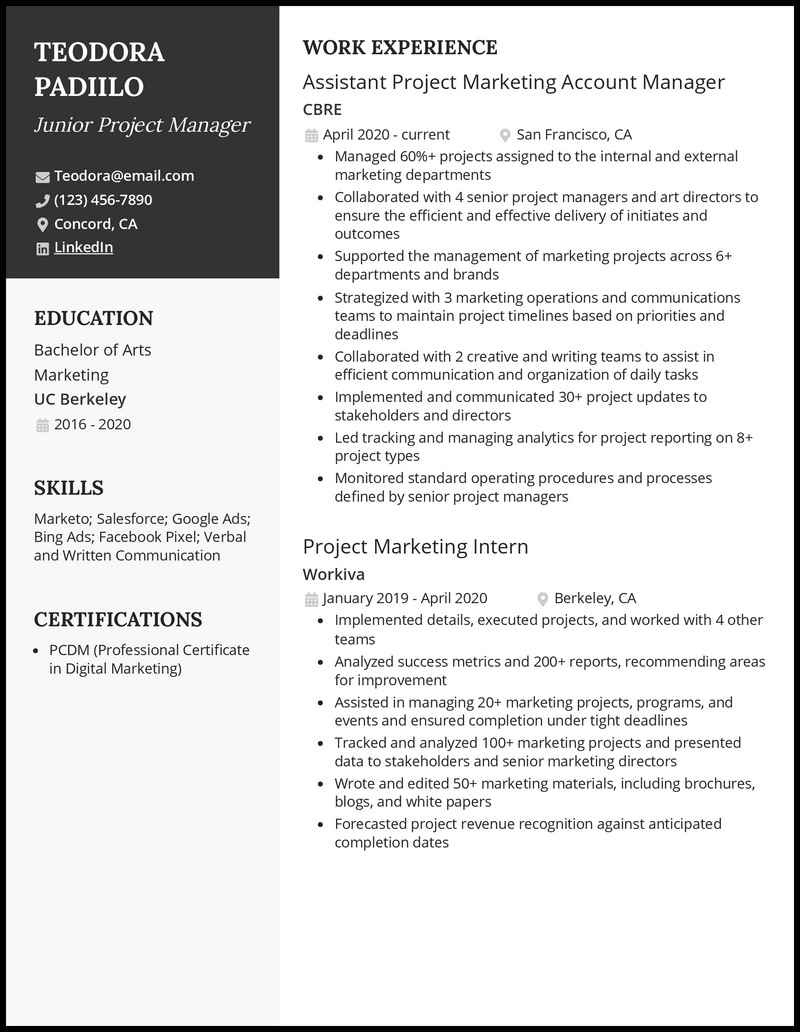
- Managed 60%+ projects assigned to the internal and external marketing departments
- Forecasted project revenue recognition against anticipated completion dates, empowering marketing team to exceed expectations by 12%
- Implemented and communicated 34 project updates to stakeholders and directors

Know when and how to take advantage of your education
If positioned strategically, education is an asset that can set you apart in your race for the job. If you’re a recent graduate, let your education section come in earlier than your relevant experience. However, if you have tangible experience in project management in any capacity, put your work experience ahead of your education.
Simply put, it’s a matter of knowing how to make the most of your qualifications to impress recruiters instantly.

Use certifications to stand out
Certifications are not aesthetics; they’re key to making a strong impression and proving your potential to excel in the job. They also show your passion and curiosity to learn and stay up-to-date with everything in the field.
Some relevant certifications for junior project managers include:
- CAPM®
- Scrum Master (CSM)
- PMP®
Top 5 tips for your junior project manager resume
- Keep it classy
- Your resume template, we mean. You want to come across as well put together and professional, so avoid overly flashy colors or strange fonts. Stick with clean, readable text and minimalistic color usage that speaks to your professionalism, even in a junior role.
- Show your certs
- You definitely don’t want to leave credentials like a Professional Certificate in Digital Marketing (PCDM) out of your resume! Make sure you include any other training certificates or independent courses that relate to project management, too, especially if it’s mentioned in the job ad.
- Nix the objective statement
- If you have enough experience via previous employers, internships, or even volunteer initiatives that tie in with junior project management, you probably don’t need one. If you include a resume objective, it should add fresh value that bolsters your qualification for the job role.
- Revisit the job ad
- When in doubt, always refer back to the job description! If you’re drawing a blank when it comes to hard vs. soft skills or which part of your experience to emphasize, match your angle, such as your chops in Asana, to what the project manager job requirements ask for, like managing teams via Asana.
- Don’t forget to proofread
- If your job history is looking a bit “airy,” then any mistakes or typos are bound to stand out all the more. Show your attention to detail and seriousness about the job by checking your resume as needed.

Key takeaways
Before you submit your resume, do a final check to ascertain the following:
- You’ve used an easy-to-scan layout
- Your draft closely matches the demands of the job posting
- Use of skills and experience to demonstrate impact
- Role-specific keywords and active verbs to align with the employer’s needs
- Leveraging education and certifications to stand out
Junior Project Manager Resume FAQs

Summarize your career, demonstrate how you use relevant skills to deliver impactful outcomes, include education and certifications, and format your draft in a clean, professional manner.
Stick with one page, and if you’re coming up short, consider adding internships or personal and academic projects that show you using your skills to complete the project lifecycle!
We’re sure you can find plenty: even volunteer projects could connect with the junior project manager role if you take the right angle with it and focus on skills that transfer well. If all else fails, opt for a resume format that makes your qualifications look fuller!
As a junior project manager, you support project planning, tracking, communication, and execution across cross-functional teams. You’ll often act as the organizational bridge between stakeholders and execution teams.
Use a modern, scannable layout with clear headings for each section to make it easy for recruiters and ATS to find relevant information. Hiring teams only spend a few seconds reviewing your resume, and you don’t want them to spend that time going through a cluttered one.
You bet! Taking that extra step to ensure you’re aligning as closely as possible with the individual job description is worth the time—not only in a resume but also when it comes to cover letter writing. Make it easy on yourself by looking for keywords or special skills, like negotiation, having a PMP certificate, or knowledge of Agile methodologies, that you can reflect in your resume.
Yes! Ensure that you display your transferrable skills from projects and internships, summarize your potential in an impactful summary, and make it easy for potential employers to see your passion and potential.

Stephen is the co-founder and CEO of BeamJobs. Frustrated with the challenges he'd faced in his own job search, he left the corporate world to start BeamJobs with his brother. Drawing on firsthand experience with hiring and getting hired as technical talent, he started BeamJobs in 2020 to help qualified job seekers land interviews with less stress. Since then, more than 4 million people have built their resumes and cover letters on BeamJobs. Stephen's insights have been featured in notable outlets, such as Fast Company, Business Insider, Yahoo Finance, MIT, and Zapier. Learn more about Stephen.