



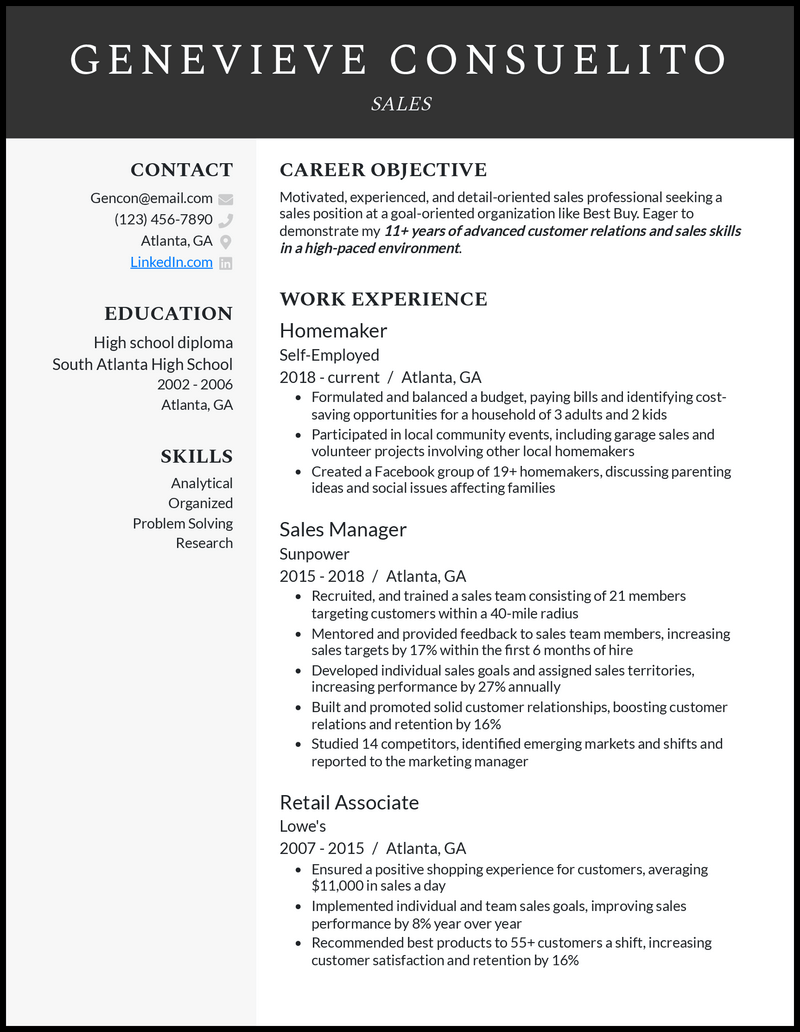
Are you ready to re-enter the workforce after time spent managing your home? The key to a successful transition is to write the best homemaker resume that defines your value—backed by practical resume examples and tips for creating an AI cover letter that completes your personable application.
Whether changing industries or restarting after a deserved break, you must present your homemaking experience confidently and clearly.
What this guide covers:
- ↪ 3 homemaker resume examples that landed real jobs
- ↪ Resume formatting tips to stand out and show professionalism
- ↪ Highlighting your transferable skills for the role you’re going after
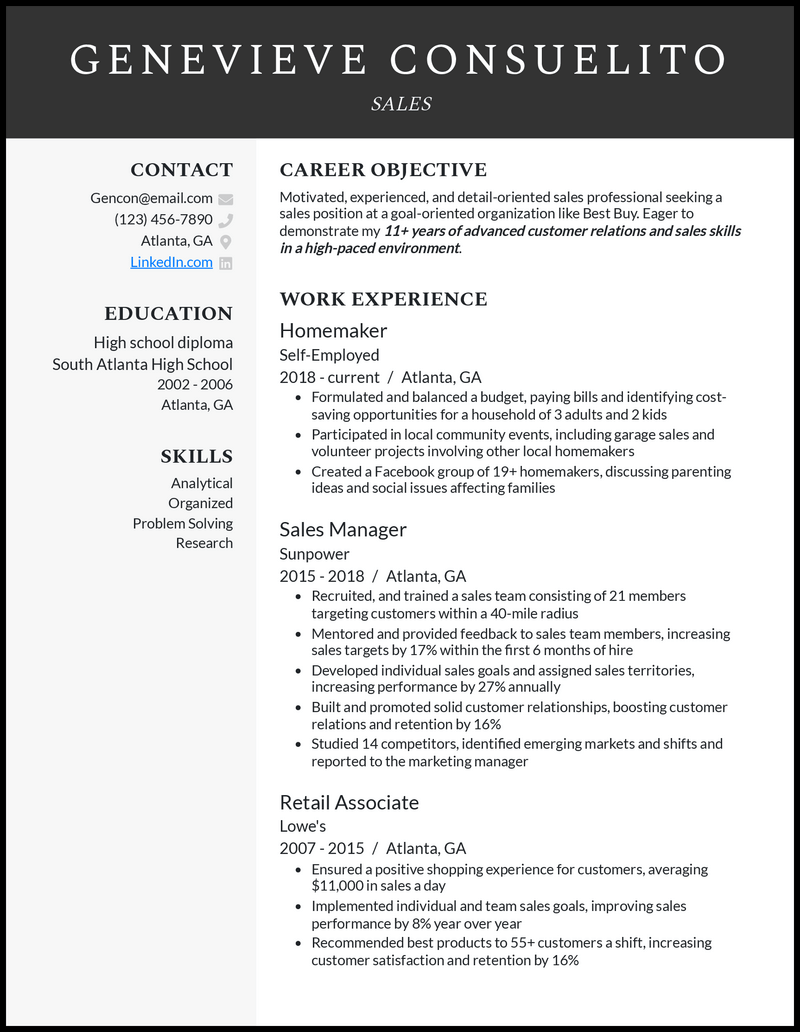
Why this resume works
- What’s going to set your homemaker resume apart from the average candidate is showing that you’re capable of doing more than just daily household activities.
- Be creative and include bullet points like creating a group to communicate with other homemakers and discuss key issues.


How to Write a Homemaker Resume

When crafting your homemaker resume, frame your everyday experience as valuable, marketable skills backed with quantifiable outcomes.
Summary
Elevate your homemaker resume by describing your home-management experience as valuable, job-ready skills. Use clean formatting, strong action verbs, and tailor each section to the role you’re applying for.
This section is dedicated to helping you confidently write a resume, choose the right templates, and leverage a resume checker to instantly polish your copy to impress recruiters.
Here’s what you’ll learn:
- How to format your resume for ATS and recruiters
- The most relevant homemaker skills employers can use to make a real impact
- How to describe your relevant experience in ways that match real job listings
- The must-have components (and what to leave out) to keep your resume concise and professional

Proven strategies to make your homemaking experience shine
Don’t treat your stint at homemaking as a gap. Instead, present it as a full-time role that equipped you with transferable skills that employers want.
The key is translating such experiences into professional terms, using formats and phrases that reflect recruiters’ mindsets and modern HR practices.
To do this right:
- Use phrases that emphasize professionalism: for example, don’t say, “Managed household;” say, “Oversaw daily operations and logistics for a six-person household.”
- Align transferable skills to the expectations of the job: Time management, budgeting, multitasking, conflict resolution, and scheduling are all directly applicable in almost every workplace.
- Turn responsibilities into valuable accomplishments: Metrics are the fuel that your value rides on. Show how you save money and time, boost efficiency, resolve conflicts, etc.
- Format your resume right: You may be creative, but that’s not what you need here. A simple, professional, and clear layout will boldly deliver your content to hiring managers. Use headers to separate sections, and be consistent throughout.

Address career gaps honestly
Be upfront if you’ve been out of the workforce for a while. Describe what you did, and relate what you learned to a real job.
Please focus on the competencies you’ve gained, your results, and how they relate to your new job. Honesty breeds trust, and homemaking adds credibility to your professional story when framed well.

Highlight your top transferable skills
Hiring recruiters look for well-rounded individuals who have what it takes to thrive in the workplace. As a homemaker, you’re well-versed in last-minute changes in plans, and you’re a dab hand at making do and making it work in a pinch.
To make your best resume, demonstrate how you picked up skills essential to managing a home, and show how those skills apply to a work environment.
Here are a few of the top skills recruiters are looking for in homemakers.
9 Top Homemaker Skills
- Money management
- Conflict resolution
- Customer service
- MS Office
- Time management
- Housekeeping
- Research skills
- Problem-solving
- Adaptability

Share measurable achievements from relevant work experiences
Depending on what you were responsible for when you were at home, the possibilities are endless when it comes to work experience bullet points. What’s important is phrasing it to suit the role you’re applying for.
Since homemaking experience can be vague, adding quantifiable metrics can help recruiters better visualize the impact you made.
Here are a few samples:
- Formulated and balanced a budget, paying bills and identifying cost-saving opportunities for a household of 3 adults and 2 kids
- Participated in 17 local community events, including garage sales and volunteer projects involving other local homemakers
- Created a Facebook group of 19+ homemakers, discussing parenting ideas and social issues affecting families
- Coordinated medical appointments for all 5 family members and follow-up with healthcare providers for the past 9 years

Make your education count
Be it a high school diploma, college degree, or trade certification, find space for it in your resume. If it was a long time ago, don’t include dates to keep the focus on relevance.
If you took relevant professional courses while managing your home—remotely or in person—add those as well. They show your initiative and commitment to growth.

Certifications amplify your credibility
Certifications can fill your experience gap, especially if you earned them during your stay from the workforce.
Credentials in bookkeeping, CPR, project management, or digital tools can show you remained active and signal readiness to re-enter the job market.
Explore a tool like the LinkedIn Resume Builder to add certifications and sync them with your online profile.

Leverage projects and volunteer work
Volunteer work and unpaid projects can play to your advantage when the time comes to re-enter the real job market after a break.
You can turn running a school fundraiser, managing a family budget, organizing community events, or helping with a local nonprofit into sources of professional value.
Package them as you would real jobs by describing your work and achievements and mirroring them to the role you’re targeting.
Top 5 tips for your homemaker resume
- If your experience is fewer than 10 years, keep your resume to one page
- This depends on the ratio between your active working years and your homemaking years. If you’ve been at home for more than five years, your work experience might not be as relevant to the current job market. When in doubt, we suggest playing it safe and keeping it to one page, preventing reader exhaustion and improving your chances.
- Generic skills sections can be made specific in your work experience section
- Show how you applied a skill in a specific way using your work experience bullet points. Something like creating and maintaining routines for your kids can demonstrate time management and adaptability within a context that might be relevant to your next job role.
- Add a career objective to give your resume more direction
- Two to three sentences explaining what you have to offer and what you’re trying to do can help your reader focus on your plans for the next chapter in your life. It can also help pad out your resume if you have too much blank space. Make sure you write a tailored objective to the role you’re applying for.
- Include any additional work experience you might have in your resume
- If you were active in community efforts or you had the chance to volunteer or freelance, all of these apply to your work experience section. Boost your bullet points with any positions or responsibilities that you held.
- Adjust your resume to the job description
- Job postings often have clues as to what the employer is looking for, so take some time to edit your resume to match the language used in the description and requirements. While you may not check all the boxes, your time as a homemaker may give you a unique perspective that your employer might appreciate.

Key takeaways
- Present your homemaking experience in a way that reflects job-readiness
- Combine metrics and action verbs to turn duties into accomplishments
- Address employment gaps confidently and honestly
- Highlight education, certifications, and volunteer work that support your goal
Homemaker resume FAQs

While you may not have specific technical skills, you most likely still have transferable skills that are common across industries. You can include these as bullet points under your skills section, or you can also add explanations to these skills showing how you applied them in a way that’s relevant to the job description.
Yes, you should, and any good resume template will feature this section! It might have been a while, but education is always a plus in lieu of traditional working experience. As a homemaker’s resume is similar to an entry-level resume, this information is welcome, as it can help recruiters get a better picture of your employment capabilities.
Certifications can sometimes help you get a foot in the door as they function as a tangible verification of your skills and abilities. An industry-specific introductory course or two can help you get familiar with employer requirements. You can also get certified in something like Microsoft Office to show that you have the technological know-how necessary in the digital age.
Use your homemaker resume to clearly communicate your transferable skills, present your experience, and show your ready-to-work attitude. Ensure you include all the key sections: experience, skills, and education, and put everything in a simple, professional layout.
A complete and impressive header for your homemaker resume must include your job title, name, and accurate contact information. This section will convince the recruiter of your professionalism, and they will read the rest of your document.

Stephen is the co-founder and CEO of BeamJobs. Frustrated with the challenges he'd faced in his own job search, he left the corporate world to start BeamJobs with his brother. Drawing on firsthand experience with hiring and getting hired as technical talent, he started BeamJobs in 2020 to help qualified job seekers land interviews with less stress. Since then, more than 4 million people have built their resumes and cover letters on BeamJobs. Stephen's insights have been featured in notable outlets, such as Fast Company, Business Insider, Yahoo Finance, MIT, and Zapier. Learn more about Stephen.