



![5 Entry-Level Security Guard Resume Examples [& Templates]](https://beamjobs.wpenginepowered.com/wp-content/uploads/2023/06/entry-level-security-guard-standout-resume-example.png)
Your entry-level security guard resume must define you as dependable, ready for action, and dedicated to people and property safety.
Using a clear resume template, a reliable resume builder, proven resume examples, and a practical cover letter generator will help you present your strengths in a way that employers notice.
In this guide, you’ll find:
- ↪ 5 entry-level security guard resume examples to shape your own application
- ↪ Tips to stand out even if you have little or no direct experience
- ↪ How to position yourself for success throughout the hiring process
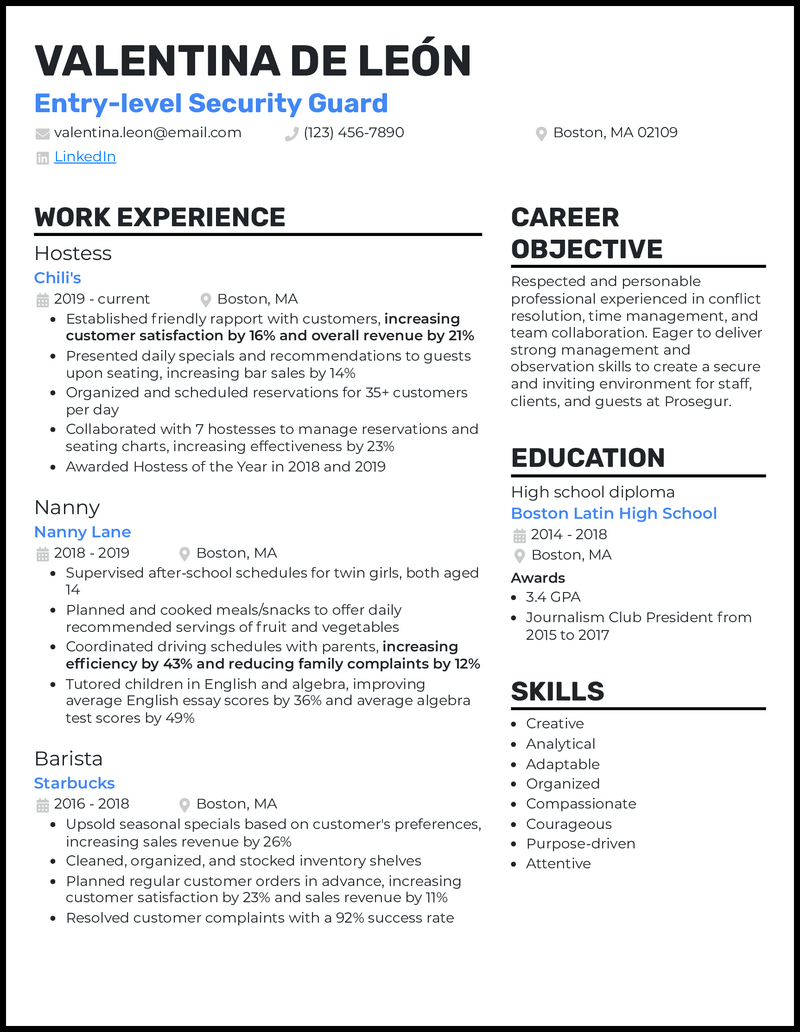
Why this resume works
- If you’ve never worked as a guard, draw out qualities from any past work/project experience that reflect must-have security guard skills like a strong sense of observation and conflict management.
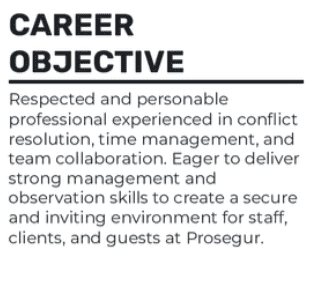
- Next, leverage the career objective section of your entry-level security guard resume to list down how you possess all the abilities required in a top-notch security worker.


How to Write an Entry-Level Security Guard Resume

Breaking into the security field starts with writing a resume that presents you as alert, trustworthy, and capable—even if you don’t have direct experience.
Summary
Command attention with a resume emphasizing your reliability, readiness, and commitment to protecting people and property.
Confidently showcase job-readiness through transferrable skills, relevant certification, physical and health fitness, and other qualifications listed for the role.
Here, you’ll learn:
- How to write a compelling security guard career objective that grabs attention
- How to leverage your past work experiences and transferable skills
- What education and certifications will boost your credibility
- Tips to tailor your resume for security guard job listings, even without experience
- Key takeaways to keep your resume clean, professional, and job-ready

Start with a career objective
Who are you? What have you done? What do you know, and does it matter? If you can answer those questions concisely, be ready to get an offer as soon as a recruiter reviews your resume.
Since you have little direct work experience and your education carries little weight, a brief snapshot of your skills, experience, and ambition will articulate your strengths and make an HR manager want to know more.
To ensure that you’re following the recruiter’s checklist, include a key phrase from the job description. A human recruiter will review your resume, which will also have to pass through applicant tracking systems (ATS).
Example of a career objective for an entry-level security guard:

Bring out your soft transferrable skills
Hiring managers reviewing resumes from security professionals will likely have some fundamental skills in mind they’re looking for in the position. However, when you don’t have much experience, you may wonder how to optimize for success in this area.
It’s often a great idea to be on the lookout for transferable skills and try to mix in some abilities listed in the job description. For example, risk assessment and conflict resolution capabilities can be transferred from many customer-facing positions where inventory loss or customer service are still a big deal.
Here are some popular entry-level security guard skills to put on resumes in today’s job market.
9 popular entry-level security guard skills
- Customer Relations
- Conflict Resolution
- Policy Enforcement
- Team Collaboration
- Building Safety
- First Aid
- Documentation
- Loss Prevention
- Surveillance Cameras

Leverage any relevant work experience
When applying to an entry-level security position, you’re probably also wondering how you can show your previous work achievements are applicable.
To help you stand out, try to use as many relevant metrics as possible, like reductions in inventory loss or customer satisfaction scores.
You can even pull examples from non-traditional work like volunteering, where customer service or inventory management would still be relevant experiences you could list.
Here are a few samples:
- Made an effort to greet every customer in a friendly and helpful way while stocking products to improve satisfaction scores by 34%.
- Kept track of inventory records while volunteering at a local hospital to reduce inventory loss or misplacement by 47%.
- Monitored entry access information and security cameras while managing the front desk to reduce unauthorized building entries by 76%.
- Reported any suspicious customer activity to supervisors while working the sales floor to reduce theft by 44%.

Include education and certifications
Education may not be necessary to nail this job, but it won’t hurt your chances if you say you went to school. Typically, a high school diploma or its equivalent is adequate. A potential employer wants to know that you’ve been through formal training and that your professionalism is unquestionable.
State what you studied, the school’s name, location, and period.
Certifications are equally important. They say you’re disciplined, committed, and dependable. Things like a guard card, CPR and First Aid Certification, and conflict resolution training prove you’re job-ready.
Top 5 tips for your entry-level security guard resume
- Consider an objective
- A two or three sentence resume objective can work well for entry-level applicants to display their most relevant abilities immediately. For instance, you could explain how you’ll apply your two years of customer relations experience to provide effective security while maintaining high levels of customer satisfaction.
- Proofread for errors
- Security guards must be vigilant and detail-oriented to get the best results. You can impress hiring managers in that aspect right away with an accurate and grammatically correct resume.
- Use reverse chronological order
- When you don’t have much experience, your most recent jobs will likely be the most relevant to your loss prevention and customer service abilities. Therefore, you should list your most recent jobs first on your resume to catch a hiring manager’s attention.
- Action words make examples more impactful
- Security guards must always have great response times and perform accurately at a moment’s notice. You can make your examples more impactful to show how you’ll perform by using action words like “monitored” or “reported.”
- Keep it organized
- When you write incident reports or security briefs, you’ll want to organize all the information for easy understanding. You should do the same with your resume to show how you’ll perform by using clear headers, 12-14 point font, and bullet points with key metrics.

Key takeaways
What did you learn here?
- Lead with a strong career objective to frame your value early—even with no experience
- List any certifications prominently, especially ones required by law or employer policy
- Use keywords from job postings to pass ATS systems and show alignment with the role
- Highlight transferable traits like reliability, vigilance, and communication
- Keep formatting clean and minimal, focusing on clarity and structure
Entry-Level Security Guard Resume FAQs

Include a clear career objective, education, certifications (like a Guard Card or CPR), soft skills such as attentiveness and calm under pressure, and any relevant experiences—even if they’re not formal jobs (e.g., volunteer security, event staff, military background).
Frame your soft skills through actions and outcomes. Avoid vague terms. Show how your soft skills directly contribute to safety, control, or teamwork.
Some examples of where you can showcase your interpersonal skills:
Maintained calm and gave directions during a school fire drill
Recognized for dependability during night shift volunteer work at community events.
Mandatory state certification for security guards, often called the Guard Card, should come first. Other optional but crucial certifications are CPR/First Aid Certification, De-escalation Training, Fire Safety, and Emergency Preparedness Training. Including these recognitions underscores your professionalism and dedication to your work.

Stephen is the co-founder and CEO of BeamJobs. Frustrated with the challenges he'd faced in his own job search, he left the corporate world to start BeamJobs with his brother. Drawing on firsthand experience with hiring and getting hired as technical talent, he started BeamJobs in 2020 to help qualified job seekers land interviews with less stress. Since then, more than 4 million people have built their resumes and cover letters on BeamJobs. Stephen's insights have been featured in notable outlets, such as Fast Company, Business Insider, Yahoo Finance, MIT, and Zapier. Learn more about Stephen.