



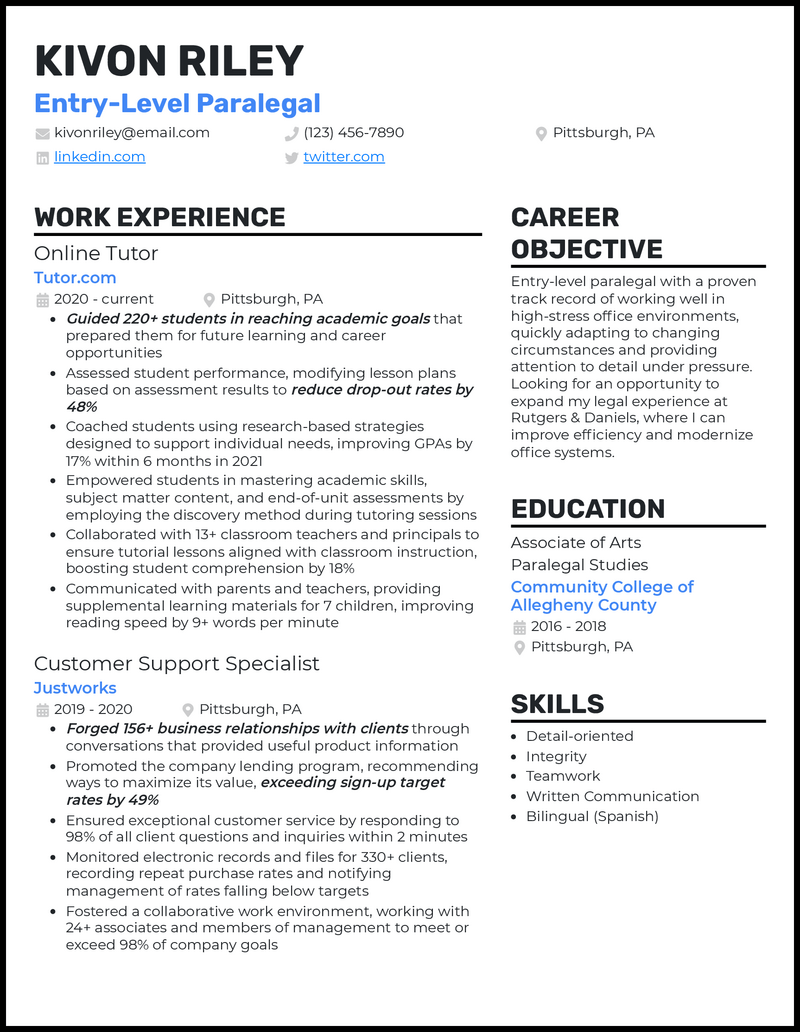


Entry Level Paralegal


Best for professionals eager to make a mark
Resume Builder
Like this template? Customize this resume and make it your own with the help of our Al-powered suggestions, accent colors, and modern fonts.
 Build my resume
 When building an entry-level paralegal resume, you need a strategy that emphasizes your transferable skills, related experience, passion, and potential for the role.
This guide will show you how to make a resume for free, use professional templates, and master organizing a resume so your application grabs attention even without legal experience.
Here’s what we’ll cover:
- ↪ 3 entry-level paralegal resume samples you can adapt fast
- ↪ How to overcome your lack of experience with clever positioning
- ↪ Ways to stand out by showing potential, passion, and transferable skills
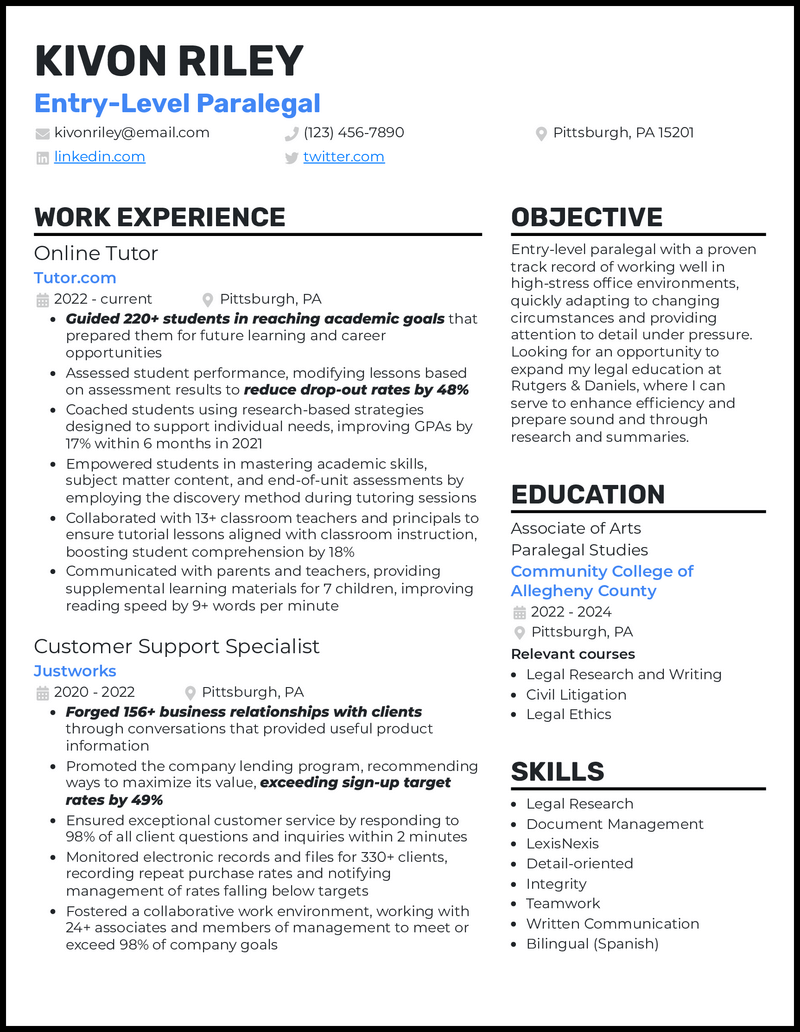
Why this resume works
- The demand for paralegals is indeed climbing. Yup, you read that correctly, but bagging that position in the face of a career transition requires you to be a cut above your competitors. And what better way to prove it than showcasing transferable skills in your entry-level paralegal resume?
- Go over the job description with a fine-tooth comb and pinpoint the several key skills the hiring company is after. Mention those competencies (cue online tutor and customer support specialist) in your “SKILLS” section and, if feasible, knit them into your work experience.

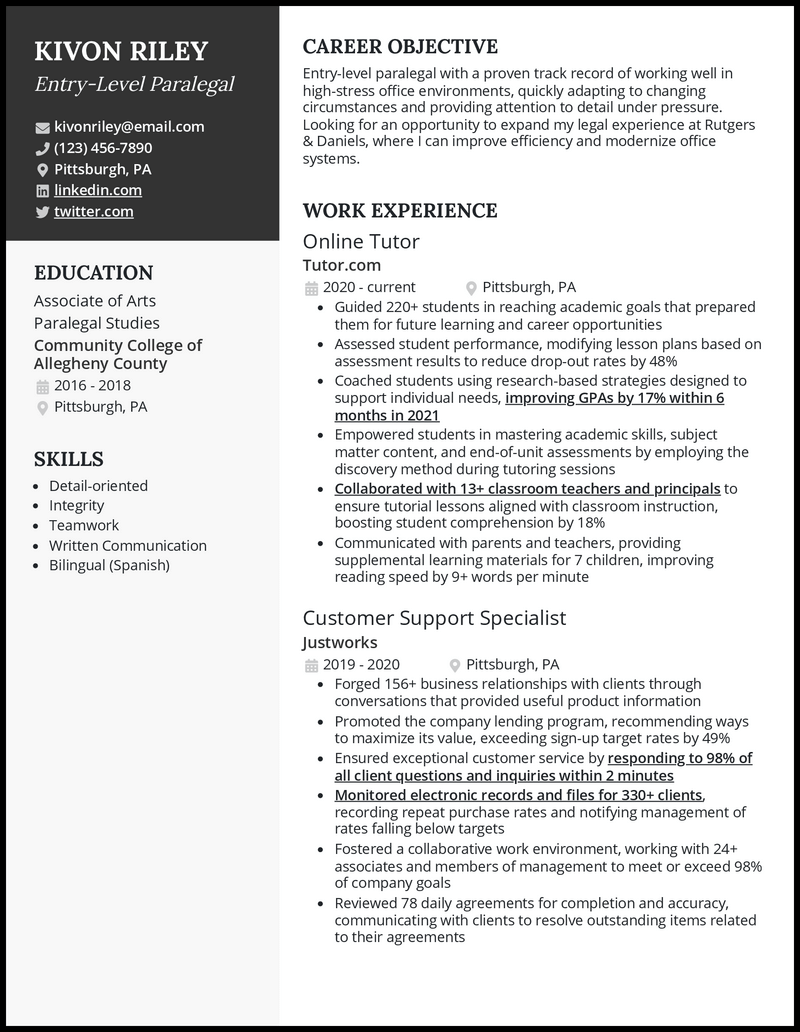
How to Write an Entry-Level Paralegal Resume

Entering the legal world where you’re surrounded by professional advocates at their best can feel intimidating, but that’s where most applicants crack, and you can succeed. Writing a confident entry-level paralegal resume will help you stand out from the crowd and prove you’ve got the hunger to grow in a demanding environment.
Summary
Suit up your entry-level paralegal resume to present your law expertise and commitment to help attorneys using strong projects/internships and legal skills.
Whether you’re just fresh out of law school or even an internship, this section is meant to help you know:
- Key components to make your resume stand out
- How to position your transferrable skills for a win
- Gathering relevant experience to impress recruiters
- Formatting your resume to win over ATS and impress recruiters
- Leveraging your education and certifications
- Tailoring your document to reflect everything mentioned in the job ad

Format your legal identity well
Attorneys want to know how they can reach out to you easily, so creating a professional contact information section is non-negotiable. Pay close attention to these personal details:
- Full Name
- Phone Number
- Professional Email Address
- Location
- LinkedIn Profile (optional)
This is almost similar to providing a business card to a legal client so make sure you don’t have any typos or errors here. If you’re unsure, consider using a spellchecker or resume scanner to spot any mistakes.
Bonus points for a link to a portfolio that shows your contribution in creating written briefs, research papers, or mock trial documents.

Draft a career objective that keeps justice on your side
As an entry-level candidate, the best way to summarize your career’s intent or goal is to use a resume objective. This 3–4 line section should briefly cover your best skills and reasons to apply. Just make sure you have the same details when creating a cover letter as well.
Example
“Passionate legal graduate with hands-on experience in law research, document drafting, and case file management for Malman Law. Eager to join Horwitz, Horwitz and Associates to support junior and senior advocates with diligence, accuracy, and a strong commitment to client service.”

What’s your legal apprenticeship?
The answer to that question will make up the work experience/projects section of your entry-level paralegal resume. Don’t count out internships or any volunteering stints either. They’ve likely given you transferable skills, which you can tailor to the job description.
A few good examples include:
- Paralegal Intern: Ever worked under an advocate or law firm and directly helped them with case proceedings or drafting documents? Write them down.
- University Projects: Recall any projects you’ve done in college. Research work with software, presenting real-life case studies with areas for improvement, or even group projects qualify to be here.
- Legal Volunteer: Did you partake in charity events to help them with legal logistics? Lending a hand to NGOs and nonprofits also count so don’t hold back from including details like scheduling client appointments or organizing legal records.

Balance your legal and soft skills for a complete profile
You may not have much (or any!) experience as a paralegal just yet, but that’s okay: Recruiters mainly want to see that you have the tools it takes to succeed at the job. Now’s your time to show off how you can leverage your knack for legal research.
Make sure your resume skills relate closely to your new paralegal profession, even if it comes from a different background—you can use plenty of overlapping skills to your advantage if you spin them the right way.
Turn stuff like “research” into “legal research” and “written communication” into “legal documentation.”
Back everything up with quantifiable data, too. Show metrics of your impact, like elevated success rates and reduced client response times.
9 most popular entry level paralegal skills
- Data Entry
- Legal Research
- Integrity
- MS Excel
- Critical Thinking
- Time Management
- Active Listening
- Data Organization
- Attention to Detail

Present your relevant work experience with clear impact
Okay, maybe not all your skills can say “Paralegal!” if taken out of context. But you can demonstrate the abilities from your skills list in your experience section via context. Show how your active listening skills helped reduce legal data entry errors or assist clients more effectively.
Use each bullet point to share an experience that aligns with entry-level paralegal duties: Pull in accomplishments that involve handling electronic records or improving customer/client satisfaction rates.
Oh, and get specific about your impact with metrics! Quantifiable data like error reduction percentages or customer satisfaction rates translate well and enhance credibility.
Here are a few examples:
- Fostered a collaborative work environment, working with peers and management to meet or exceed 98% of company goals
- Increased number of business-client relationships by 11% through active listening and personalized direction
- Ensured exceptional customer service by responding to 94% of all client questions and inquiries within 40 minutes
- Maximized company lending program value, exceeding target sign-up rates by 49%

Revealing your academic case files
This one’s pretty much a no-brainer—you’ve either studied law or you haven’t. There’s no in-between. Mention your law degree and year (or expected year) of graduation. In fact, what can really help here is adding coursework relevant to your practice: civil or criminal.
For instance, if you’re planning to become a criminal paralegal assistant, here’s how you can format this section:
Example
Associate of Arts in Paralegal Studies
Community College of Allegheny County
2022 – 2024
Pittsburgh, PA
Relevant Courses:
- Criminal Justice System
- Criminal Law and Procedure
- Evidence and Trial Practice
Top 5 tips for your entry-level paralegal resume
- Get creative with your experience
- Sometimes, showing off your experience can be tricky at an entry level. But you can bolster your credibility by using volunteer initiatives or college projects that use collaboration, communication, or legal research skills related to your new role.
- Try a career objective
- Not every resume needs an objective statement, but you can use one to sum up how your past organization or customer service experiences translate into excellent entry-level paralegal performance.
- Look professional
- Ensure your polished, professional content is taken seriously by avoiding loud colors or distracting fonts. Recruiters won’t spend much time reading about your amazing client response times if your resume template isn’t reader-friendly.
- Shine through a cover letter
- If you’re extra eager to prove your qualifications for entering the legal field, you can supplement your resume by writing a cover letter: Go into a bit more detail there about how your attention to detail and client needs align you with the new role.
- Focus on growth
- Even if you don’t have an extensive work history, you can still demonstrate an eagerness to grow by making your example points more complex as they become more recent.

Key takeaways
- Lead with your transferable skills
- Let your relevant work experiences show potential and value
- Use your education and certifications to seal the experience gap
- Volunteer work, internships, and projects are valuable assets
- Use a simple format that focuses on your strengths and not fancy designs
Entry-Level Paralegal Resume FAQs

As someone in the law field, your entry-level paralegal resume should be one page and professional. The Official template at BeamJobs is the best fit for a role like this. It lets you add all your necessary details while keeping things formal.
Since you’re only starting out, include skills like law research, drafting legal paperwork, case management software, litigation handling, etc. Make sure to have a good blend of your technical, law, and soft skills.
Revisit the job description and look for a theme to reflect. If you’re applying to a firm that specializes in environmental litigation, don’t over-emphasize that your previous experience was in a teaching environment: Focus on “transferrable” success metrics instead for your best resume.
Align your work experience/project bullet points with beginner paralegal duties. Try to mention some duties directly in the job description and be specific about the level of impact your work had. So, don’t be afraid to use numbers to describe your work.

Stephen is the co-founder and CEO of BeamJobs. Frustrated with the challenges he'd faced in his own job search, he left the corporate world to start BeamJobs with his brother. Drawing on firsthand experience with hiring and getting hired as technical talent, he started BeamJobs in 2020 to help qualified job seekers land interviews with less stress. Since then, more than 4 million people have built their resumes and cover letters on BeamJobs. Stephen's insights have been featured in notable outlets, such as Fast Company, Business Insider, Yahoo Finance, MIT, and Zapier. Learn more about Stephen.