



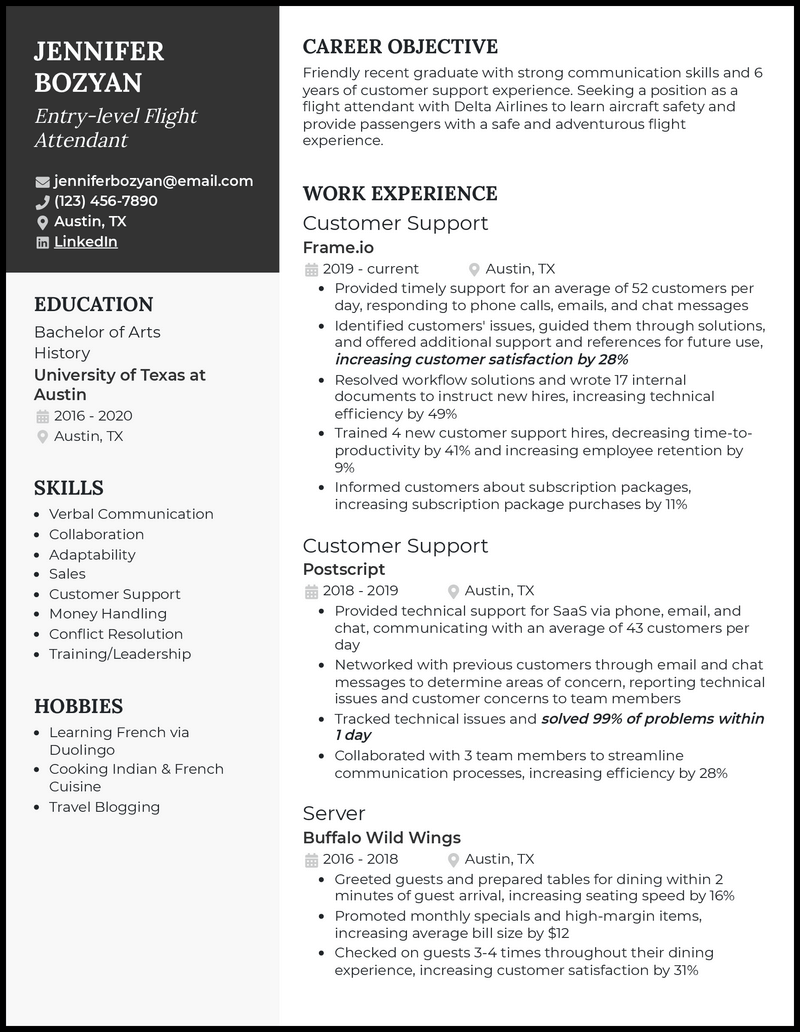
Kickstart your aviation career with a professionally crafted entry-level flight attendant resume, blending modern style with strategic storytelling.
Use a modern resume template and make your cover letter stand out from the competition—even if you have no prior experience.
What this guide covers:
- ↪ 3 entry-level flight attendant resume examples tailored to different backgrounds
- ↪ How to translate your transferable skills into airline-ready qualifications
- ↪ Ways to reframe your experience and launch a fresh career trajectory in aviation

Why this resume works
- Landing that first gig without previous experience can be quite the climb. But why let your hobbies sit on the sidelines when they can swoop in to turbocharge your entry-level flight attendant resume?
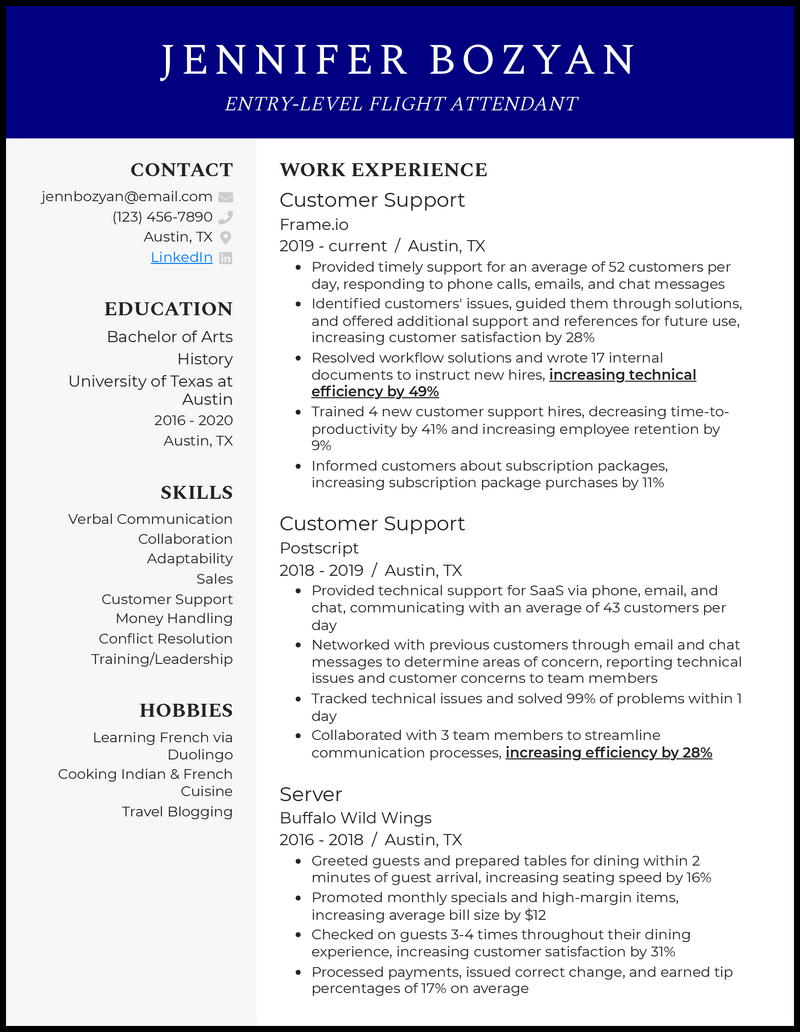
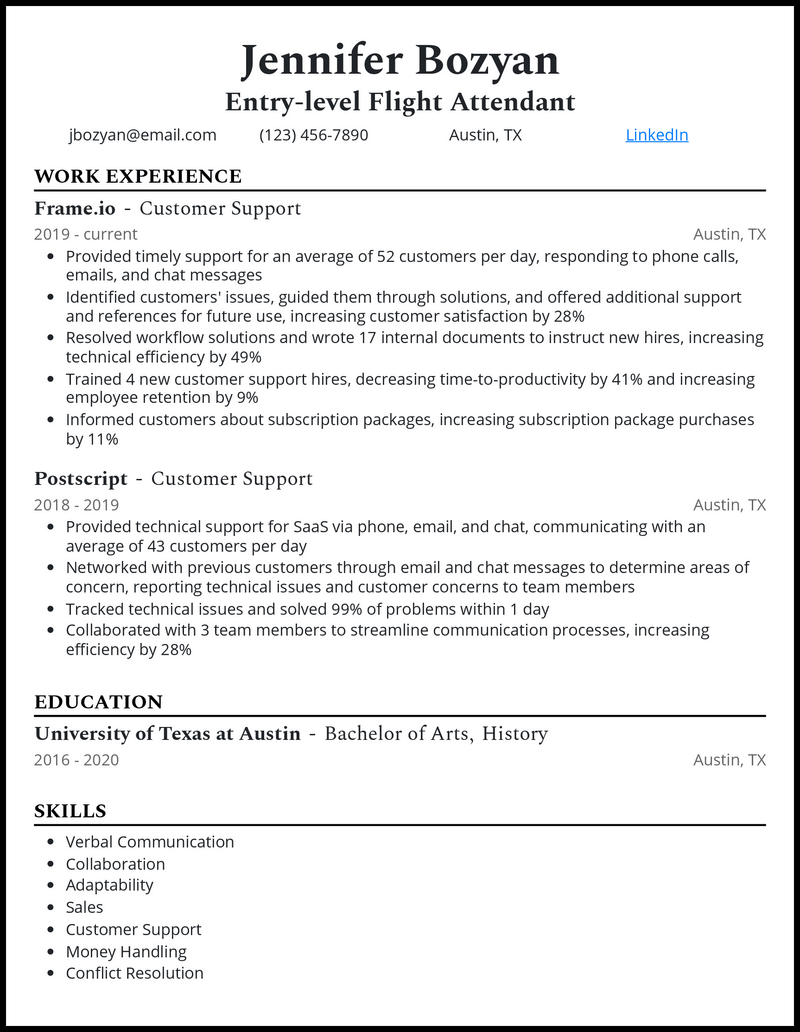
Related resume examples
How to Write an Entry-Level Flight Attendant Resume

To land an entry-level flight attendant job starts with crafting a resume that prioritizes your strengths—even if this is your first stab in the aviation industry.
Summary
Emphasize your experience helping people, staying composed in high-stress situations, and thriving in busy settings—qualities airlines look for in new hires. Keep your resume clean, focused, and honest, showing how your background, even outside aviation, makes you a strong fit for the role.
Summary: Emphasize your experience helping people, staying composed in high-stress situations, and thriving in busy settings—qualities airlines look for in new hires. Keep your resume clean, focused, and honest, showing how your background, even outside aviation, makes you a strong fit for the role.
This section shares practical tips and examples to help your application rise to the top.
What you’ll learn:
- How to format your resume so it’s easy to scan
- What to include in a strong, purpose-driven objective
- Ways to present past jobs as relevant experience
- Which soft skills airline recruiters actually look for
- The value of training, certifications, and second languages
- How to design a clean, professional layout that passes ATS filters

Format your resume to impress ATS and recruiters
Recruiters won’t see your resume unless it clears the first hurdle: the Applicant Tracking System (ATS). When the HR managers review your resume, they only spend an average of 8 seconds to decide your fate, so you better make every second count.
To get through, put all the key sections each in a distinctive place—clearly, concisely, and compelling.
Stick to a reverse-chronological order and avoid using columns, graphics, or complicated formatting that can trip up the system.
Keep your font simple and professional—think Arial or Calibri—and leave plenty of space so it’s easy to read. Always save your file as a PDF unless told otherwise.
Still unsure if your resume hits the mark? Run it through a keyword scanner to check for important airline-specific terms.

Craft a compelling career objective
Your objective is your first impression. Make it concise, fluff-free, and tailored to the job. Think of it as your quick pitch—what you bring, what you care about, and why you’re a great match for the role.
Mention soft skills like communication, calm under pressure, or a genuine passion for service. If you need help refining your wording, try using a summary generator to shape your message into something sharp and professional.
Example
Excited to bring a strong background in customer-facing roles to an entry-level flight attendant position at JetBlue Airways. Excellent in communication, quick thinking in high-stress situations, and a friendly, team-first approach to service.

Add your academic background and credentials
You don’t need airline experience to build a strong resume. Start with your highest level of education, and be sure to list any relevant coursework or certifications. That includes CPR and First Aid, language fluency, or any safety training.
If you’ve taken flight attendant prep courses—even outside a major airline—include them. Tools like a resume rewriter can help you reframe past experiences to better match the role you’re aiming for.

Leverage your transferrable skills
Safety and passenger experience are always top priorities. You’ll want to show airlines you have the right skills to perform the related tasks effectively.
Entry-level candidates often find it difficult to pick the right skills to list. That said, you still have a lot to choose from. Think back to your time preparing to get FAA certified and the key skills you learned in CPR and flight safety.
Also, consider any previous work experience that will translate to the position, like working in retail and providing great customer service or managing a tight schedule.
The following entry-level flight attendant skills are most in demand in 2026.
9 top entry-level flight attendant skills
- Ramp Service
- Food & Beverage Prep
- Pre-flight Briefings
- Emergency Care
- Safety Compliance
- CPR/AED
- MyRadar
- Crew Rest
- 2Hot2Cold

Showcase impact from relevant work experience
Examples of your past work achievements will help airlines feel more comfortable bringing you on board. Showing how you’ve implemented aspects like customer service and safety will be key here.
While you may not have much in terms of in-air experience attending flights, you can still pull lots of relevant examples from previous work and education that showcase your skills.
For instance, if you worked at a restaurant taking orders and performing food and beverage prep for hundreds of customers per day, that would translate to many of your tasks as a flight attendant.
Here are a few ideas:
- Provided customers with clear instructions to help entrance lines move 20% faster.
- Built a friendly rapport with customers while answering questions and concerns to improve satisfaction scores by 52%.
- Took orders and assisted in food prep with 99% order accuracy and always complied with top food safety protocols to maintain Grade A health inspection scores.
- Scored a 98% overall grade on FAA flight safety and CPR/AED certifications by diligently studying course materials to provide the best passenger experience.
- Used Crew Rest to manage breaks and schedules to increase efficiency by 70%.

Tailor for the specific job and airline
Every airline looks for something different in its crew. Read the job post closely and take note of any skills, values, or traits that stand out. Then, reflect that language in your resume.
Mention the airline in your objective, and adjust your skills section to fit the company’s focus. Some airlines may prioritize bilingual candidates, while others care more about emergency readiness or conflict resolution. Matching their tone shows you’re paying attention—and that you’re serious about the role.
Top 5 tips for your entry-level flight attendant resume
- Consider including a resume objective
- Many applying to an entry-level attendant position won’t have much experience. An objective statement can help present your abilities to perform well in the position. For instance, you could explain how you’re a motivated professional with three years of customer service experience.
- Both technical and interpersonal skills matter
- All flights need attendants who provide friendly service while having high levels of technical ability. You can use both in examples for the most impact, like how you explained technical safety procedures to customers and helped with any concerns during the flight.
- Action words make more impact
- Using action words like “assisted” or “prepared” in your descriptions provides more impact. For instance, you could say you “assisted all passengers by taking food orders and prepared them with 99 percent accuracy.”
- Proofread for errors
- Flight attendants manage many details that contribute to the success of flights. Submit a resume free of grammatical errors to provide a professional first impression and showcase your abilities to handle information accurately, like notifying passengers before upcoming turbulence or scheduling updates.
- Numbers are essential
- Quantifying your flight attendant training and past work can feel challenging, but there are many metrics you can use to prove your impact. For instance, you can say how following updated safety procedures reduced accidents by 22 percent and improved satisfaction scores by 37 percent.

Key takeaways
- Stick to a layout that’s clear, simple, and ATS-friendly
- Write a career objective that shows personality and purpose
- Highlight your education, certifications, and transferable skills
- Customize every resume to the job and airline you’re applying to
Entry-Level Flight Attendant Resume FAQs

A one-page resume is the optimal length for entry-level flight attendant resumes. You want everything included to be concise and relevant. For example, one sentence on how you used your CPR/AED knowledge to attend to over 100 passenger medical needs in your career can go a long way.
Include any examples from previous work experience that will be the most relevant. If you have five years of retail customer service experience with thousands of five-star customer satisfaction ratings on surveys, that’ll help show your ability to provide outstanding flight service.
Including hobbies/interests can be a good idea in entry-level positions to provide more depth about your top skills. For instance, if you enjoy volunteering at a local nursing home on weekends, that can underscore your ability to provide passengers excellent care on flights.

Stephen is the co-founder and CEO of BeamJobs. Frustrated with the challenges he'd faced in his own job search, he left the corporate world to start BeamJobs with his brother. Drawing on firsthand experience with hiring and getting hired as technical talent, he started BeamJobs in 2020 to help qualified job seekers land interviews with less stress. Since then, more than 4 million people have built their resumes and cover letters on BeamJobs. Stephen's insights have been featured in notable outlets, such as Fast Company, Business Insider, Yahoo Finance, MIT, and Zapier. Learn more about Stephen.