



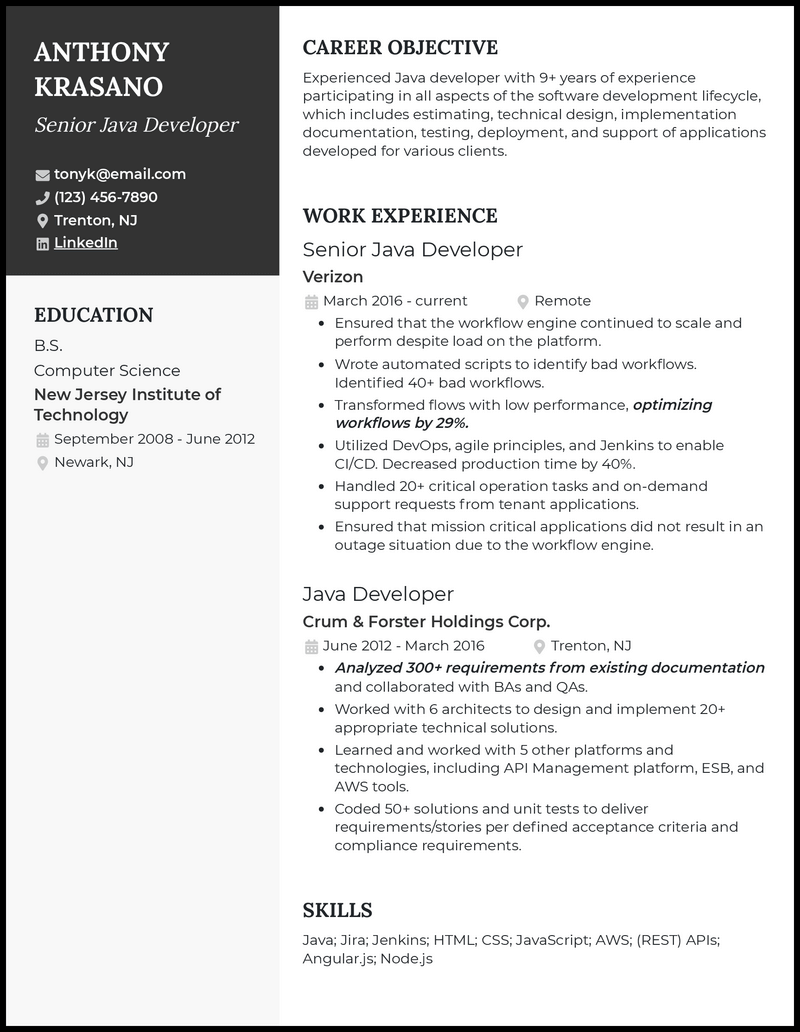
If you’re aiming for a senior Java developer role, your resume should clearly show the depth of your experience, the systems you’ve built or scaled, and the impact you’ve had on engineering teams.
This guide shares practical tips and real-world examples to help you create a resume that’s sharp, relevant, and easy to navigate—plus links to helpful resume templates.
In this guide you’ll find:
- ↪ Three senior Java developer resume examples that highlight different career paths and strengths
- ↪ Tips for choosing what to include (and what to leave out) based on the role you want
- ↪ Resume formatting strategies that improve readability and get past ATS filters


How to Write a Senior Java Developer Resume

A strong senior Java developer resume doesn’t just list technologies—it tells the story of what you’ve built, led, and improved.
Summary
Showcase your value by weaving together real results, technical depth, and clear focus—your resume should prove you’re not just a developer, but a leader in your craft.
This section outlines what matters most when putting your experience on paper.
What to focus on:
- The Java tools, frameworks, and systems you’ve worked with in real production environments
- Projects and roles that highlight leadership, architecture decisions, and team collaboration
- Education, certifications, and any specialized training that adds weight to your expertise
- Extras that set you apart—public code samples, contributions to developer communities, or performance wins backed by data

Components that make the perfect senior Java developer resume
Your resume needs to do more than tick off boxes—it has to tell your story as a senior engineer. At this stage in your career, hiring managers want to see more than just the languages you know. They’re looking for ownership, architectural thinking, and how you’ve contributed to real business outcomes.
Keep it tight and focused. Lead with a professional summary that reflects your experience in enterprise-level systems, cross-functional teams, or scalable backend architecture.
Follow with your most impactful projects—not necessarily the biggest, but the ones that show you solved hard problems.

Command attention with Java development skills
While Java is used everywhere, your job title alone doesn’t provide much detail about what you specialize in or what projects you’ve worked on. Use your skills list to fill in the blanks by including the tools, platforms, and frameworks you’ve used most.
Also, bump technologies mentioned in the job description to the top of your list to ensure they stand out. Keep things technical and avoid using generic template resume skills like “creativity,” “problem-solving,” or “teamwork.”
In fact, it’s usually better to omit soft skills in a developer’s resume altogether. Recruiters often use applicant tracking systems to scan for relevant keywords, so focus on the skills they’re seeking.
9 best senior Java developer skills
- Java
- SQL
- JavaScript
- HTML and CSS
- Powershell
- REST Web Services
- Spring
- AWS Services
- Hibernate

Demonstrate results and impact from your experience
Your work as a Java developer sees you developing web applications, creating cross-platform tools, processing big data, and much more.
Don’t oversimplify your resume to make it easier to read—that downplays your expertise. Instead, lean into your technical knowledge and make your work experience stand out by listing your achievements and demonstrating their value through metrics.
Be specific and talk about your work’s impact, such as improving efficiency and delivering the finished product 3 months ahead of schedule.
Here are some examples:
- Optimized database queries and indexing strategies that reduced overall query response times by 33%
- Designed and developed RESTful APIs using Spring Boot, resulting in improved integration with external systems and achieving an 18% reduction in integration time
- Spearheaded the migration of a legacy Java application to a distributed microservices architecture, shortening the feature development and deployment cycle by 12%
- Collaborated as part of a cross-functional team to research and analyze user requirements, leading to the deployment of new feature-rich applications that increased user satisfaction by 9%

Use Java-focused active verbs to underscore value
The right verbs can completely change how your resume lands. Instead of saying “worked on backend services,” try verbs that show intent and mastery: engineered, optimized, refactored, architected, deployed, integrated, or scaled.
Each impactful bulle point should begin with a verb that matches what you did—and that resonates with technical readers.

Showcase leadership and career progression
As a senior developer, it’s not enough to say you wrote great code. Present your wins in making decisions, leading teams, defining course of action, and mentoring juniors.
Talk about:
- Projects where you served as tech lead or handled end-to-end delivery
- Moments where you influenced engineering practices or tooling decisions
- Team performance improvements tied to your contributions
Recruiters are skimming for signs you can handle autonomy and drive results without hand-holding. Make it easy for them.

Leverage your education for maximum benefit
Even with years of experience, education still adds credibility—especially if it supports your specialization. A degree in Computer Science or a related field is worth listing, but so are certifications that prove ongoing learning.
If you’ve earned certifications like Oracle Certified Professional (OCP) Java SE Programmer, AWS Certified Developer, or Scrum Master, add them near the top or highlight them in your summary. They’re quick trust signals that show you take your growth seriously.

Customize your draft to the senior role
Not every senior Java role is the same. Some are hands-on coding positions. Others lean into architecture, DevOps, or mentoring. Tailor each resume you send to match the exact job description.
Scan the posting for:
- Tech stacks (Spring, Hibernate, Docker, Kubernetes, etc.)
- Methodologies (Agile, CI/CD, cloud-native practices)
- Role expectations (individual contributor vs. leadership)
Then shape your bullets to reflect those areas. Use keywords without stuffing, and cut anything that doesn’t directly support your fit for the role.

How to Include Certifications on Your Senior Java Developer Resume
Adding certifications to your senior Java developer resume can give you an edge in the hiring process by showcasing high-level knowledge in aspects like project management or using Apache Spark.
To start, you’ll want to add your certifications section beneath your computer science education and skills sections. Make sure each certification you list includes the following information:
- The certification’s title, such as Professional Scrum Master Certification
- The organization you received the certification from, such as Oracle University
- The date you acquired the certificate
- The certificate’s expiration date (when applicable)

What are the best certifications to have on a senior Java developer resume?
The best certifications to select for your senior Java developer resume will depend on the skills you need for the role. Are you looking to take on more leadership? Then, a project management certificate might be the right choice. Will you be managing server pages? Listing that you’re a certified web component developer could be an excellent option.
Here are some leading certifications that will make your Java development skills shine:
- Oracle Certified Associate Java Programmer (OCA): The OCA is usually seen as the foundation of Java development skills. Listing this one on your resume shows that you possess well-rounded capabilities in Javascript and are proficient with the Oracle suite for common workplace tasks.
- Spring Certified Professional: Are you applying to a company that wants to simplify its Javascript management process? Being a Spring Certified Professional will showcase fundamental abilities in aspect-oriented programming that make project organization much more manageable.
- Certified Project Management Professional (PMP): Once you make it to a senior Java development role, it’s common to take on more leadership within your team. Being a certified project manager will show your abilities to motivate others, use Agile methodologies to keep development on track, and create strategies to achieve organizational goals.
Other highly sought-after certifications for senior Java developers are:
Top 5 tips for your senior java developer resume
- Highlight relevant projects
- Match your resume to each job you apply for by highlighting relevant projects from your past work. If Powershell is listed as a skill, mention an automation project where you used Powershell.
- Showcase technical skills
- Instead of listing every technology you’ve ever worked with, focus on the specific tools and platforms mentioned in the job description. Make sure they’re listed in order of importance.
- Include education and certifications
- Certifications are a great way to convey your level of expertise in a specific area or technology. Passing exams like the Java EE 7, the SCP, and the OCP, show employers that you’re fully qualified for roles using these tools and platforms.
- Illustrate your knowledge
- Highlight your understanding of best practices such as Agile methodologies, version control systems, or code review processes to indicate your ability to deliver high-quality, maintainable code.
- Link to relevant personal projects
- Don’t forget to include your GitHub link at the top of your resume and any other external links you feel strengthen your candidacy. This could be your LinkedIn page, an open-source project you contribute to, or a blog on Java and programming topics.

Key takeaways
- Lead with accomplishments, not just responsibilities
- Use strong Java-specific action verbs to frame your impact
- Highlight leadership and the evolution of your role over time
- Include relevant degrees and certifications to reinforce expertise
- Customize your resume to the company’s tech stack and team needs
Senior Java Developer Resume FAQs

There’s no need to include work experience in fields other than Java development, and if you’ve already had multiple jobs, it’s best to focus on the two most recent. This makes your resume appear up-to-date and allows you to focus on your best work.
Avoid vague soft skills. Instead, focus on tangible outcomes and quantifiable achievements. Show what you can bring to the company by demonstrating the value you’ve brought to other roles. Complement this by writing an effective cover letter that tells a story about those skills in action.
You can, but you don’t have to, although it’s a good way to add a bit of personality to your resume. It’s also useful to name-drop the company you’re applying to, indicating from the get-go that you’re a serious candidate who has paid attention to the job post.
A senior Java developer designs, builds, and maintains scalable backend systems—often taking on architecture decisions, code reviews, performance tuning, and team mentorship. You usually work on high-impact features and are expected to contribute to both code and strategic planning.
Start by tailoring your resume to the specific job description. Focus on outcomes you’ve delivered in past roles, and use clear, active language that reflects your technical and leadership strengths. Pair your resume with a focused cover letter, and if possible, include links to relevant code samples, GitHub repos, or case studies that back up your experience.

Stephen is the co-founder and CEO of BeamJobs. Frustrated with the challenges he'd faced in his own job search, he left the corporate world to start BeamJobs with his brother. Drawing on firsthand experience with hiring and getting hired as technical talent, he started BeamJobs in 2020 to help qualified job seekers land interviews with less stress. Since then, more than 4 million people have built their resumes and cover letters on BeamJobs. Stephen's insights have been featured in notable outlets, such as Fast Company, Business Insider, Yahoo Finance, MIT, and Zapier. Learn more about Stephen.