



If you’re aiming for your first role in Android development, your resume needs to show you can code well, work with others, and get things done—no matter how much experience you have.
This guide will walk you through creating the perfect resume and writing an effective cover letter that can get you in front of hiring managers and move you closer to your dream job.
We’ll cover:
- ↪ 5 entry-level Android developer resume examples
- ↪ How to build a resume that gets noticed and leads to interviews
- ↪ What recruiters look for when hiring junior Android developers

Why this resume works
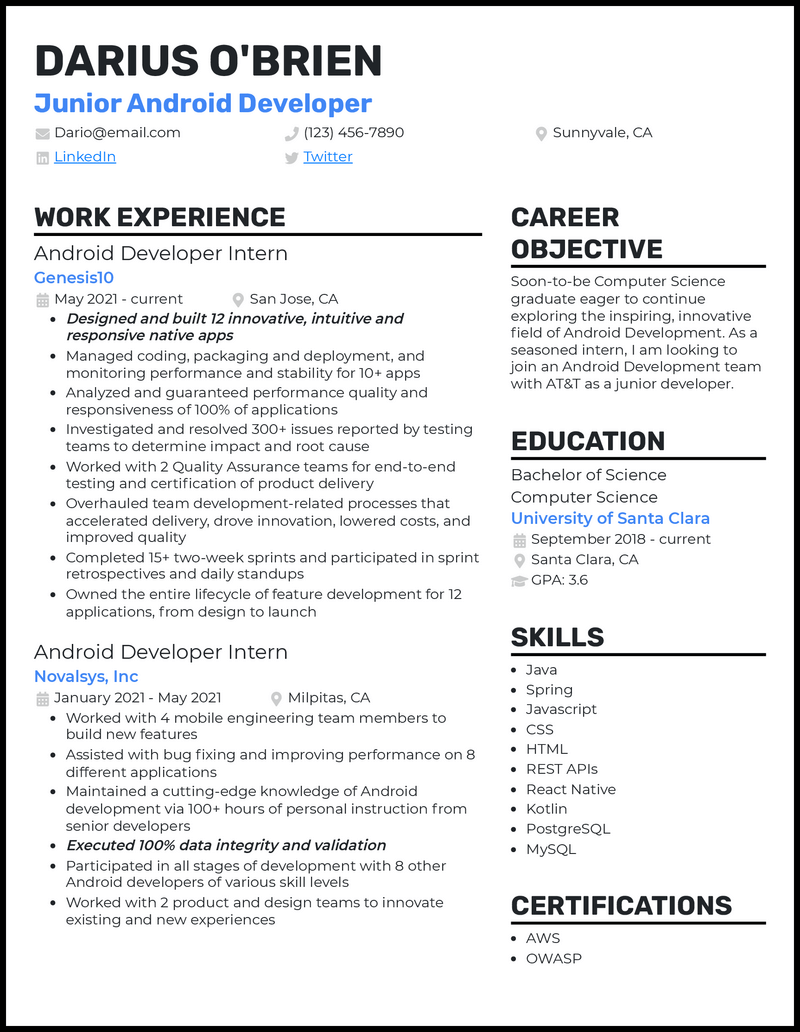
- When putting together your entry-level Android developer resume, skip the bizarre decorations and stick with classic colors like blue and black in coordination to display professionalism. In the end, have a neat section for listing your career objective, education, skills, and certifications.


How to Write an Entry-Level Android Developer Resume

You must write a resume communicating your technical strengths, showcasing real projects, and proving you’re ready to build scalable, user-friendly apps.
Summary
Jumpstart your Android development career with a resume that’s as clean, intuitive, and high-performing as the apps you build—focused on your projects, tools, skills, and passion for mobile innovation.
You may be terrific when it comes to working with Java or Kotlin. However, such qualities won’t offer an entry-level Android developer job on a silver platter.
Recruiters may give a thought about your training, but their focus will be on what you’ve done and can bring to the job. To impress them, your resume should speak their language, be tailored to the job description, and pass through an ATS (Applicant Tracking System) with flying colors.
Ready to land a gig or nail your first job? Follow our steps to learn how to strategically write a resume that helps you break into Android development.
We’ll show you how to:
- Highlight Android development projects, even academic or personal ones
- Confidently demonstrate your tech savviness
- Draw strength from your transferable skills
- Keep your document neat for quick scanning
- Reflect what employers want

Start with the Right Resume Format
We recommend using the reverse chronological format because it prioritizes your best qualifications. Your most recent and relevant work experiences take precedence. Most importantly, this layout emphasizes your measurable contributions, giving recruiters a glimpse of what you would bring to the table if hired.
Structure your resume with clearly defined sections: Contact Information, Resume Objective, Projects, Technical Skills, Education, and Certifications. Avoid flashy designs to keep things clean and professional. If you want to test whether your resume is readable by hiring software, use a keyword scanner to check alignment with entry-level Android developer job descriptions.

Share accurate contact information
Save your creativity for something else. All you need here are your official names, a professional email address, an active and current personal phone number, city, and state, tailored LinkedIn and GitHub profiles, and links to published apps on Google or Apple Play stores.

Stand out with an attention-grabbing resume objective
Don’t let your lack of relevant work experience break your chances of applying for the job. You’re not out of options, yet. From your internships, volunteer activities, and personal projects, you have a lot to show and convince employers of your potential.
The secret is to take as many of your transferable skills from these activities as possible and match them to what recruiters hope for in the perfect candidate.
Example
Self-driven recent Computer science graduate with Java and Kotlin skills ready to make an impact and drive UX experience with intuitive mobile apps at a forward-thinking team like Apple’s. Known for cutting app load time by 27% during an internship by implementing asynchronous caching in a ride-sharing app.

Make a bold statement with your skills
In a nutshell, recruiters want to see that, as an entry level Android developer, you can write good code and have the right mindset to hit the ground running. When they, or an applicant tracking system (ATS) skim resumes, they’re looking to quickly disqualify candidates.
Remember, a single junior Android engineer position might receive hundreds of applicants. If you don’t clearly showcase the hard technical skills that you possess (and that they want), you’ll end up in the reject pile faster than you can type: print(“Hello world!”)!
To avoid this, closely read the job description and include all the hard skills you possess that they want. As a starter, here are some of the top skills entry-level Android developers should have.
9 Best Entry Level Android Developer Skills
- Java
- Kotlin
- Android Jetpack
- Android Studio
- XML
- SQL
- React
- Android SDK
- Android APIs

Sample entry-level android developer work experience bullet points
Okay, so you’ve made it clear that you’ve got the skill. But you’re not quite ready to accept a new job offer. Next, you need to showcase your accomplishments from your previous experience as a developer or programmer. How? Ensuring your bullet points answer the most crucial questions and provide all the crucial information to align you to the job.
Impact. You want to use quantifiable metrics and hard numbers to showcase the impact you had through your previous roles (whether internships, academic projects, or volunteer work). That way, developer recruiters will clearly see what you could add to the team.
You should also use this section to weave in tools like languages or SDKs you’ve used, plus highlight any soft skills like project management.
Here are some examples:
- Integrated Google and Instagram log-in features using Android Studio for the GoTV! app, increasing app usage by 15%
- Reviewed 150 lines of code weekly, isolating sections of code to ensure 100% correctness across platforms
- Decreased debugging time by 54% by optimizing UIs using React
- Redesigned a clean API together with 4 interns to increase scalability for 2 eCommerce applications, increasing revenue by $15,000
- Created a free spelling app for high school students using self-documenting code utilizing Java, Kotlin, and C++, which was downloaded over 20,000 times

Leverage relevant projects
If you don’t have work experience, projects are your experience. Treat them like professional work.
Give the name of the project, your role, what you did, and the direct impact. Use numbers where possible and ensure they’re logical and align with the expectations of the tasks ahead of you.
Some of the projects include hackathons, freelance gigs, boot camp, and individual or group class work. Remember to highlight the skills used, the lesson, and how you would leverage them in a real-work scenario.

Include education and certifications
Android development is more about what you can do than your educational background. You can be self-taught and still get the job. Nevertheless, if you have a degree or any other relevant training, let a potential employer know about it.
In your education section, give the name of your degree/diploma, the college’s name, location, when you graduated, GPA if 3.5 and above, and relevant coursework (must be recent).
Certifications are equally important. If you have any recognition from Google or any other Android development platform, show it. Anything that brings out your unique qualifications should be on your resume.

Bonus sections: awards, honors, publications
Did you make it to the Dean’s List and earn a scholarship? Add it. Published an article on Medium titled, “Modern Android UI with Jetpack Compose” and garnered 4.5K views? Say that proudly.
You can see where all this is going: making you stand out and being noticed ahead of any other candidate.
Top 5 tips for your entry level android developer resume
- Focus on hard skills in the skills section
- The skills section of your resume should include any hard skills the recruiter or ATS will be looking for, like databases (AWS or SQL) or frameworks (Django or React). Soft skills like cross-team collaboration should be reflected in your work experience.
- Quantify your impact
- One thing you should not do on your resume is be vague. When you’re talking about your impact, quantify it. Don’t say you significantly scaled an Android app you maintained, mention specifically how many users you scaled it to. It makes a difference!
- Customize your resume each time
- Yes, it might feel as frustrating as trying to debug some stubborn code, but it’s worth it! Include the skills the junior Android developer job description asks for, and mention projects that reflect the skills or mindset they want. It’s that easy!
- Less is more
- While you might want to detail all of your past experience in painstaking detail because you’re earlier on in your career, trust us here: don’t. Follow a simple format in your bullet points, starting with an active verb to tell what you did and follow that up with how you did it and the result. Include your skills and contact info, and you’re good to go! Save the rest for the interview.
- Showcase your expertise
- Don’t try to impress recruiters by writing down 10 languages you’re familiar with. Only include those that you could comfortably code in. If you haven’t used Python since high school, it shouldn’t be there.

Key takeaways
Don’t forget to:
- Please keep it to one page so it’s quick to read
- Open with a short statement that shows your interest in Android development
- Include projects that show what you can do, whether from school or on your own
- Add any internships, freelance jobs, or hackathon work
- Use wording from the job post so your skills match what they’re asking for
- Lay it out neatly with clear section titles
- Check everything carefully for typos or formatting slips
Entry-Level Android Developer Resume FAQs

Yes—without exception. Whether you’re applying to internships, junior developer roles, or contract gigs, your resume is proof of capability. Even if you’ve got a killer portfolio or GitHub, hiring managers still expect a professionally written resume. You can also pair it with a tailored cover letter from a cover letter generator to maximize your impact.
A good objective is tailored, tech-focused, and backed by action. Even without the much-needed experience, you can turn this short overview into a strength that says you can do the job.
Example:
Self-taught Android developer with 3 mobile apps published on Apple App Store. With expertise in Git, Kotlin, XML, and Koin, and ready to join Apple and be part of the user-centric culture and tech leadership.
For a new Android developer, your work experience will primarily feature your wins from projects, internships, and part-time gigs. As long as you can tie your achievements from such activities to skills and responsibilities for the role you’re going after, you’re making a strong case for your candidacy.

Stephen is the co-founder and CEO of BeamJobs. Frustrated with the challenges he'd faced in his own job search, he left the corporate world to start BeamJobs with his brother. Drawing on firsthand experience with hiring and getting hired as technical talent, he started BeamJobs in 2020 to help qualified job seekers land interviews with less stress. Since then, more than 4 million people have built their resumes and cover letters on BeamJobs. Stephen's insights have been featured in notable outlets, such as Fast Company, Business Insider, Yahoo Finance, MIT, and Zapier. Learn more about Stephen.