





Beginner CNA Resume


Best for senior and mid-level candidates
Resume Builder
Like this template? Customize this resume and make it your own with the help of our Al-powered suggestions, accent colors, and modern fonts.
 Build my resume
 Becoming a Certified Nursing Assistant (CNA) is more about mastering and delivering patient care. However, as you do this, you should show compassion under pressure, communicate clearly with diverse teams, and prove that you’re the calm in the chaos of healthcare.
No matter if you want to work in a nursing home, hospital, rehab center, or private home care, your beginner CNA resume should show your hands-on experience, commitment to patient care, and your ability to support nurses and medical staff in a professional way.
With our 3 beginner CNA resume examples, this guide will walk you through the complete resume-building process and offer time-tested resume advice so you can:
- ✅Build a resume that captures your passion, empathy, reliability, and real-world clinical experience
- ✅Tailor your resume to match specific healthcare roles, settings, and the job description
- ✅Highlight your skills in patient monitoring, vital sign recording, daily living assistance, and teamwork, even though you’re just starting out

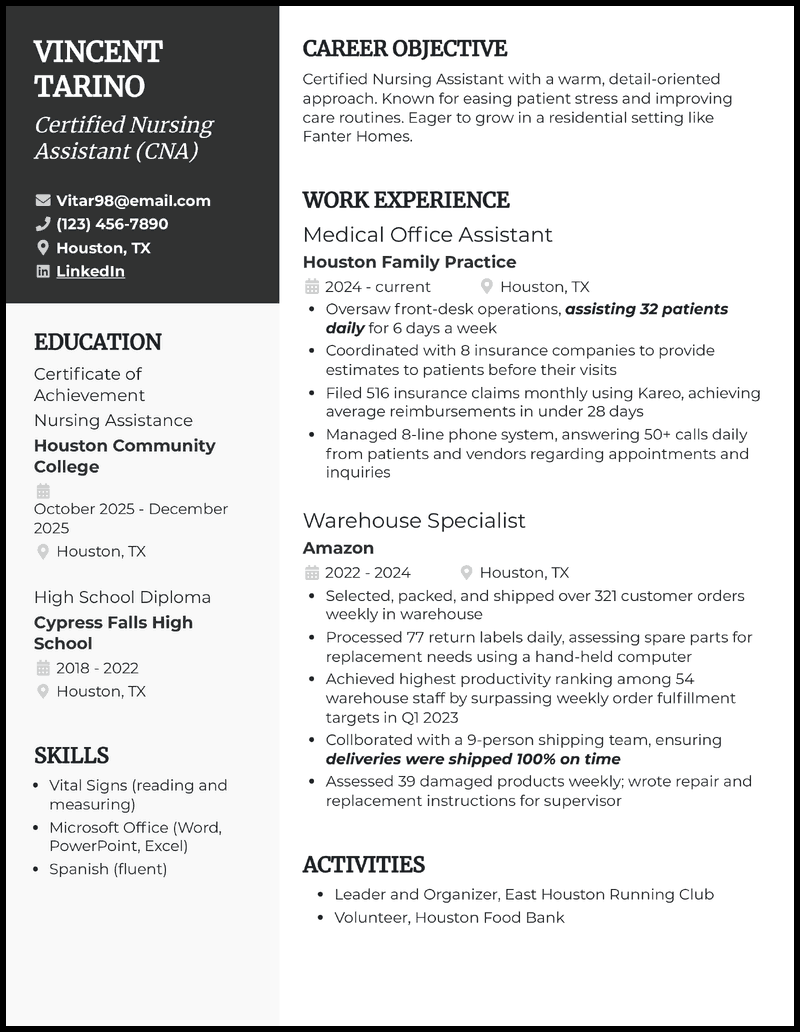
Why this resume works
- No beginner CNA resume is going to catch the attention of prospective employers if it doesn’t include a course certificate or educational background in nursing.
- It’s completely fine if you’ve got a gap between your diploma and any nursing education, too. Try peeking through your past jobs to find any relevant roles where you’ve been a part of the healthcare industry to improve your chances of getting hired.
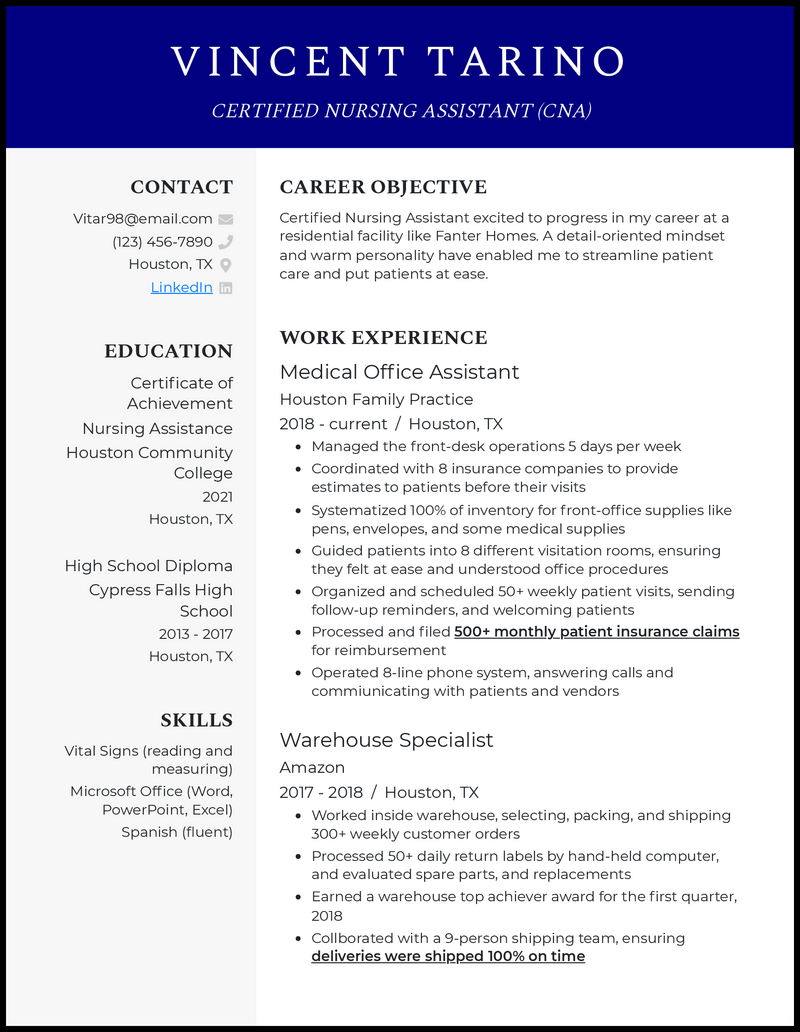
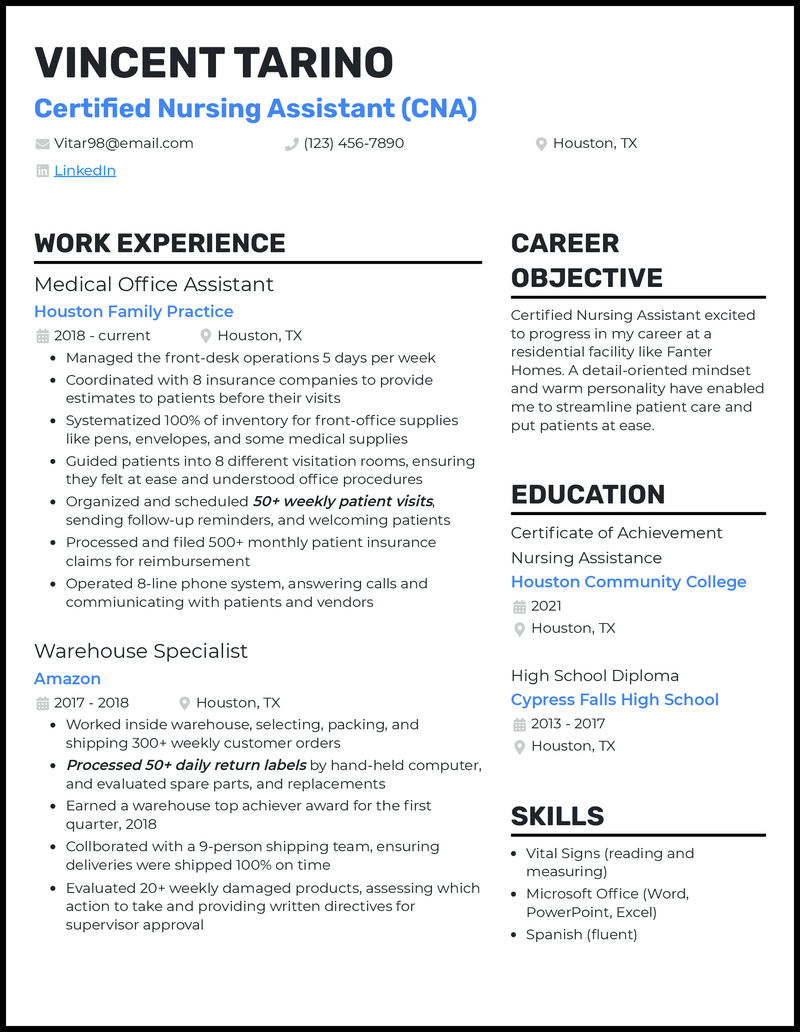
Related resume examples
What Matters Most: Your Skills & Experience Sections

You call upon a wide variety of patient care skills as a beginner CNA! Between helping patients shave and get dressed to ensuring and documenting adequate food and water intake, you utilize soft and hard skills on a daily basis.
Show recruiters that you’re equipped to excel in your job role by keeping skills specific to the profession. Instead of vague list items like “patient care,” specify “patient hygeine” or “diet planning.”
And be as specific about the nature of the skills themselves as you are about how they relate to your profession: Name any programs you use, and be clear about what you do:
9 most popular beginner CNA skills
- MS Excel
- MS Word
- Vital Signs
- Diet Planning
- Patient Care Records
- Patient Hygiene
- CPR
- First Aid
- Empathy
Sample beginner CNA work experience bullet points
Now that you’ve provided a nice list of skills, it’s time to show recruiters that you’re already prepared for the beginner CNA role—after all, no two days on the job are the same! Provide examples of tasks like patient or customer care that you’d leverage as a CNA.
Feel free to pull in experiences and accomplishments from other job roles or volunteer experiences as long as they relate directly to the job you’re applying for! Pinpoint overlapping areas such as record keeping or client outreach/follow-up calls.
And always provide metrics for your positive impact! Recruiters want to see percentages, rates, and other quantifiable data to back your accomplishments.
These examples do a good job of pulling in transferable experience from outside CNA work:
- Collaborated with employee team to ensure that 98% of delivery initiatives were met on time
- Systematized 97% of inventory for office and medical supplies, reducing unnecessary spending by 9%
- Processed and filed over 489 patient insurance claims for reimbursement per month, exceeding goals by 13%
- Operated an 8-line phone system, answering calls and quickly responding to patients and vendors to earn a 4.8/5.0-star personal rating
Top 5 tips for your beginner CNA resume
- Switch up context
- Add intrigue to your resume by varying the context surrounding your experience points: Talk about everything from high-quality daily patient care to your ability to save time by efficiently filing insurance claims.
- Analyze your objective
- When you want to use an objective statement to set off your resume, make sure you’re not repeating yourself. Any references to your excellent bedside manner or multitasking abilities should be fresh!
- Show off certifications
- You worked for them, so share them! Alongside earning your CNA, include any other credentials you have, such as a First Aid, CPR, or Emergency Medical Response (EMR) certification.
- Keep things simple
- The details of your experience points should be as straightforward as your patient wellness reports. State what you did, why you did it, and give a metric for how it helped.
- Prioritize readability for recruiters
- They don’t have much time to spend on your resume, so stick with super-clear fonts and minimal color usage that preserves contrast. Don’t get too zany and draw attention away from the fact that you’re empathetic and love giving dignity to your patients.
Beginner CNA Resume FAQs

Keep your resume to one page and ensure it is simple and easy to read. Add a short objective, list your CNA skills, include certifications like your CNA license and CPR, and mention any clinical or volunteer experience. Use a clean layout without graphics or columns.
Start with a career objective that shows your interest in patient care. List your high school diploma and any skills you learned from activities, like helping with hygiene, safety, or taking vital signs. Add any volunteer or caregiving experience you have.
Add a section called “Certifications” and use the following format:
Certified Nursing Assistant (CNA), State of California, License #98765 – Expires 2027
CPR & First Aid, American Heart Association – Valid through 2026
Confidently indicate you’re changing careers and present your previous skills in a context to benefit healthcare. It would be helpful if you already have CNA training, a license, and CPR certification to establish the value you bring to the role. Share any hands-on care experience, even if it was unpaid. Demonstrate how your past jobs have taught you valuable skills such as communication and dependability.

Stephen is the co-founder and CEO of BeamJobs. Frustrated with the challenges he'd faced in his own job search, he left the corporate world to start BeamJobs with his brother. Drawing on firsthand experience with hiring and getting hired as technical talent, he started BeamJobs in 2020 to help qualified job seekers land interviews with less stress. Since then, more than 4 million people have built their resumes and cover letters on BeamJobs. Stephen's insights have been featured in notable outlets, such as Fast Company, Business Insider, Yahoo Finance, MIT, and Zapier. Learn more about Stephen.