



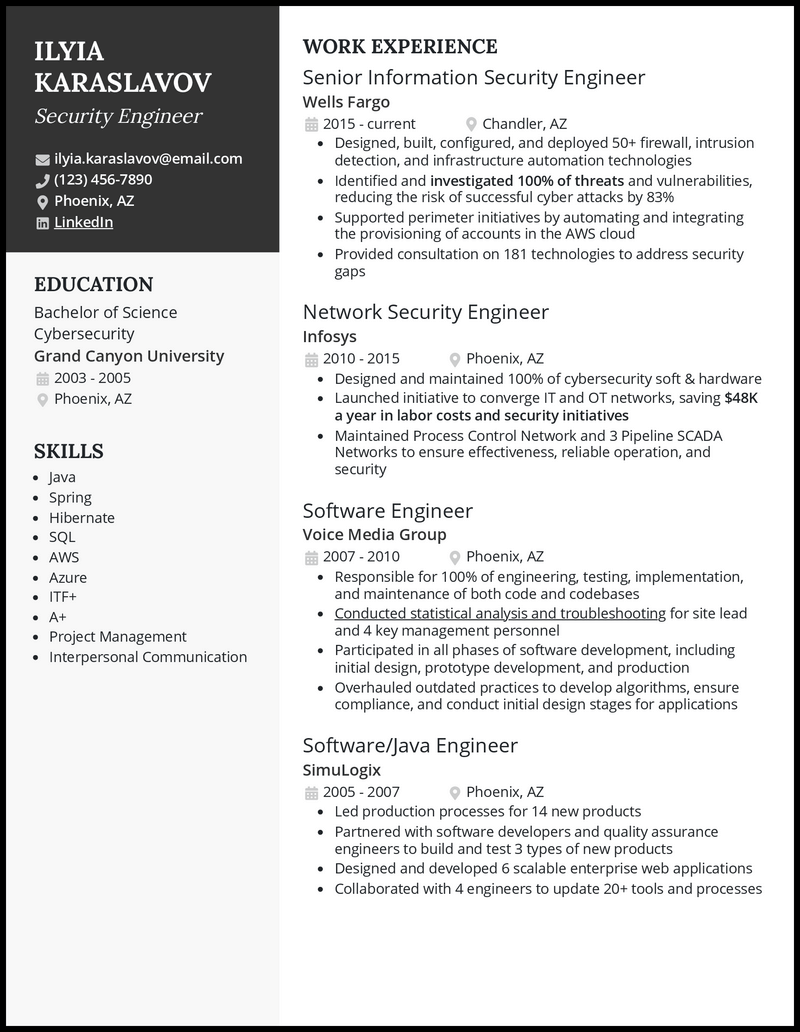
Crafting the best security engineer resume means pairing your achievements with real-world vulnerabilities you’ve mitigated, code you’ve written, and systems you’ve fortified—using phrases that align with both recruiter intent and AI retrieval.
For a winning strategy, integrate your technical depth into a tailored resume template and give more perspective in a persuasive cover letter highlighting your threat modeling, secure coding, and cross-functional security engineering impact.
- Key things to discuss:
- ↪ Three security engineer resume templates
- ↪ Demonstrating understanding of vulnerabilities in a tech stack
- ↪ Highlighting programming abilities that answer the needs of the potential employer

Why this resume works
- Since you’re practically a guardian of networks, protecting them from external breaches, make your security engineer resume shine with quantified bullet points.
- Skip the fluff and include more impactful bullet points like “reduced the risk of cyberattacks by 83%” and “Configured and deployed 50+ firewalls” to show that you’re the IT guy every company needs to keep their systems guarded as heavily as Area 51.


How to Write a Security Engineer Resume

Before you get onto securing digital systems for companies, you need to secure the job itself, and that starts with writing a resume that’s as strong as your firewalls.
Summary
✅Lead with your security engineering skills
✅Emphasize outcomes from past work
✅Clear formatting does a lot of good
✅Remember, certifications and work experience are a cybersecurity resume’s best friends
✅Leave no single error when you submit
Talent acquisition leaders typically look for professionals with:
- Relevant experience
- Industry certifications
- Genuine passion for cybersecurity.
However, this doesn’t undermine other resume elements, such as skills and education. Stick around and we’ll uncover how you can build a good security engineer resume by covering the following:
- Formatting tips to sprint past ATS and impress HR managers
- Combining the power of achievements and skills to fit the job’s requirements
- Understanding the job posting and using it as the recruiter’s marking scheme
- Leveraging education to reflect your aligned professional background

Begin with a professional and accurate header
You’ll come across various resume templates that let you pick different designs, and to be honest, there’s no bad design, unless it turns finding your contact information into a puzzle game.
The best way to show your personal details is at the top, but playing around with the layout a little is fine, too. Some important things you want to mention here are:
- Full name
- Professional email
- Phone number
- LinkedIn (optional)
- Portfolio/GitHub (if you’ve ever written automation code)

Make the perfect first impression with your secuirty engineering stack
The first thing a recruiter will want to know when looking at your security engineer resume is if you know how to program. And if you do, what languages you’re an expert in.
Then, they’ll want to make sure you have experience with the requisite security protocols, penetration testing, etc.
As a result, the first section the rectruiter will jump to is your skills section. Here they are looking for reasons to say “no” to you. It’s key you add relevant skills mentioned in the job description.
9 biggest security engineer skills
- Python
- Assembly
- Java
- Penetration testing
- Security auditing
- SQL
- Networking
- Linux
- Git

Quantify your past results to underline your fitness for the open role
A lot of trust is placed in you. Of course, the best security teams have redundancies and checks in place, but you’re still the first and last line of defense for a company’s data.
As such, you need to showcase why you should be trusted based on your past experiences in security engineering. The best way to do that? Numbers.
Show the scale of what you’ve done. When it comes to your security engineer resume, numbers speak much louder than words.
Instead of focusing on your responsibilities, focus on the impact of the projects you’ve worked on. Here are a few examples:
- Implemented regular penetration testing for new features launched, increasing detection of vulnerabilities by 17%
- Built automated security testing in Java so that new code can’t be pushed to production unless it passes security checks, saving over 700 manual hours each month of QA
- Led the investigation into exposure from a vendor data breach and implemented resolution to protect user data within 48 hours
- Created real-time monitoring and reporting of suspicious network activity in C++, reducing time to first response by 76%

Include relevant education and certifications
Your education and certifications give employers a sense of trust that you’ve earned your way to getting this job and aren’t relying on job experience alone.
As a security engineer, you don’t strictly need to have a Bachelor of Science in Cybersecurity. Instead, any IT or technology degree will do the job. Some examples include:
- Bachelor of Science in Information Technology
- Bachelor of Science in Information Systems
- Bachelor of Computer Science
Similarly, depending on your level of experience, add relevant certifications. Recruiters tend to trust certs from from CompTIA and Cisco, but reading the job description is your best option here. Check which certifications the company recognizes or demands.
Typically, if you’re a mid-level security engineer, you can mention:
- Certified Information Systems Security Professional (CISSP)
- GIAC Security Essentials
- AWS Certified Security

Follow this final checklist before hitting “send”
Hold your horses before submitting an application. Go through this mini-checklist and make sure you’re ticking all the boxes in your resume:
- Resume fits on one page
- Your work experience is quantified
- Mention of relevant certs/education
- Including a strong skills list
- No grammar errors or typos present
- Design is clean and leaves room to breathe
Top 5 tips for your security engineer resume
- Be specific in your experience
- The phrase “security engineer” means a lot of different things at a lot of different companies. Your work experience bullet points need to be specific. Did you work on network security? Focus on penetration testing? What were your areas of focus?
- Be a master of a few trades
- I don’t know why, but developers tend to love to throw every programming language they’ve ever seen on their resume. Bad idea. It’s much better to be an expert in your domain than a jack of all trades, especially when it comes to security!
- It’s all about the impact
- What lends more credibility: saying, “I run fast” or “I run a four-minute mile”? Numbers add relevant specificity and context to your work. It also demonstrates you focus on measurable, proven outcomes. This is exactly what recruiters are looking for.
- Documentation matters
- If you’ve ever been responsible for documentation of protocols, processes, or code then that needs to be mentioned on your resume. Documentation and historical record is everything in security so remove that area of doubt from a would-be employer.
- Customize your resume for each job
- It’s admittedly more work, but you won’t get a better return on 15 minutes of work anywhere else in the job application process. Just add any relevant technical skills or projects that come to mind as you read the job description. It’s that simple.

Key takeaways
- Use your skills and track record of impactful achievements to pitch your value
- Your education and certifications add a professional depth
- Format for easy and quick review
- Get rid of all errors before sending
Security Engineer Resume FAQs

Typically, your security engineer resume needs to include two main things: relevant certifications and work experience. 80% of your profile and first impression will depend on how you present them both. Including a degree in IT or tech will also help.
Security engineers are different from security analysts. The former builds systems that companies can use to secure their systems and data, while the latter generally monitors networks and incidents.
The first step is choosing a good template. Next, add your professional contact information and create your key sections. If you’re unsure about framing work experience, using a bullet point generator can help you quantify your impact and impress employers.

Stephen is the co-founder and CEO of BeamJobs. Frustrated with the challenges he'd faced in his own job search, he left the corporate world to start BeamJobs with his brother. Drawing on firsthand experience with hiring and getting hired as technical talent, he started BeamJobs in 2020 to help qualified job seekers land interviews with less stress. Since then, more than 4 million people have built their resumes and cover letters on BeamJobs. Stephen's insights have been featured in notable outlets, such as Fast Company, Business Insider, Yahoo Finance, MIT, and Zapier. Learn more about Stephen.