



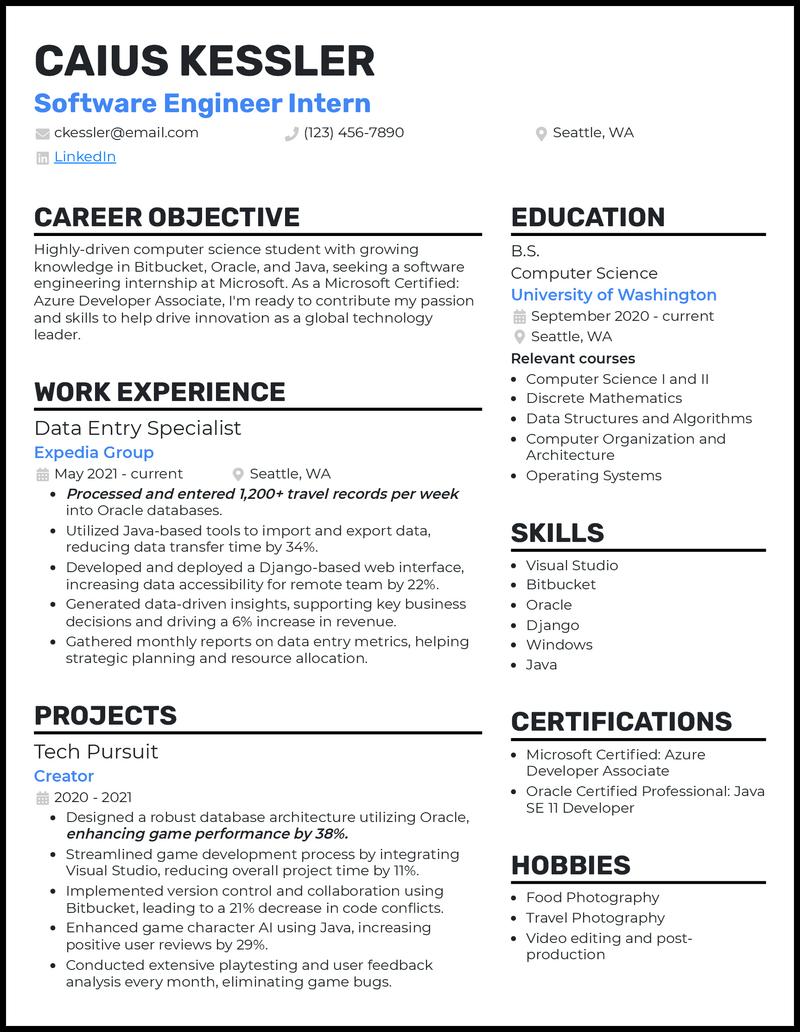
A strong software engineer intern resume demonstrates that you can effectively utilize your technical skills to achieve tangible results, even if you are new to the field. Highlight your coding projects, internships, and coursework that show you can solve problems, work with others, and keep learning.
Looking at resume examples can help you get started and head in the right direction. Additionally, write a cover letter that highlights your technical and teamwork strengths, ensuring your application is polished, complete, and ready for 2026.
Here’s what you’ll find in this guide:
- ↪ Five examples of software engineer intern resumes
- ↪ How to highlight technical skills that show you are ready for the job
- ↪ Tips to help you get the internship/junior role that starts your career

Why this resume works
- Your software engineer intern resume can become miles better with a good set of projects. Potential employers are going to be more concerned with your impacts than the actual work. Therefore, craft your points to highlight marginal changes you made.
Learn how to
land a job
Get the free 4-day email course for college students and recent grads.


How to Write a Software Engineer Intern Resume

Landing your first software engineering internship isn’t just about showcasing your coding skills—it’s about proving you’re internship-ready. Therefore, build a resume that champions your technical chops, project impact, and potential—tailored with purpose, clarity, and strategy.
Recruiters aren’t looking for a perfect engineer—they want a capable, curious, and committed learner. To beat the odds of your lack of work-related experience, your resume should scream “I’m ready to contribute.” That means structuring it for clarity, centering it around real-world projects, and positioning your technical background in ways that solve problems.
Even if you lack formal job experience, your classwork, GitHub contributions, and side projects can speak volumes—if framed effectively to align with the role.
This section focuses on:
- Using a well-structured format for ATS and HR managers
- Putting forward your best programming skills, tools, and technologies you know well
- Leveraging projects and coursework to tease out your potential
- Letting numbers speak of your value
- Making your resume all about the internship opportunity
Let us show you exactly how to do that.

What should a software engineer intern resume include?
Below is a breakdown of the core sections to make your software engineer intern resume complete and stand out in 2026:
Header & contact info
This is the first visual signal recruiters and ATs see and read on your resume. It should be scannable, clean, and visually appealing. Include:
- Full name
- Phone number
- Professional email address
- GitHub
- Optional: Portfolio or personal website link
Career objective/summary statement
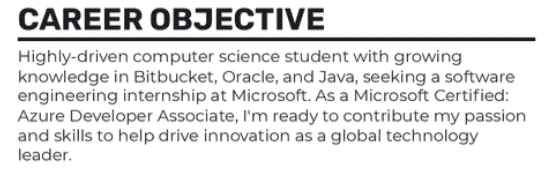
Your career objective sets the tone for the rest of your application by demonstrating your passion, ambitions, willingness to learn, and what you bring to the real-world of work as a beginner. Keep it at 2-3 lines and ensure that you mention skills that align with the job description.
Education
Even if you’re self-taught, your education adds a layer of credibility to your resume. Here, list:
- Name of the school you went to
- Degree title
- Graduation date
- GPA if 3.5+, relevant courses, and academic honors (for recent graduates)
Technical skills
It is in this section that your strengths are determined. Group your competencies by type and ensure that you incorporate keywords from the job posting.
Your list can include:
- Programming languages
- Frameworks & tools
- Databases & cloud
Relevant projects & coursework
This section is particularly critical if you’re seeking your first internship. It blurs your lack of work experience by showcasing your input in building, testing, and shipping code. Indicate:
- Project name
- Context of what you did
- Tools used
- Problem solved
- Outcomes
Certifications, awards, extracurriculars
Relevant certifications demonstrate that you possess the necessary technical skills, meet professional standards, and are committed to ongoing learning.
Academic awards demonstrate your outstanding performance in class, tech clubs, and open-source platforms.
Part-time/volunteer work (When to include)
Only include voluntary activities that offer transferable skills, such as working effectively in a team, taking initiative, and leading by example.

What is the best way to format my software engineer intern resume?
Use the reverse chronological order. This format prioritizes your most recent and relevant projects, followed by education, and then your technical expertise. That’s precisely how Applicant Tracking Systems (ATS) and hiring managers review and rank your resume.
Your resume format should be clean, professional, and easy to read. Here’s how to get it right:
Stick to one page
Keep your resume to one page. In each section, include only essential details like your name, academic projects, programming experience, and coursework. Use bullet points for your expertise instead of paragraphs.
Use a clean, ATS-friendly layout
ATS cannot read graphics, tables, or text boxes. Recruiters also prefer simple designs.
Follow this script:
- Use a simple layout
- Clear section headings
- Professional fonts like Arial, Calibri, or Helvetica (10–12 pt)
- Consistent spacing and margins
- Save your file as a PDF unless a posting specifies another format
Choose the right resume format type
Choose the right format depending on:
- Reverse-chronological: Use if you want to include experience from relevant coursework or internships.
- Functional: Capitalizes on your skills and is effective if you lack experience entirely
- Combination: Merges your relevant work experience and skills.
Prioritize readability and white space
Add white space between sections to make your resume easy to scan. Recruiters typically spend only 6 to 8 seconds reviewing each resume, so keep your information concise and easy to locate.
Order sections strategically
Most of the time, this order of sections will serve you better:
- Header (Name, contact, GitHub, LinkedIn)
- Objective
- Education
- Projects
- Technical Skills
- Coursework / Certifications
- Experience (if any)

Craft a compelling career objective to demonstrate career-readiness
Your objective isn’t a throwaway. It’s your hook. Make it short but powerful—show that you know who you are, what you bring, and what you want.
Instead of going around stories of how great a student you are, train your guns on your potential coupled with skills, significant achievements, and the determination to learn and make an impact. You’ll get an interview invite if you can prove you have what it takes to thrive.
Example of a career objective for a software engineer intern resume

How do you list software engineer intern skills on a resume?
In the fast-paced world of software engineering, your skills are your greatest assets. Be it hands-on coding, debugging, testing, or participating in code reviews, you’ve been honing these skills for a while now, so it’s important to make the most of them in your resume.
You might be tempted to show that you’re a quick learner and an eager collaborator. Both are important in this role, but you’re better off emphasizing your technical skills instead.
Use this section to highlight the programming languages you know. It’s okay if you’ve not mastered them just yet, but you should feel comfortable using them on a daily basis.
9 best software engineer intern skills
- Java
- Python
- JavaScript
- Visual Studio Code
- Algorithms
- SQL
- Azure
- NoSQL
- Git

How to present measurable achievements
Recruiters care about your skills, but they often prefer knowing how you manage to put them into action.
It doesn’t matter if you’ve already had a taste of on-the-job software engineering—the projects you’ve worked on are important regardless. This can mean college courses or other internships. However, don’t overlook self-made projects.
Think about your greatest accomplishments and what you were already able to make with your programming language of choice. Next, add some quantifiable metrics to make them “pop.”
For example, if you’ve written something like “worked on a Java project,” elaborate on it to explain what that entails and the impact that you had. If you rephrase it to “collaborated with a team of 5 students to develop, test, and debug a Java application, contributing over 300 lines of code over a 2-month period,” it will immediately capture more interest.
Here’s how you can do this on your resume:
- Utilized Java-based tools to import and export data, reducing data transfer time by 34%
- Developed and deployed a Django-based web interface, increasing data accessibility for remote teams by 22%
- Planned and developed an automated script in Python that improved software testing efficiency by 14%
- Contributed to an open-source project using Angular and React, adding over 1,000 lines of code over a 3-month period

Should a software engineer intern put project experience on the resume?
Yes, projects are key for showing recruiters that even if you lack work experience, you can still get results. Like most candidates, you probably don’t have direct work experience, so your projects highlight technical skills, teamwork, and problem-solving.
You can lean on projects in coding, software development, or using a tool listed in the job description. For each project, use 3-4 bullet points to list the tech stack, explain your role, and share the results.
Example
Project title: Machine Learning Classifier
Tech stack: Python, scikit-learn, Flask
Context: Built a text classifier that achieved 92% accuracy after implementing model optimization and deployment pipeline using Flask

How long should a software engineer internship resume be?
You only need one page for your software engineering internship resume. Focus on your technical experience, education, and relevant projects, and exclude anything that isn’t important.
Keep your software engineer internship resume to one page. Recruiters want clear, focused resumes that show your most relevant technical experience, education, and projects. Use bullet points to highlight what you achieved in testing, development, implementation, and design.
As a recent graduate, recruiters don’t expect you to have a two-page resume. Besides, a single page is easier for both recruiters and applicant tracking bots to read.

Should I include unrelated work experience on my software engineer intern resume?
Be careful when listing unrelated work experience. Only include jobs where you gained skills that transfer to software engineering, like time management, planning, teamwork, or leadership.
For example, a retail or tutoring job can show you know how to mentor, take initiative, and work well with others to reach goals. Make sure to explain why these skills matter by describing them as achievements, not just tasks.
Example
Oriented 6 new retail associates, which cut their onboarding time by 12 hours compared to the previous process.

Don’t underestimate your education and certifications
Your coding may be out of this world, and that’s good. However, that’s not to say that your education should take the backseat and gather dust while you build your career to greatness. If anything, your training got you the first stab at what you do now.
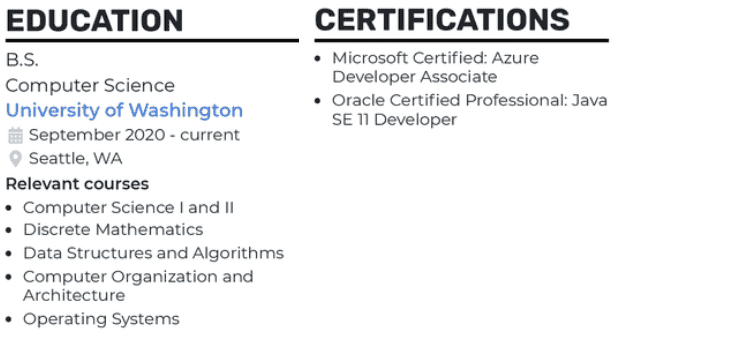
Therefore, credit your educational background by indicating your area of study, school’s name, location, year of graduation, GPA of 3.5 or above, and any relevant coursework.
If you’ve earned certifications—like Google IT Support, AWS Certified Cloud Practitioner, or Meta Front-End Developer—feature them under this section or in a separate Certifications section.
How to leverage education and certifications in your software engineer intern resume

Use strong active verbs to underscore value
It’s not all about flaunting your skills and accomplishments that get you to the door; it’s how you say it. For instance, cliches and buzzwords such as “assisted”, “helped”, and “responsible for” open a door to doubts about your abilities. You’re clearly showing your weaknesses, and recruiters will pass without blinking twice.
Alternatively, add power to your bullet points with active verbs that reflect your professionalism, capabilities, and enthusiasm for the industry. When you do this, a recruiter will be forced to pay attention because you’re using language that aligns with their dream candidate.

Tailor your resume to the job
One-size-fits-all doesn’t work here. Each software engineering internship has unique expectations. Study the job description, examining repeated phrases, software, tools, skills, and niche words. That’s your secret to making your resume pop.
And do you know what that means? Your document will breeze through ATS and land on the desk of an HR manager ready for review. Look, that doubles your chances of going to the next round. Who knows? It may be the break you need to get hired.
Top 5 tips for your software engineer intern resume
- Master your key skills
- Even if you’re applying for an internship, you might be asked to go through a technical interview. To handle it with confidence, only fill your resume with things you know well. For example, if you’ve only just started learning Java but you’re proficient in Python, leave Java at the bottom of your skills list to not give the impression that you’re a pro at it.
- Target transferable skills
- If you have work experience in roles that don’t involve programming, you can still include it if it’s somewhat relevant to the job. For example, if you’ve worked with data entry, QA, software testing, or even just led a coding club at your college, there’s plenty of overlap.
- Never re-use your resume
- Some software engineer internships are highly competitive, so make sure you always make a resume to match the job. Read the job description and include the skills it asks for if you possess them, and if you include a career objective, tie it to the company you’re applying to.
- Build a portfolio
- If you don’t have a portfolio or a keyword-rich LinkedIn headline yet, building one will help you stand out. It’s an extension of your resume, so all the same rules apply, but you should fill it up with your projects, be it websites, mobile apps, scripts, or programs.
- Add your certifications
- Certifications often aren’t necessary, but they can help, so add them if you have any. This can include Microsoft Certified: Azure Fundamentals, OCAJP, Google Associate Cloud Engineer, or AWS Certified Cloud Practitioner.

Key takeaways
Things to remember:
- Be specific
- Show impact
- Optimize formatting for ATS and recruiters
- Don’t ignore the power of your education
- No one internship is like the other
- Replace your lack of experience with passion, projects, and readiness to learn
Software Engineer Intern Resume FAQs

Your resume should include a header, objective, education, technical skills, relevant projects, coursework, and any part-time work. Projects and technical skills are significant for candidates with limited work experience.
Of course, yes! Projects are the closest to relevant work experience because they show what you can do. The results and skills used can be transferred to a real workplace and reflect what you can do if given the chance.
One page, no more! You’re probably a new graduate or about to graduate. One thing you don’t have is a lot of experience. Your part-time gigs, personal projects, volunteer work, and extracurriculars don’t need more than a page to say that you’re cut out for the job. Keep off fluff and only include information that shows your value.
If your past roles aren’t relevant, it’s better to focus on the programming projects you’ve contributed to. However, you can mention them during the interview to show that you’re not new to the professional world.
It can be a useful tool if you feel your resume is looking a little empty, but only if you make it relevant to the company you’re applying to. Update it for each internship.

Stephen is the co-founder and CEO of BeamJobs. Frustrated with the challenges he'd faced in his own job search, he left the corporate world to start BeamJobs with his brother. Drawing on firsthand experience with hiring and getting hired as technical talent, he started BeamJobs in 2020 to help qualified job seekers land interviews with less stress. Since then, more than 4 million people have built their resumes and cover letters on BeamJobs. Stephen's insights have been featured in notable outlets, such as Fast Company, Business Insider, Yahoo Finance, MIT, and Zapier. Learn more about Stephen.